Accession Number
1925.1001.a
Medium
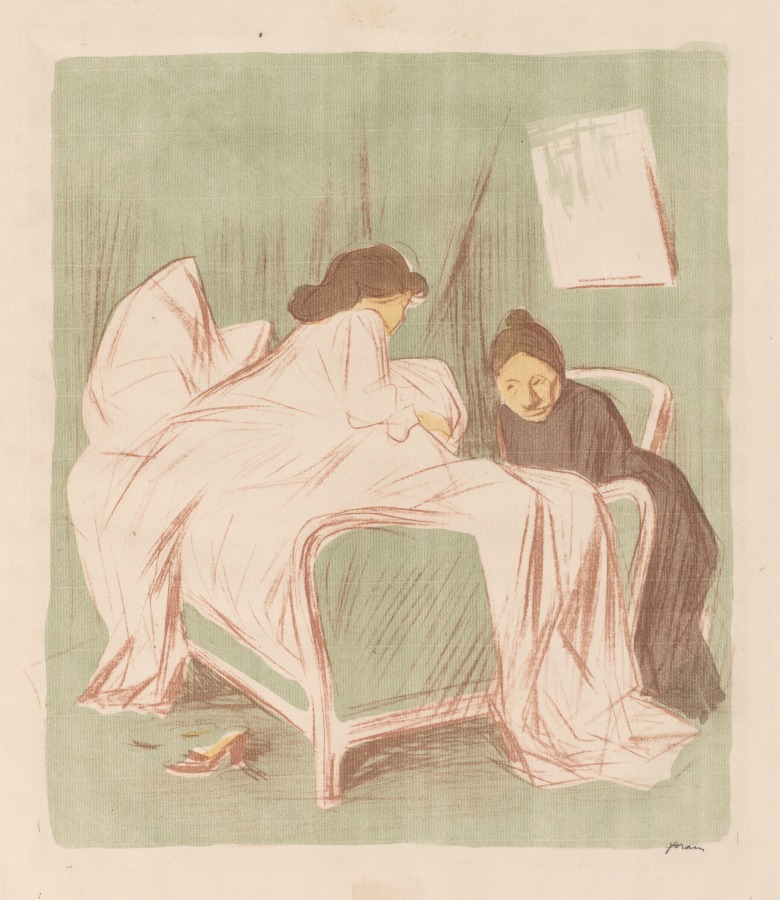
watercolor and gouache over black crayon
Dimensions
Sheet: 36.9 x 54.9 cm (14 1/2 x 21 5/8 in.)
Classification
Drawing
Credit Line
Gift of Ralph King
Tags
Drawing Impressionist & Modern (1851–1900) Watercolor Gouache French Color: Brown Color: White Color: Gray
Background & Context
Background Story
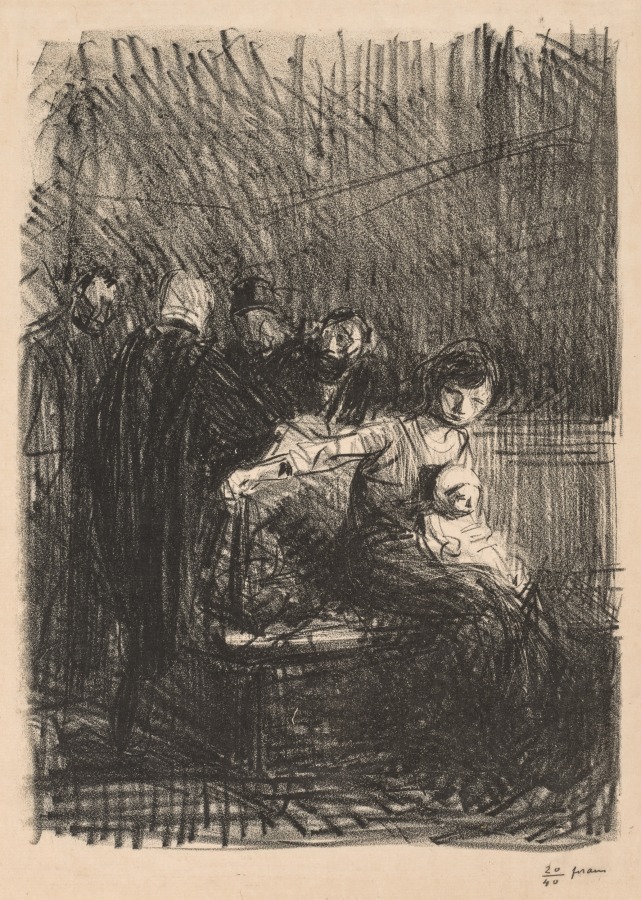
In the Hospital, painted in the late 19th or early 20th century, belongs to Jean-Louis Forain body of work depicting the institutions of modern Parisian life: the courtroom, the hospital, the cafe, and the brothel. Forain, who had been a member of the Impressionist circle and a close friend of Degas, brought to these subjects the same unsentimental eye and rapid technique that characterized his earlier café and theater scenes.
Forain hospital paintings belong to a tradition of medical realism that extends from Goya and Daumier to the 20th century. His treatment of the hospital interior, with its stark lighting and its confined spaces, conveys the institutional atmosphere of the 19th-century hospital with a directness that shocked viewers accustomed to more idealized representations of medical care.
The painting most Forain-like quality is its economy of means. Working in a technique even more abbreviated than Degas, Forain renders the hospital scene in a few rapid strokes that suggest the setting and the figures without fully describing them. This brevity, which was Forain signature, creates a sense of immediacy that places the viewer inside the hospital, experiencing its atmosphere rather than observing it from outside.
Cultural Impact
Forain institutional paintings documented the social conditions of Belle Epoque Paris and influenced the development of social realism in French art. His combination of Impressionist technique with Realist subject matter created a model for the socially engaged painting that would flourish in the 20th century.
Why It Matters
In the Hospital captures Forain most valuable quality: the ability to see the institutions of modern life without illusion. His hospital, rendered with a few strokes of grey and brown, is not a place of healing but a place of suffering - and Forain refusal to prettify it is his contribution to the tradition of social witness in French art.