Accession Number
1926.250
Medium
charcoal
Dimensions
N/A
Classification
Drawing
Credit Line
Dudley P. Allen Fund
Tags
Color: White
Background & Context
Background Story
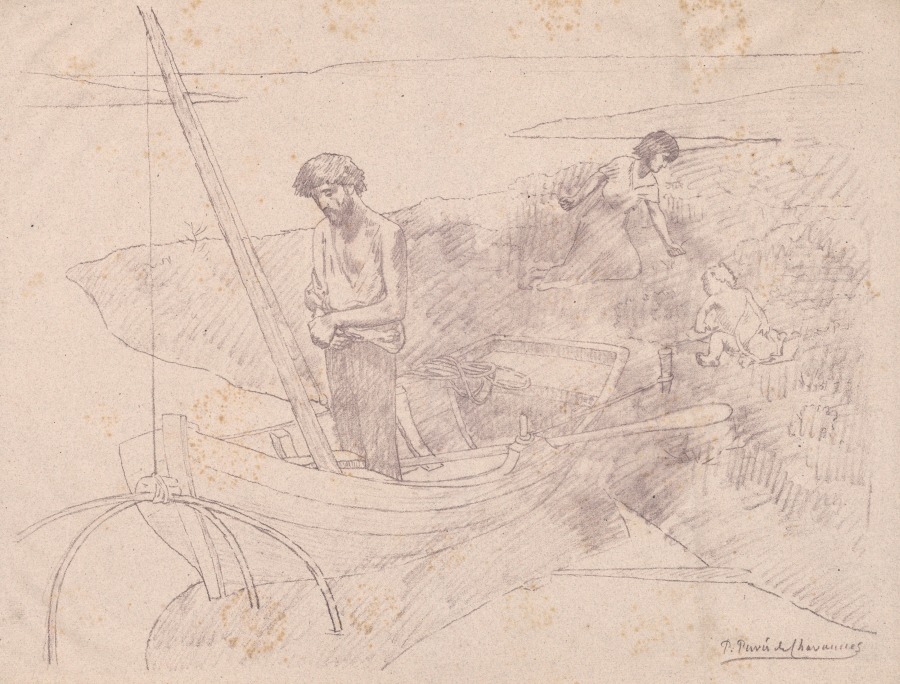
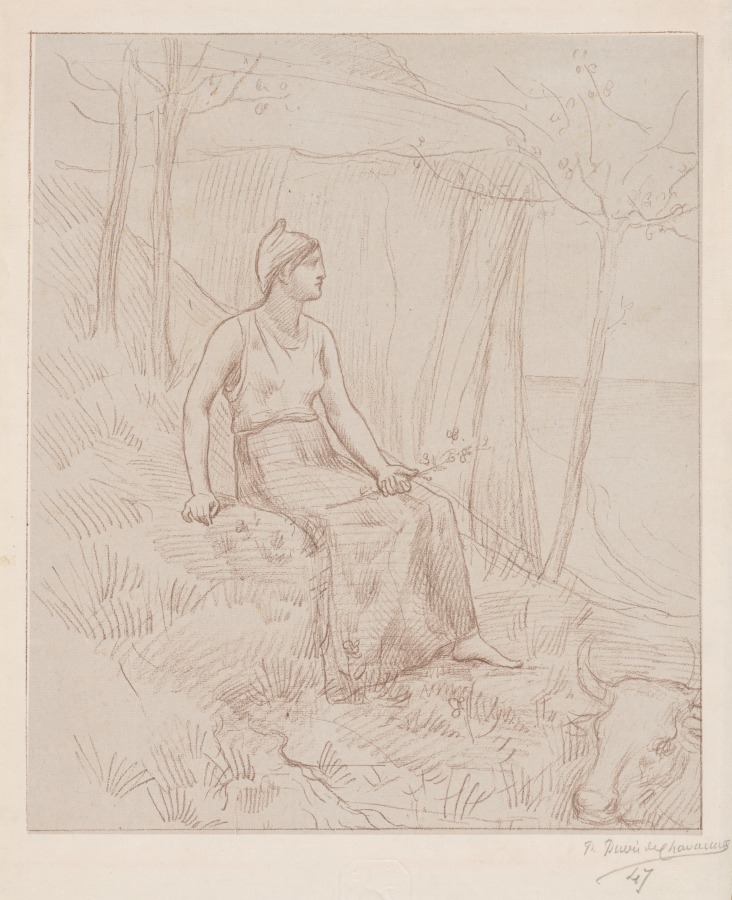
Pierre Puvis de Chavannes's "Study for The War" (1861) is a preparatory charcoal drawing for one of the monumental murals that defined the artist's career. Puvis de Chavannes (1824–1898) was one of the most influential French painters of the 19th century, known for his large-scale mural cycles that decorated major public buildings across France, including the Panthéon, the Sorbonne, and the Musée des Beaux-Arts in Lyon. "The War" was part of an allegorical cycle commissioned for the Palais des Beaux-Arts in Amiens, his first major public commission. This study shows Puvis developing the composition's key figures, with powerful, simplified forms rendered in vigorous charcoal strokes. His drawing style is distinctive—he reduced figures to their essential volumes, creating a sense of gravity and timelessness that became his trademark. Puvis's murals addressed universal themes—Peace, War, Work, Rest—in a deliberately archaizing style that looked back to early Renaissance frescoes while remaining thoroughly modern in their simplified forms and muted palettes. This study offers invaluable insight into his working method, showing how he built his monumental compositions from careful figure studies.
Cultural Impact
Puvis de Chavannes was a crucial bridge between academic painting and the modernists who followed—Seurat, Gauguin, and Picasso all admired and learned from his simplified forms and monumental compositions.
Why It Matters
This charcoal study reveals the foundation of Puvis's mural practice, showing how his quest for universal, timeless imagery began with careful study from life, transformed into the simplified, heroic forms that would influence generations of modern artists.