Accession Number
1927.198
Medium
oil on canvas
Dimensions
Unframed: 61 x 140 cm (24 x 55 1/8 in.)
Classification
Painting
Credit Line
The Charles W. Harkness Endowment Fund
Tags
Color: Blue
Background & Context
Background Story
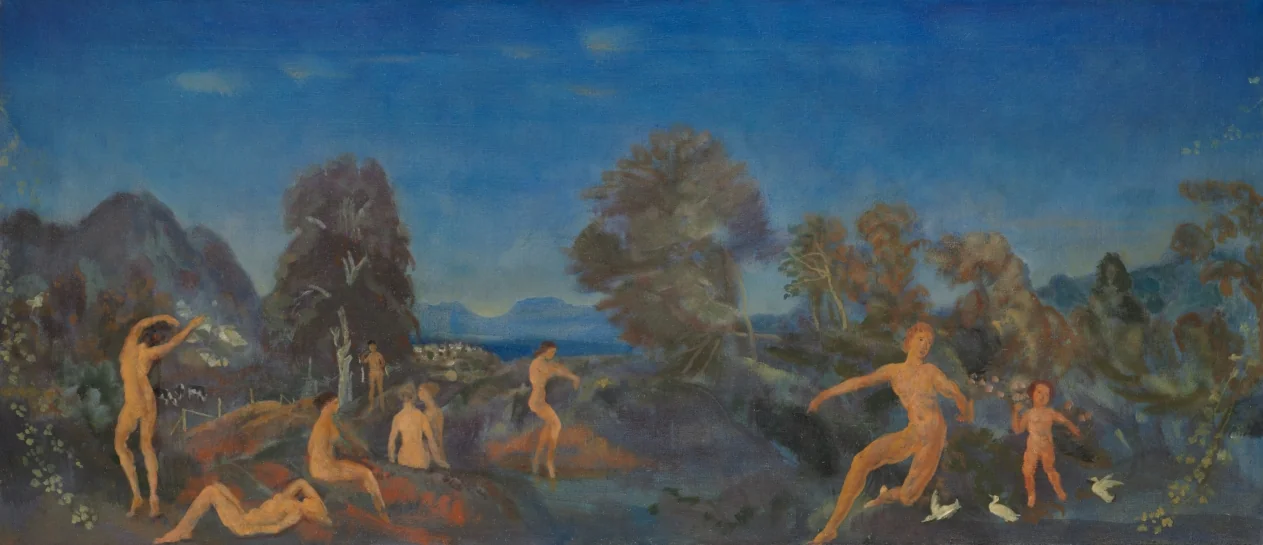
Arthur B. Davies's "Hermes and the Infant Dionysus" (1900–1915) is an oil on canvas that reenvisions the celebrated ancient Greek statue by Praxiteles, capturing the mythological moment when the messenger god Hermes carries the infant Dionysus to be raised by nymphs. Davies (1862–1928) was a pivotal figure in American art—a painter of dreamlike, mythological scenes and the driving force behind the legendary 1913 Armory Show that introduced European modernism to America. His style blended Symbolism, classical idealism, and an ethereal tonalism reminiscent of Whistler. In this painting, Davies transforms the sculptural group into a misty, atmospheric landscape, with the figures emerging from a golden-hued, Arcadian setting. The relationship between Hermes and the infant god is rendered with tender gravity. Davies's work often explored themes of childhood, mythology, and the pastoral ideal, creating a body of work that felt deliberately apart from the industrialization and urbanization of early 20th-century America. As a collector and organizer, Davies shaped the course of American modernism more than almost any single figure.
Cultural Impact
Davies's role in organizing the 1913 Armory Show made him arguably the single most important figure in bringing European modernism to American audiences, revolutionizing American art in the process.
Why It Matters
This oil painting demonstrates Davies's unique synthesis of classical mythology and modern painterly sensibility, creating a dreamlike world that offered an alternative to both academic realism and avant-garde abstraction.
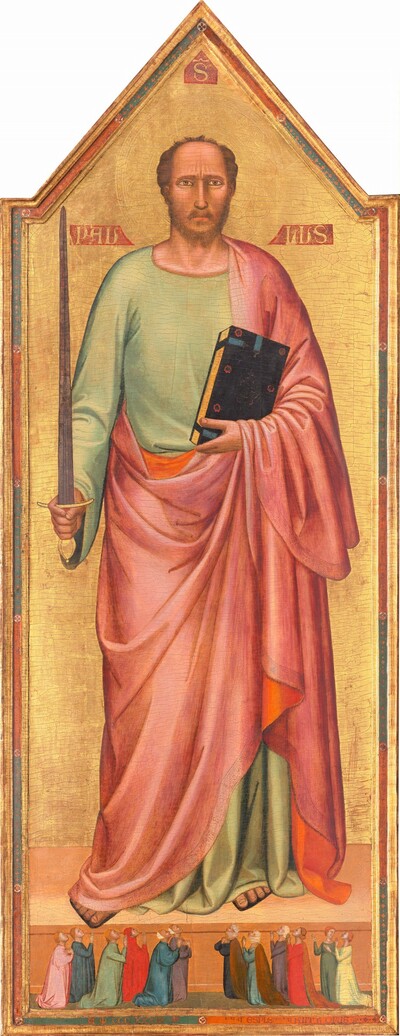
![Saint Bernard and Saint Catherine of Alexandria with the Virgin of the Annunciation [right panel]](https://api.nga.gov/iiif/e6890364-4d99-4684-a62b-5060ee3c3446/full/400,/0/default.jpg)