Description
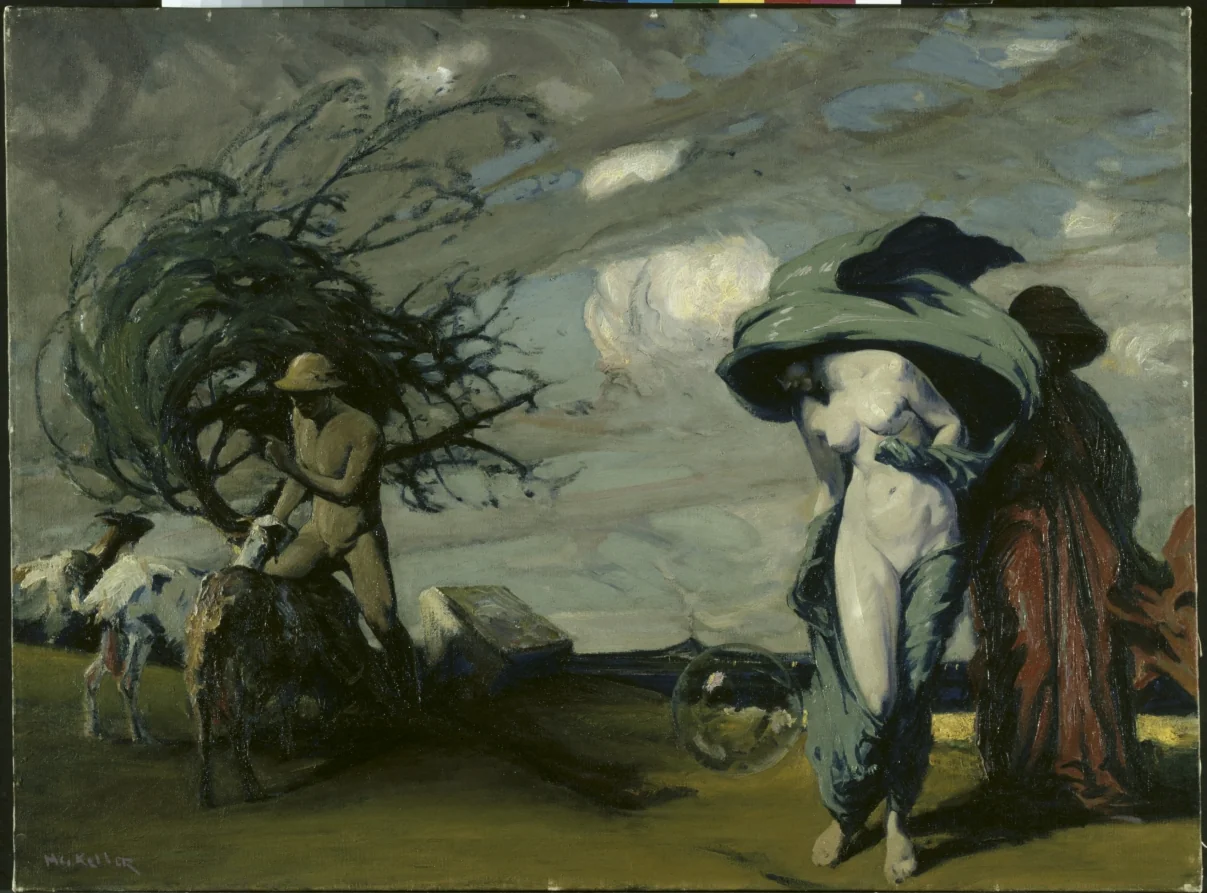
Keller championed modern art in Cleveland through lectures, teaching, and the example of his own work. Wisdom and Destiny, based on an essay by the Belgian writer Maurice Maeterlinck, features the two allegorical figures at the right, while a carefree shepherd at the left seems oblivious to their existence. The painting was featured in the famed Armory Show of 1913, a large-scale traveling exhibition often credited with introducing the American public to avant-garde art. Because of the critical success surrounding Wisdom and Destiny, Keller was commissioned to create a 70-foot mural of the composition for Cleveland City Hall. However, he resentfully withdrew from the project when asked to paint clothing on the nude figure.
Provenance
[]
Accession Number
1928.580
Medium
oil on canvas
Dimensions
Framed: 94.6 x 120 x 5.8 cm (37 1/4 x 47 1/4 x 2 5/16 in.); Unframed: 76.5 x 101.9 cm (30 1/8 x 40 1/8 in.)
Classification
Painting
Credit Line
Gift of Mrs. Henry A. Everett for the Dorothy Burnham Everett Memorial Collection
Tags
Painting Early Modern (1901–1950) Oil Painting Canvas American Color: Gray
Background & Context
Background Story
The allegorical title Wisdom and Destiny signals a departure from Keller's typical observational subjects. Painted in 1913 — a year of radical artistic experiment across Europe and America — this work engages with Symbolist and allegorical traditions that were largely absent from the Cleveland School's realist mainstream. The painting likely depicts figures representing the abstract concepts of wisdom and destiny in a compositional arrangement that balances the two forces: wisdom looking inward, destiny propelling forward. The formal treatment remains characteristically solid, with Keller's structural planes and assertive color grounding the allegorical content in visual specificity.
Cultural Impact
1913 was the year of the Armory Show, which introduced European modernism to the American public and sent shockwaves through the art establishment. Keller's response was characteristically independent: rather than either embracing or rejecting the new art, he incorporated its symbolic and psychological dimensions into his own structural framework. Wisdom and Destiny is the result — a painting that engages with ideas rather than appearance while maintaining the formal rigor of the Cleveland School tradition.
Why It Matters
Wisdom and Destiny shows Keller engaging with the largest questions through the most specific means. The allegorical subject is handled with the same structural clarity he brought to a sandpit or a stream crossing — proof that realist discipline and intellectual ambition are not incompatible.