Description
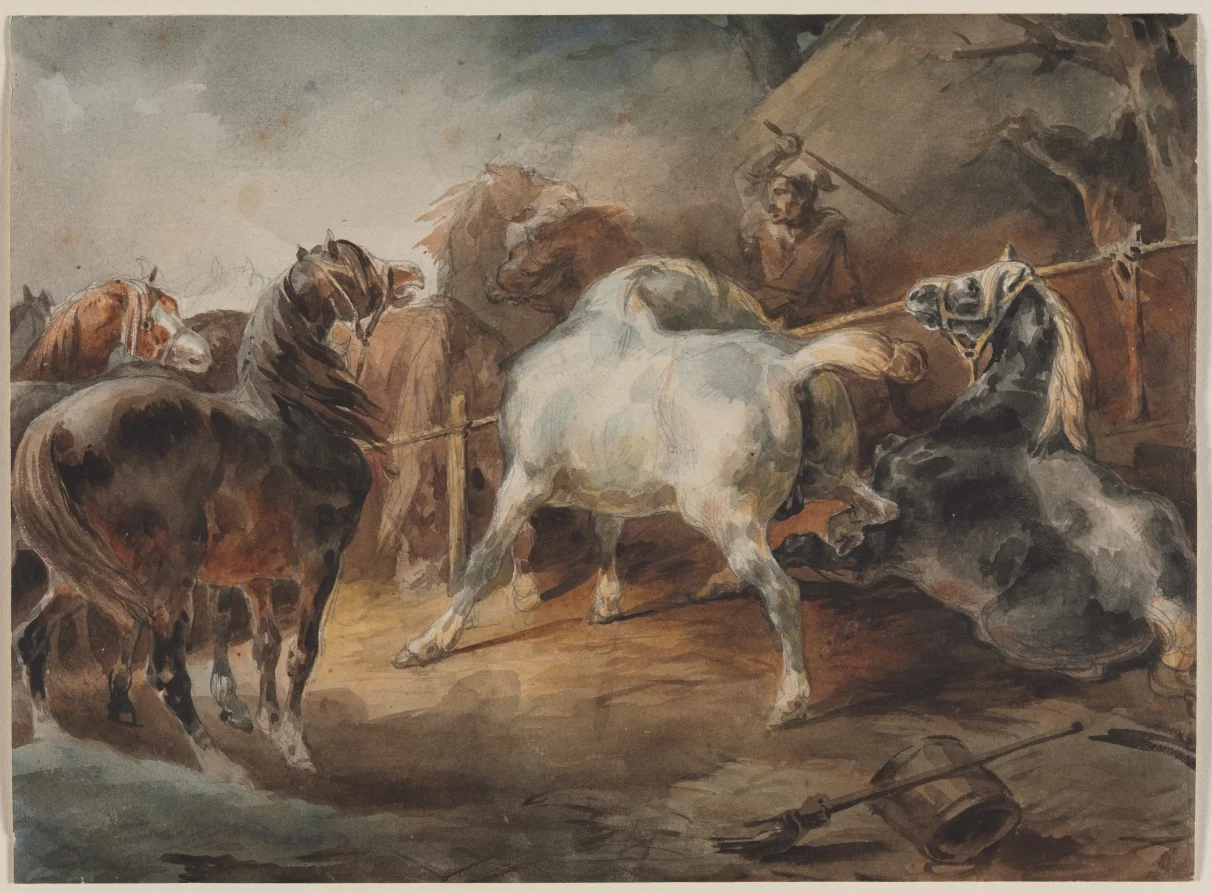
Théodore Géricault turned away from traditional subjects such as mythology and the Bible in favor of modernity, emotion, and drama. He was fascinated by the power and physical beauty of horses and depicted them often. Géricault himself was an avid rider and his paintings and drawings on this theme are characterized by vigor and movement. In this watercolor, he focused on a conflict, in which a groom struggles to separate a pair of fighting horses—a scene that appeared only a few times throughout his many interpretations of similar subjects. A sketchbook, now in the collection of the Art Institute of Chicago, shows that the artist carefully studied the animals, including the kicking white stallion at center, in graphite before beginning this finished work.
Provenance
Possibly Anatole Demidoff [1812-1870], Paris (?-1863); (Hotel Drouot, Paris, Tableaux des premiers maitres..., January 13-16, 1863, no. 58, probably sold to Richard Seymour-Conway, 4th Marquess of Hertford) (1863); Richard Seymour-Conway, 4th Marquess of Hertford [1800-1870], by descent to his son Sir Richard Wallace (probably 1863-1870); Sir Richard Wallace [1818-1890], Paris, by descent to his wife Julie-Amélie-Charlotte Castelnau, Lady Wallace (1870-1890); Julie-Amélie-Charlotte Castelnau, Lady Wallace [1819-1897], London, by descent to her advisor Sir John Murray Scott (1890-1897); Sir John Murray Scott [1847-1912], London (1897-1912); (Phillips, Son & Neale, Contents of the Residence...of Sir John E.A. Murray Scott, February 9, 1914, no. 446) (1914); (Ernest Leggatt [1853-1922; Lugt 1664e], London, sold to Guy Bellingham Smith) (after 1914-?); Guy Bellingham Smith, London (after 1914-1927); (Frederik Muller & Cie, Amsterdam, Dessins anciens...Collection Bellingham-Smith, July 5-6, 1927, no. 38, probably sold to Gustav Nebehay) (1927); (Gustav Nebehay [1881-1935], Vienna, sold to the Cleveland Museum of Art) (1927); The Cleveland Museum of Art, Cleveland, OH (1929-)
Accession Number
1929.13
Medium
watercolor over graphite
Dimensions
Sheet: 21.7 x 29.4 cm (8 9/16 x 11 9/16 in.)
Classification
Drawing
Credit Line
Charles W. Harkness Endowment Fund
Tags
Drawing Neoclassical & Romantic (1751–1850) Watercolor Graphite & Pencil French Color: Orange Color: Brown
Background & Context
Background Story
Theodore Gericault (1791-1824) was a French painter known for the dramatic energy and muscular power that distinguish his best work from the more restrained Neoclassicism of his contemporaries. Fighting Horses from c. 1820 depicts two horses in combat in the dramatic, muscular manner that distinguishes Gericault's best animal subjects from the more restrained animal painting of the period. The c. 1820 date places this in Gericault's most productive period, when he was producing the dramatic animal subjects and history paintings that are his most accomplished works.
Cultural Impact
Fighting Horses is important in Gericault's oeuvre because it demonstrates the dramatic energy and muscular power that he brought to animal subjects. Gericault's treatment of horses—rendered with the same muscular power and dramatic energy that he brought to his history paintings—shows that his dramatic manner was not limited to human subjects but could be applied to animals with equal force, making him one of the most important animal painters of the 19th century.
Why It Matters
Fighting Horses is Gericault's dramatic energy at full force: two horses in combat rendered with the muscular power and dramatic energy that distinguish his best animal subjects. The c. 1820 painting shows Gericault applying the dramatic manner of his history paintings to animal subjects with equal force.