Accession Number
1934.127
Medium
pencil
Dimensions
Image: 12.7 x 18.4 cm (5 x 7 1/4 in.)
Classification
Drawing
Credit Line
Gift of Richard Seymour Bayham
Tags
Drawing Neoclassical & Romantic (1751–1850) Graphite & Pencil American Color: White Color: Gray
Background & Context
Background Story
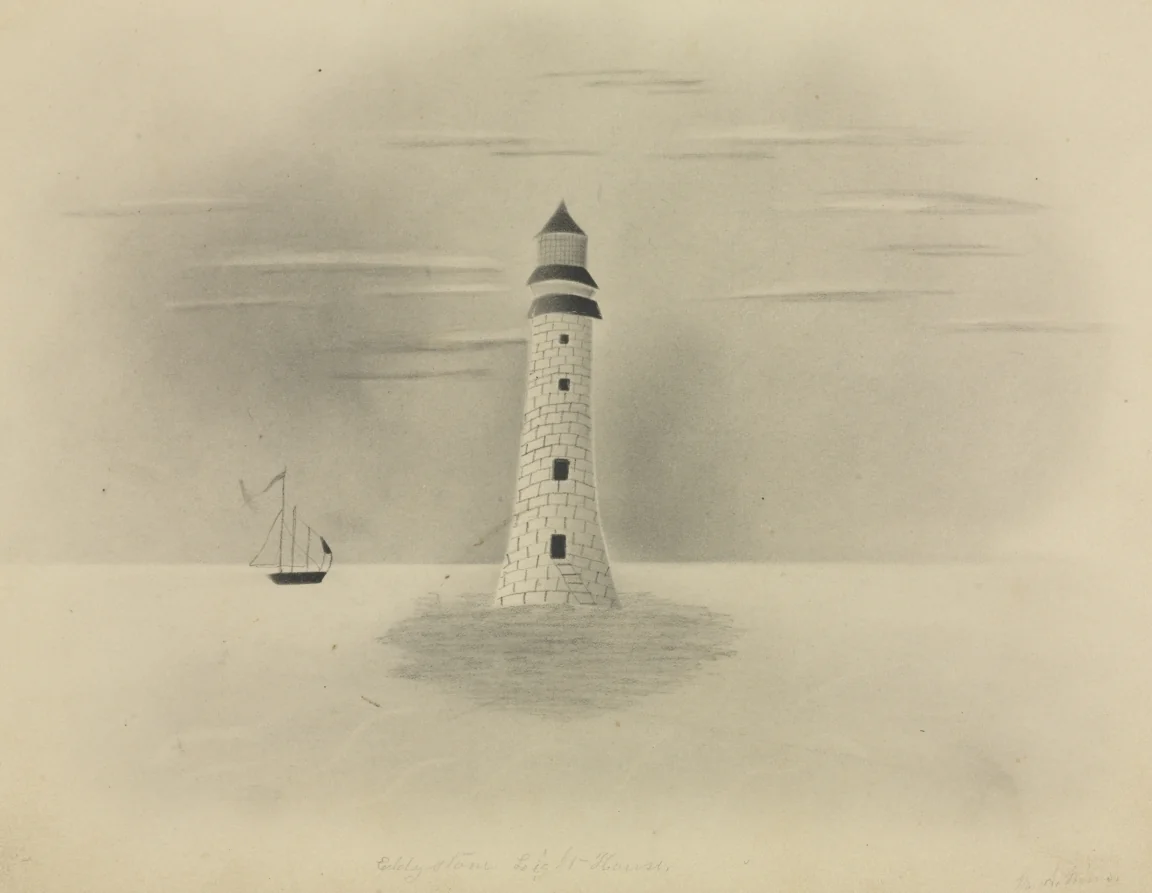
The Eddystone Lighthouse, located on a dangerous reef off the coast of Cornwall, was one of the most famous engineering landmarks of the 18th and 19th centuries. Nims's pencil drawing depicts the lighthouse standing against the sea, its stone tower rising from the rock in a demonstration of human engineering against natural force. The drawing is both a topographical record and a Romantic statement: the lighthouse as a symbol of human resilience in the face of the ocean's power.
Cultural Impact
Lighthouse subjects had special resonance in 19th-century Anglo-American culture. The Eddystone in particular — rebuilt three times after destruction by storm and fire — was a symbol of engineering perseverance. Nims's choice of this subject, and her careful rendering of the lighthouse's stone courses and gallery details, suggests an interest in engineering and construction that went beyond the typical feminine accomplishments of her era.
Why It Matters
Eddystone Lighthouse is the most ambitious of Nims's pencil drawings in the collection, combining topographical precision with Romantic symbolism. The lighthouse is both a specific engineered structure and a universal symbol of light against darkness.