Accession Number
1934.135
Medium
watercolor
Dimensions
N/A
Classification
Drawing
Credit Line
Gift of Richard Seymour Bayham
Tags
Drawing Neoclassical & Romantic (1751–1850) Watercolor American Color: Orange Color: White
Background & Context
Background Story
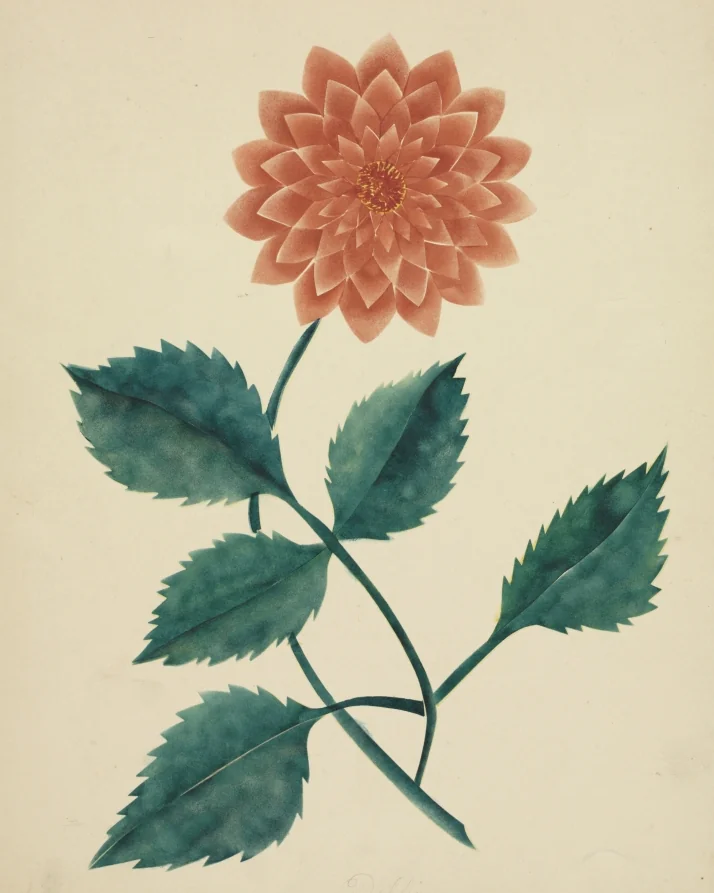
Nims's watercolor of a dahlia belongs to the tradition of botanical illustration that was one of the few artistic fields open to women in the 19th century. But her treatment goes beyond the merely documentary: the dahlia's complex petal structure is rendered with such precision and attention to color gradation that it functions simultaneously as a scientific record and an aesthetic object. The dahlia, with its geometric petal arrangement and rich color range, was an ideal subject for an artist with strong draftsmanship skills and a colorist's eye.
Cultural Impact
Botanical watercolor was a serious scientific discipline in the 19th century, requiring detailed knowledge of plant structure and exceptional control of watercolor technique. Women artists who excelled in this field — including Nims, Maria Sibylla Merian, and Sarah Drake — produced work that served the scientific community while also functioning as works of art. Nims's dahlia sits precisely at this intersection: beautiful and accurate in equal measure.
Why It Matters
Dahlia demonstrates that the traditional distinction between 'art' and 'illustration' does a disservice to women who worked in botanical watercolor. Nims's dahlia is both a scientific document and an aesthetic achievement — proof that observational precision and artistic beauty are not opposites.