Accession Number
1934.136
Medium
watercolor
Dimensions
N/A
Classification
Drawing
Credit Line
Gift of Richard Seymour Bayham
Tags
Drawing Neoclassical & Romantic (1751–1850) Watercolor American Color: Green Color: Gray
Background & Context
Background Story
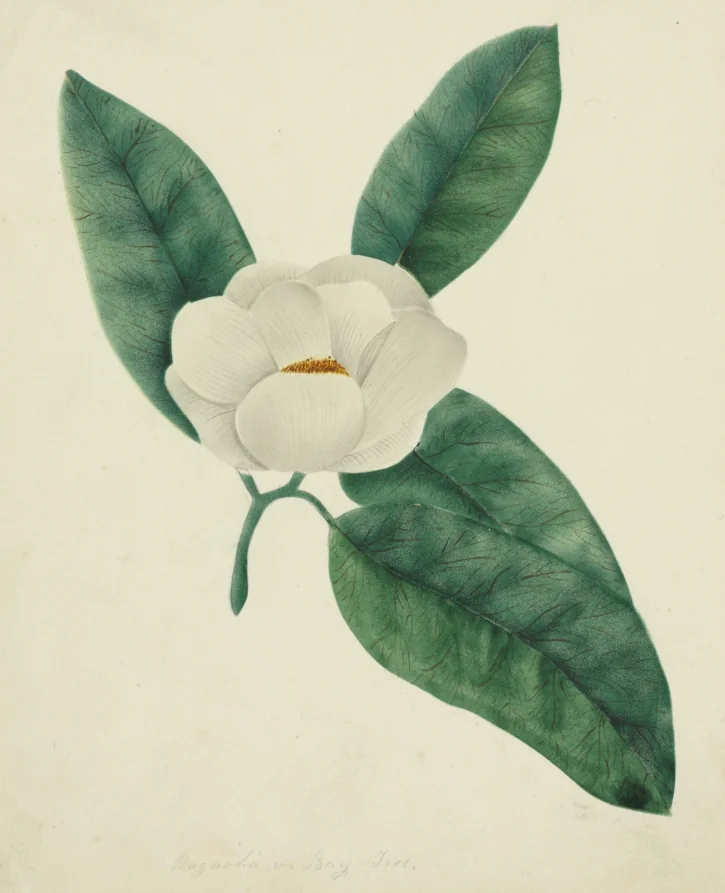
The magnolia, with its large, sculptural petals and understated color, is a subject that rewards the watercolorist who values subtlety over spectacle. Nims's treatment captures the magnolia's characteristic creamy whiteness with careful gradations of tone that suggest the flower's translucency and weight. The composition isolates the blossom against white paper, following the conventions of botanical illustration while achieving an aesthetic economy that anticipates 20th-century design.
Cultural Impact
The magnolia held special significance in American botanical illustration as a native genus that European botanists found remarkable. William Bartram's descriptions of southern magnolias had helped establish American natural history as a field distinct from its European predecessors. Nims's magnolia participates in this tradition of American botanical pride while demonstrating the watercolor technique that American women artists had developed to a high level.
Why It Matters
Magnolia is Nims's most minimalist watercolor: a single flower, rendered with maximum precision and minimum fuss. The result is a design object as much as a botanical study — proof that less is more when the subject is this beautiful.