Description
Rapturous flower still lifes like this dominated the last decade and a half of Odilon Redon’s career and provided his greatest commercial success. His interest in plants and flowers began in his youth; child of wine producers, he grew up northwest of Bordeaux and was sensitive to fluctuations in weather, light, and temperature affecting the grape harvest. When he was 20, Redon met Armond Clavaud, a botanist and draftsman who illustrated his own compendium of flowers of the Bordeaux region. Clavaud’s meticulously rendered drawings sparked the young Redon’s imagination and helped to instill his desire to paint “nature, as seen in a dream.”
Provenance
(Georges Bernheim, Paris, France, January 1929, stock no. A498, sold to Knoedler & Co.) (1929); (Knoedler & Co., New York, NY, September 1929, stock no. A1021, sold to George C. Lee) (1929); Mrs. G. C. Lee returned to Knoedler & Co., New York, NY (stock number A1021) November 1929, held jointly with E. Bignou. (1929); (Knoedler & Co., New York, NY, January 1930, stock number A1171, jointly with E. Bignou, sold to Mrs. R.T. Wilson) (1929-1930); Mrs. R.T. Wilson [1875-1947], New York, NY returned to Knoedler & Co., May 1930 (1930); (M. Knoedler & Co., New York, NY, December 1935, sold to the Cleveland Museum of Art) (1930-1935); The Cleveland Museum of Art, Cleveland, OH (1935-)
Accession Number
1935.233
Medium
oil on fabric
Dimensions
Framed: 90.8 x 62.2 x 10.2 cm (35 3/4 x 24 1/2 x 4 in.); Unframed: 73 x 59 cm (28 3/4 x 23 1/4 in.)
Classification
Painting
Credit Line
Gift of Roberta Holden Bole
Tags
Color: Orange Color: Gold
Background & Context
Background Story
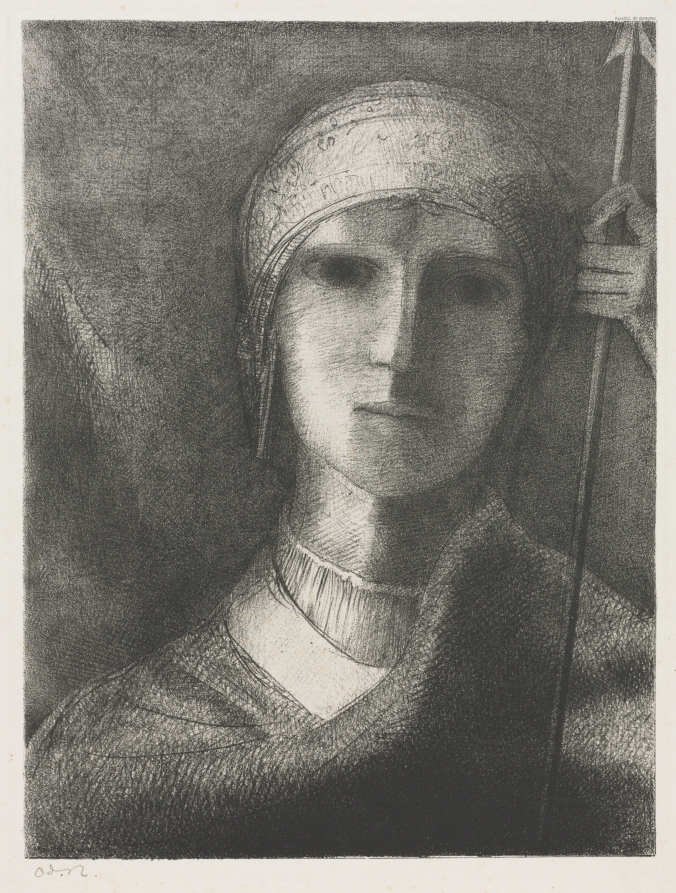
Odilon Redon's "Vase of Flowers" (c. 1905) is an oil on fabric painting from the artist's late, radiant period. After two decades of creating mysterious black-and-white "noirs," Redon (1840–1916) turned to vivid color in the 1890s and never looked back. His flower paintings—bouquets of poppies, chrysanthemums, and other blooms arranged in simple vases—became one of his most beloved subjects. But Redon's flowers are not botanical studies; they are visions, almost hallucinations, of flowers. Colors are intensified beyond nature—electric blues, hot pinks, deep violets—and the blooms seem to float in an indeterminate space, as if seen in a dream. The paint handling is distinctive: Redon builds the surface with short, feathery strokes, creating a soft, velvety texture that seems to absorb rather than reflect light. This painting dates from the final decade of Redon's life, when he was at the height of his creative powers and enjoying the recognition that had eluded him for so long. His flower paintings were particularly admired by his fellow artists and by collectors, and they remain among his most accessible and beloved works.
Cultural Impact
Redon's flower paintings marked his triumphant transition from the dark Symbolism of his early career to a late style of luminous, almost abstract color that anticipated the Fauves and early modernism.
Why It Matters
This oil painting transforms a simple bouquet into a visionary experience, showing Redon's belief that even the most ordinary subject could become a vehicle for transcendent beauty when filtered through the artist's imagination.