Description
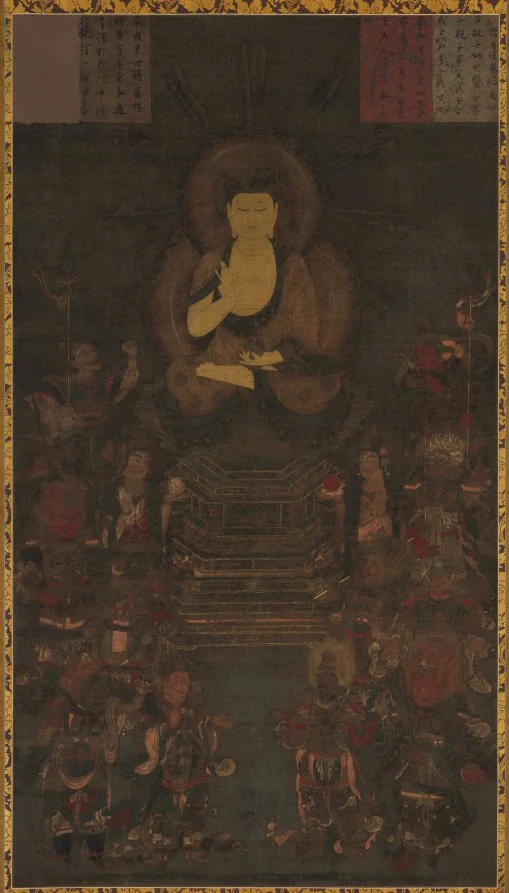
From the 700s, people in Japan began praying to the Medicine Master Buddha (Yakushi Nyorai) for longevity. Yakushi is at the center of this image, flanked by the bodhisattvas of the sun and moon, Nikkō and Gakkō. The Twelve Divine Generals, a group of protective deities, surround him. Yakushi sits in a meditative pose with his right hand in a gesture bestowing fearlessness while his left hand holds a medicine jar. In the upper part of the painting, rectangles simulating decorative paper inscription slips contain excerpts from a sacred text about Yakushi, in which he asks that sick people who speak his name should become well and that all who hear his name might have their purity restored.
Provenance
Joseph Bangs Warner [1848–1923], Boston, MA (by 1916–?); Langdon Warner [1881–1955] sold to the Cleveland Museum of Art (?–1938); The Cleveland Museum of Art, Cleveland, OH (1938–)
Accession Number
1938.422
Medium
Hanging scroll painting; ink, color, gold, and silver on silk
Dimensions
Image: 151.2 x 84.1 cm (59 1/2 x 33 1/8 in.); Overall: 261 x 106.6 cm (102 3/4 x 41 15/16 in.); with knobs: 261 x 113.3 cm (102 3/4 x 44 5/8 in.)
Classification
Painting
Credit Line
Edward L. Whittemore Fund
Tags
Painting Medieval (500–1399) Ink Silk Painting Gold Leaf Color: Orange Color: Brown
Background & Context
Background Story
Medicine Master Buddha and the Twelve Divine Generals from the 1200s is an anonymous Japanese Buddhist painting depicting the Medicine Master Buddha (Bhaisajyaguru) surrounded by the twelve divine generals who protect the Buddhist teaching, rendered in the lavish, colorful manner that distinguishes the best Japanese Buddhist painting of the Kamakura period. The 1200s date places this in the Kamakura period (1185-1333), when Japanese Buddhist painting was producing some of its most accomplished works in the lavish, colorful manner of the esoteric Buddhist tradition.
Cultural Impact
Medicine Master Buddha and the Twelve Divine Generals is important in the history of Japanese Buddhist painting because it demonstrates the lavish, colorful manner that distinguishes the best Kamakura-period Buddhist painting. The twelve divine generals who protect the Buddhist teaching are rendered with the fierce, dynamic manner that distinguishes Kamakura Buddhist painting from the more serene Heian-period tradition, and the painting shows the Kamakura period at its most dynamic and accomplished.
Why It Matters
Medicine Master Buddha and the Twelve Divine Generals is Kamakura Buddhist painting at its most dynamic: the Medicine Master Buddha surrounded by twelve fierce divine generals rendered in the lavish, colorful manner of the esoteric Buddhist tradition. The 1200s painting shows Japanese Buddhist painting at one of its most accomplished moments, combining serene devotion with fierce protector energy.