Description
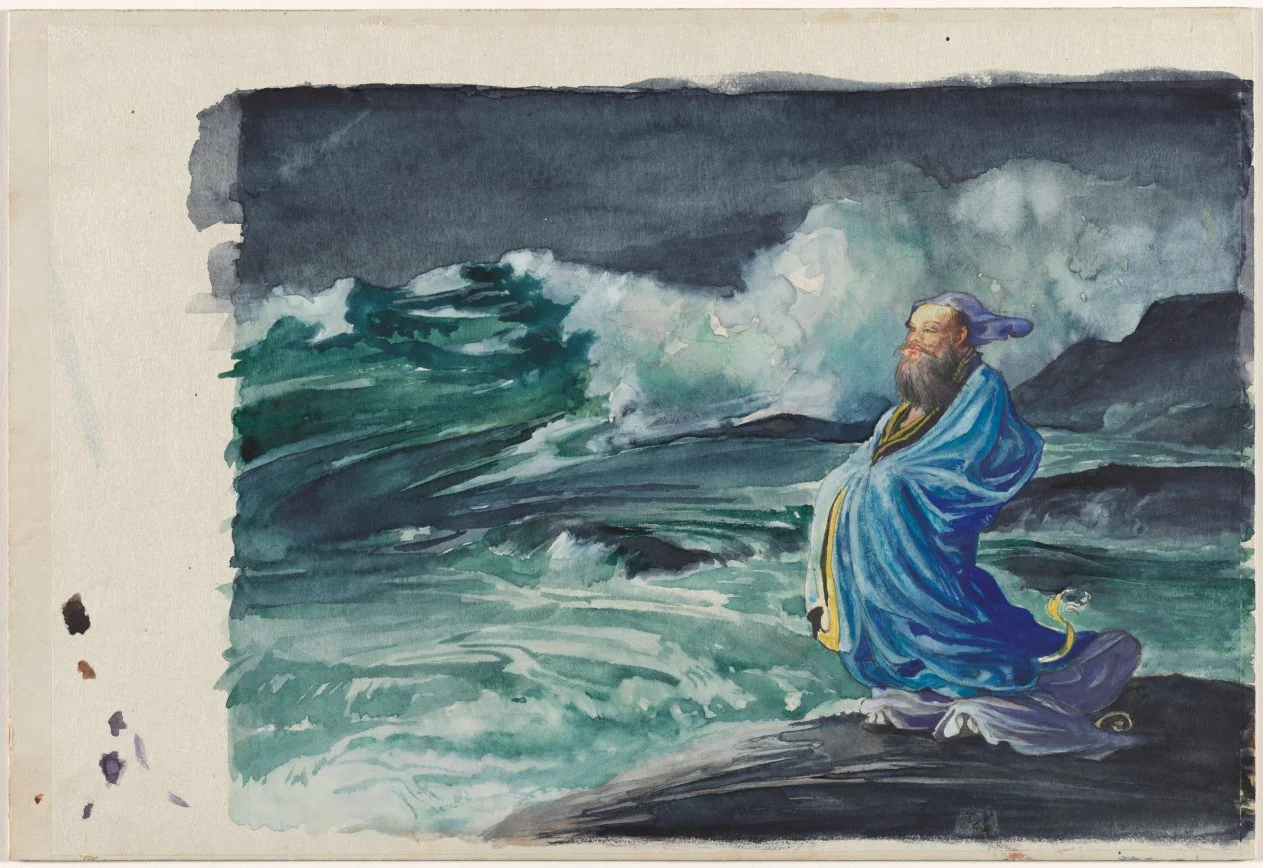
In the late 19th century, John La Farge was one of the first American artists to take a serious interest in Japanese art. This watercolor was produced after La Farge visited Japan in 1886, where he studied Daoism and painting with the writer Okakura Kakuzō (1862–1913). Here, he employed Western modeling and depth, building the water’s mass through transparent washes of light and dark blue, but also simulated the asymmetrical composition, lyrical tone, and bright blue color palette of contemporary Japanese woodblock prints. Hinting at the relationship between humans and the natural world, the ocean’s tempestuous curls echo the swirls of dense gouache in the imaginary figure’s robes, merging the figure of the “rishi” with the surging waters behind him. According to the artist's writings, “rishi” designates a powerful being who has reached immortality by following Daoist teachings. However, it is possible that La Farge misunderstood the term rishi: Resshi—the Japanese pronunciation of Liezi (列子), is a legendary Daoist philosopher who could ride the wind.
Provenance
(Doll and Richards Gallery (est. 1866), Boston, MA.) (1898-?); The Wheelwright family, Boston, MA.
Mary C. Wheelwright [1878-1958], Boston, MA, sold to The Cleveland Museum of Art, 1939. (?-1939); The Cleveland Museum of Art, Cleveland, OH. (1939-)
Accession Number
1939.267
Medium
watercolor and gouache over graphite
Dimensions
Sheet: 27.3 x 38.9 cm (10 3/4 x 15 5/16 in.); Image: 25 x 33.7 cm (9 13/16 x 13 1/4 in.); Secondary Support: 28 x 40.8 cm (11 x 16 1/16 in.)
Classification
Drawing
Credit Line
Purchase from the J. H. Wade Fund
Tags
Drawing Impressionist & Modern (1851–1900) Watercolor Graphite & Pencil Gouache American Color: Teal
Background & Context
Background Story
This watercolor illustrates a story from Hindu mythology — a rishi (sage) whose spiritual power is sufficient to stir up a storm — and it comes from La Farge's South Seas journey of 1890-91 and its aftermath. The subject is characteristic of La Farge's interest in non-Western spiritual traditions, which he explored through his writing as well as his art. The rishi's concentrated gesture and the storm's dramatic vortex create a composition that combines La Farge's Western figure-drawing tradition with his interest in Asian and Pacific spiritual iconography, producing an image unlike anything else in American art of the period.
Cultural Impact
La Farge was one of the first major American artists to engage seriously with Asian and Pacific cultures, and his South Seas work represents a radical departure from the Eurocentric tradition that dominated American art. A Rishi Stirring Up a Storm draws on Hindu mythology in a way that respects its spiritual content rather than merely exoticizing it — a distinction that separates La Farge from the Orientalist painters who treated non-Western cultures as picturesque spectacle.
Why It Matters
A Rishi Stirring Up a Storm is La Farge's most spiritually ambitious work: a Hindu story painted with Western technique by an American artist who had traveled the Pacific. The result is a cross-cultural image that respects both traditions — the spiritual power of the rishi and the artistic power of the watercolorist.