Provenance
Dr. Daniel A. Huebsch [1871-1936], Cleveland, OH (?-1936); Robert Hays Gries [1900-1966], Shake Heights, OH (?-1939); The Cleveland Museum of Art, Cleveland, OH (December 19, 1939)
Accession Number
1939.639
Medium
watercolor
Dimensions
Image: 19.8 x 7.7 cm (7 13/16 x 3 1/16 in.); Sheet: 40.5 x 27 cm (15 15/16 x 10 5/8 in.)
Classification
Drawing
Credit Line
Gift of Robert Hays Gries
Tags
Drawing Neoclassical & Romantic (1751–1850) Watercolor American Color: Gray
Background & Context
Background Story
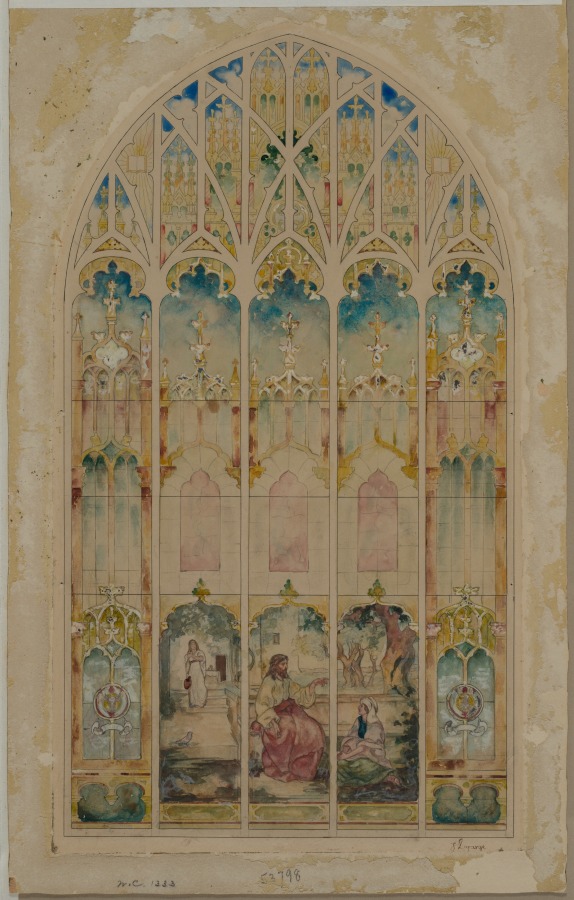
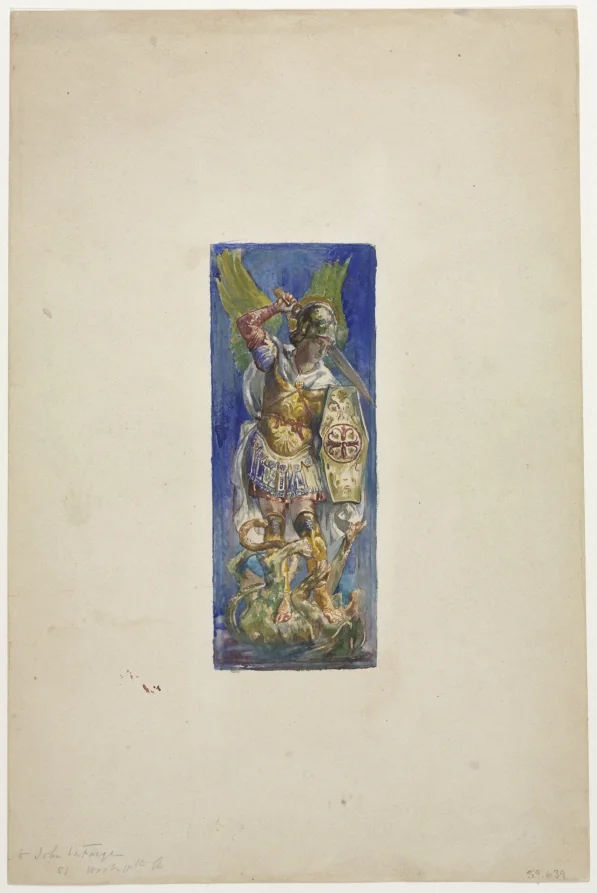
This watercolor is a preparatory design for one of La Farge's revolutionary stained glass windows — the art form that brought him his greatest fame and his most lasting influence. La Farge's designs are notable for their integration of figure and ornament, their sophisticated color harmonies, and their use of opalescent glass, which he developed and patented in the 1880s. The watercolor medium allows him to study the effects of transmitted light — the way color changes when viewed against light rather than reflected off a surface — which is the fundamental challenge and opportunity of stained glass design.
Cultural Impact
La Farge's stained glass designs are among the most important documents in the history of American decorative arts. His invention of opalescent glass (or his independent development of it, in competition with Louis Comfort Tiffany) transformed the medium from a vehicle for pictorial narrative into an art of pure color and light. The designs record his thinking about color relationships in their most experimental form, before the constraints of glass fabrication force modifications.
Why It Matters
Design for Stained Glass is La Farge thinking in color and light: a watercolor that anticipates the experience of looking through glass at transmitted light rather than at paint on canvas. The design is not a picture of a stained glass window — it is a study of how color behaves when it is the light itself rather than a reflection of it.