Provenance
?Unidentified stamp, lower left, in black ink. Dr. Daniel A. Huebsch, Cleveland (according to departmental card). Robert Hays Gries, Cleveland
Accession Number
1939.655
Medium
pen and brown ink and brush and brown wash; incised, squared in black chalk, framing lines in graphite (left and bottom)
Dimensions
Sheet: 25.6 x 18.7 cm (10 1/16 x 7 3/8 in.); Secondary Support: 29.3 x 22 cm (11 9/16 x 8 11/16 in.)
Classification
Drawing
Credit Line
Gift of Robert Hays Gries
Tags
Drawing Renaissance (1400–1599) Ink Graphite & Pencil Italian Color: White
Background & Context
Background Story
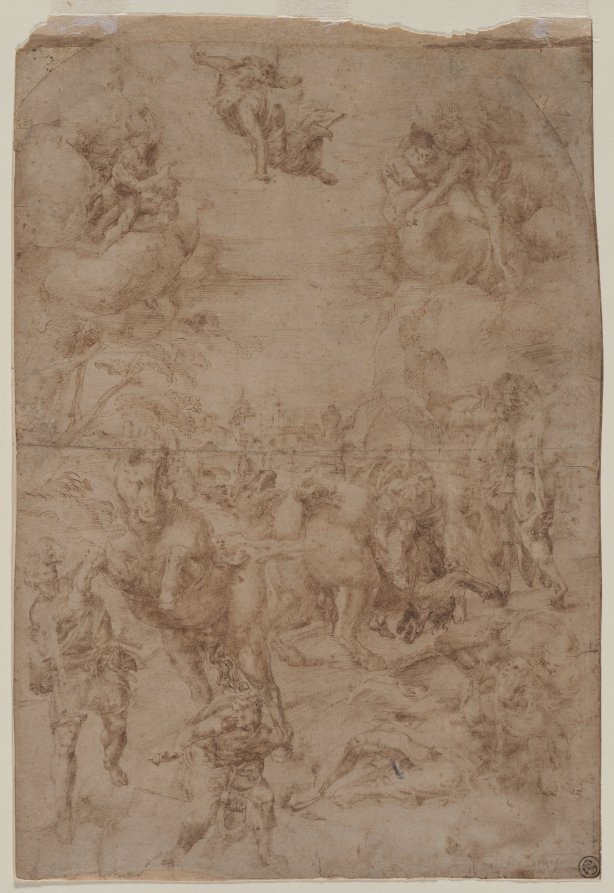
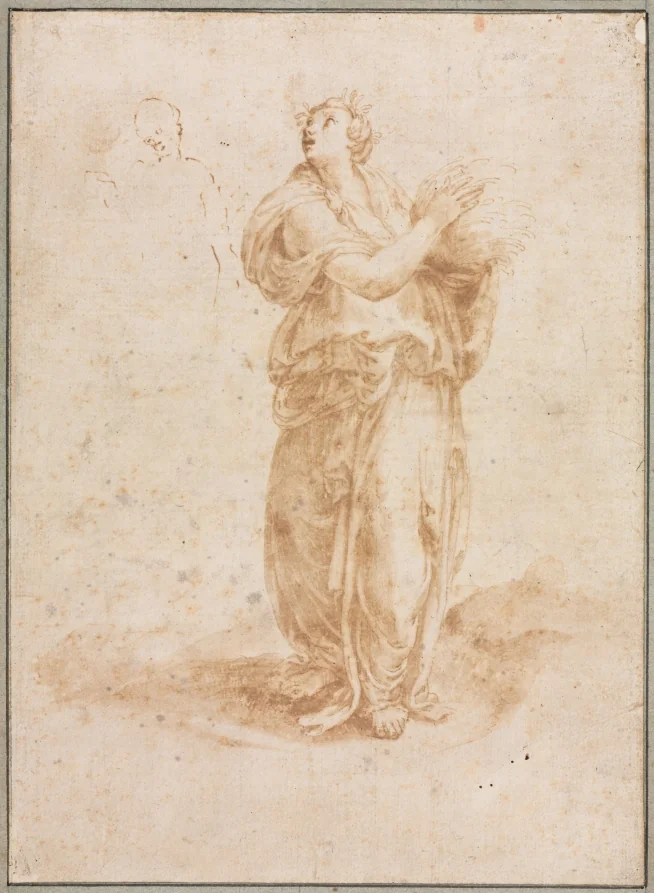
Lelio Orsi (c. 1511-1587) was an Italian painter known for the Mannerist style that combined Correggio's soft modeling with Michelangelo's muscular figures in the distinctive manner that distinguishes his best work. Ceres from the 16th century depicts the Roman goddess of agriculture in the Mannerist manner that Orsi developed from his study of Correggio and Michelangelo. The Mannerist combination of Correggio's soft modeling with Michelangelo's muscular figures creates a distinctive type of painting that is simultaneously soft and muscular—a combination that makes Orsi one of the most distinctive minor painters of the Italian Mannerist period.
Cultural Impact
Ceres is important in the context of Italian Mannerist painting because it demonstrates the distinctive combination of Correggio's soft modeling and Michelangelo's muscular figures that makes Orsi's work immediately recognizable among the minor painters of the Mannerist period. Orsi's Mannerist style shows how provincial painters could combine the innovations of the major masters into a distinctive personal manner, and Ceres shows this combination in a mythological subject that allows Orsi to exercise both soft modeling and muscular figure painting.
Why It Matters
Ceres is Orsi's distinctive Mannerist combination: the Roman goddess of agriculture rendered in the soft modeling of Correggio combined with the muscular figures of Michelangelo. The 16th century painting demonstrates how a provincial Mannerist painter could combine the innovations of the major masters into an immediately recognizable personal manner.