Accession Number
1939.656
Medium
pen and black ink and brush and brown wash over black chalk, heightened with white gouache; framing lines in brown ink
Dimensions
Sheet: 24.2 x 36.3 cm (9 1/2 x 14 5/16 in.); Secondary Support: 24.2 x 36.3 cm (9 1/2 x 14 5/16 in.)
Classification
Drawing
Credit Line
Gift of Robert Hays Gries
Tags
Drawing Baroque (1600–1750) Ink Gouache French Color: Brown
Background & Context
Background Story
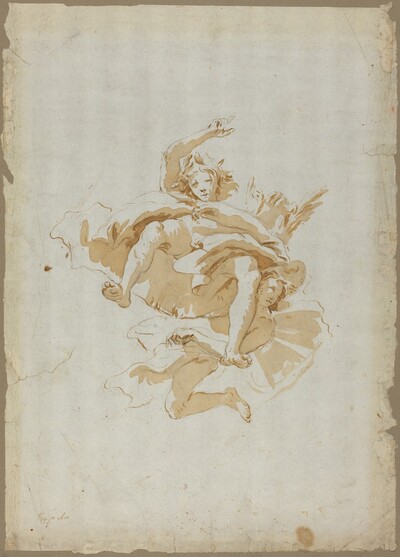
Roman Subject by Philibert Benoit Delarue, created in the 1700s, reflects the enduring European fascination with classical antiquity that pervaded artistic culture throughout the eighteenth century. Delarue, a French artist working in a period dominated by the Grand Tour and the rediscovery of ancient Roman ruins, produced a work that likely depicts scenes from Roman history, mythology, or architectural vistas. The designation 'Roman Subject' was a broad category in eighteenth-century art, encompassing everything from precise archaeological renderings of ancient monuments to imaginative recreations of Roman daily life and mythological narratives. The 1700s saw the height of neoclassical taste, fueled by excavations at Pompeii and Herculaneum and by the influential writings of Johann Joachim Winckelmann, who championed the nobility and simplicity of ancient Greek and Roman art. Painters of Roman subjects typically drew from an educational system that emphasized classical learning, and their works were informed by firsthand observation of ruins, sculptures, and the Italian landscape itself. Delarue's contribution to this tradition demonstrates how thoroughly Roman visual culture permeated European artistic imagination, serving as a mirror through which contemporary concerns about virtue, power, and aesthetic perfection were refracted.
Cultural Impact
Roman subjects in eighteenth-century art reinforced neoclassical ideals that shaped European visual culture, architecture, and political thought, inspiring movements from the American Revolution to the French Republic.
Why It Matters
This work exemplifies how classical antiquity served as a foundational visual language for European artists, connecting the Enlightenment's intellectual values to the visual traditions that expressed them.