Provenance
Estate of James Parmelee, Washington, D.C. (?-1940); The Cleveland Museum of Art, Cleveland, OH (October 30, 1940-)
Accession Number
1940.726
Medium
graphite
Dimensions
N/A
Classification
Drawing
Credit Line
Bequest of James Parmelee
Tags
Drawing Impressionist & Modern (1851–1900) Graphite & Pencil British Color: White
Background & Context
Background Story
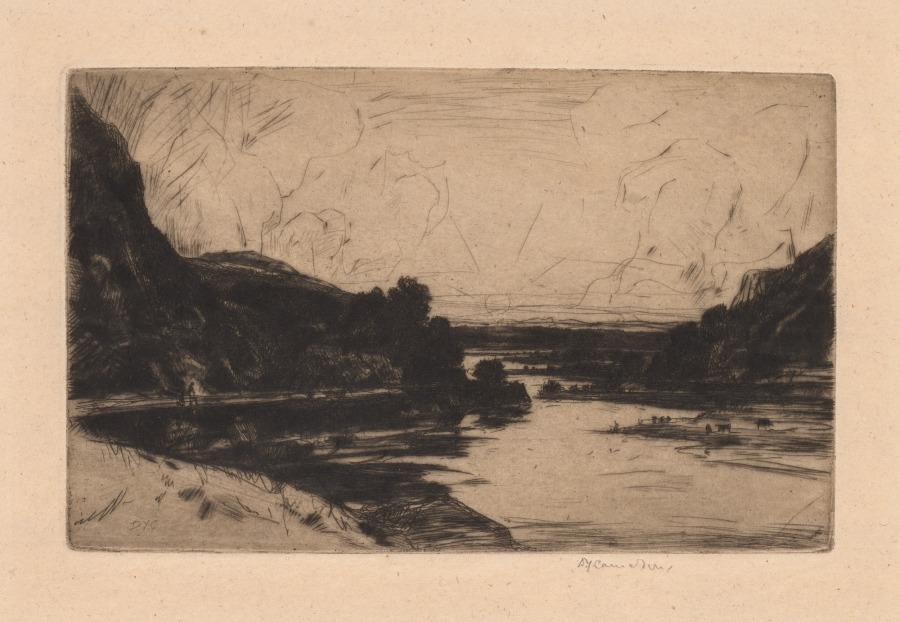
A Scottish River in pure graphite is Cameron's landscape reduced to its most essential elements: the river drawn in silvery line, the banks rendered in tonal strokes, and the surrounding landscape suggested through the lightest possible touch of the pencil. As an etcher, Cameron understood the expressive potential of pure line better than most landscape painters, and this graphite drawing demonstrates that understanding in its most concentrated form. The absence of color, wash, or atmospheric effect forces the viewer to appreciate the landscape through its structure alone—the curves of the river, the geometry of the banks, the relationship between water and land.
Cultural Impact
Cameron's graphite drawings are the graphic equivalent of his etchings: landscape reduced to line and tone without the intermediary of color. This reduction to essentials was not a limitation but a choice—an artist who was also one of Britain's greatest etchers understood that the most powerful landscape statements are often the most economical.
Why It Matters
A Scottish River is Cameron's landscape reduced to graphite: the etcher's eye for line and the landscapist's eye for composition combined in a drawing that proves structure alone can carry a landscape. No color, no atmosphere—just line and tone, and the river running through.