Provenance
Estate of James Parmelee, Washington, D.C. (?-1940); The Cleveland Museum of Art, Cleveland, OH (October 30, 1940-)
Accession Number
1940.734
Medium
watercolor
Dimensions
Sheet: 31 x 20.8 cm (12 3/16 x 8 3/16 in.)
Classification
Drawing
Credit Line
Bequest of James Parmelee
Tags
Drawing Neoclassical & Romantic (1751–1850) Watercolor British Color: White Color: Gray
Background & Context
Background Story
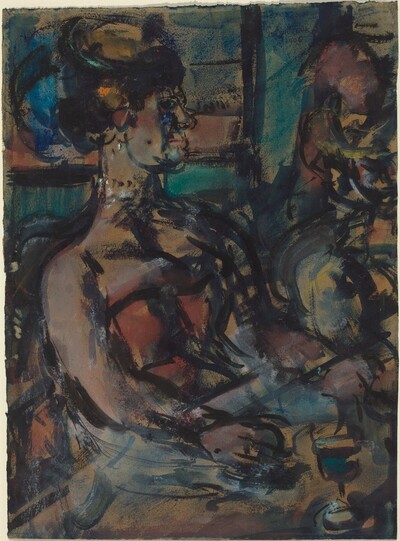
Mrs. Samuel Howitt by George Murgatroyd Woodward, created around 1780-85, is a portrait depicting Elizabeth Rowlandson, the sister of the famous caricaturist Thomas Rowlandson, who married Samuel Howitt, himself an artist known for his sporting and animal illustrations. Woodward, the artist of this portrait, was a caricaturist and amateur artist who was part of the same social and artistic circles as the Rowlandson family in late eighteenth-century London. The sitter's connection to two significant figures in English art—her brother Thomas, whose satirical drawings defined Regency visual culture, and her husband Samuel, whose sporting subjects were widely admired—places this portrait at the intersection of several important artistic networks. Portraits of women connected to the art world in this period offer valuable insights into the social dynamics of artistic production, where family relationships often facilitated artistic training, patronage, and collaboration. Woodward's depiction likely employs the conventions of late eighteenth-century English portraiture, which balanced fashionable presentation with individual character. The period 1780-85 falls between the height of Reynolds and Gainsborough and the emergence of Lawrence, a time when portrait painting in Britain was achieving unprecedented sophistication and public appeal.
Cultural Impact
This portrait documents the interconnected social networks of late eighteenth-century English artists, revealing how family relationships shaped artistic production, patronage, and collaboration in Regency-era London.
Why It Matters
The work preserves an important record of the social fabric of English art during a pivotal period, connecting the Rowlandson family's artistic legacy to the broader network of caricaturists and sporting artists.