Provenance
estate of the artist (Lugt 658, lower left, in red ink and Lugt 657, verso, upper right, in red ink). [Galerie Georg Petit, Paris, 2-4 July 1919, cat. no. 182b] (photocopy in departmental file)
Accession Number
1941.316
Medium
charcoal
Dimensions
Sheet: 44.9 x 28.5 cm (17 11/16 x 11 1/4 in.)
Classification
Drawing
Credit Line
Gift of Ralph M. Coe, twenty-fifth anniversary gift
Tags
Color: White Color: Gray
Background & Context
Background Story
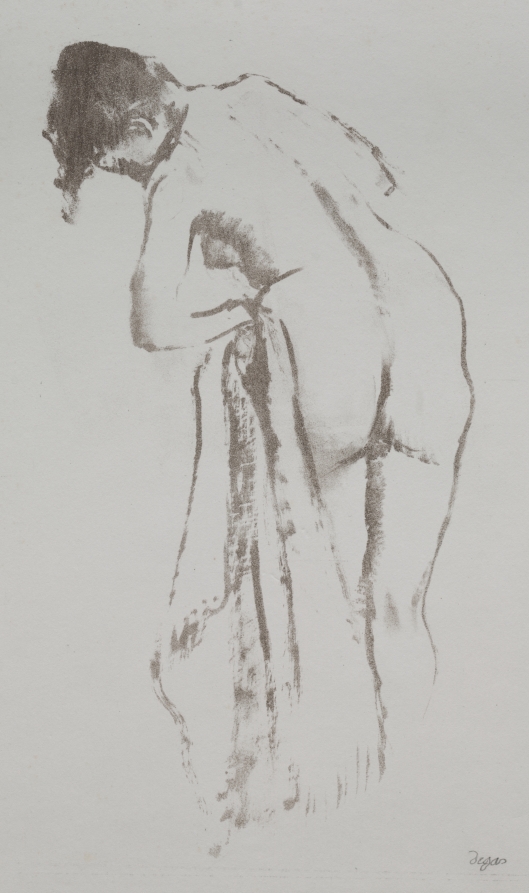
Edgar Degas's "Nude Man Standing, with Left Hand Raised" (c. 1900) is a charcoal drawing from the final phase of the artist's career, when his failing eyesight led him to work in increasingly bold and expressive media. Degas (1834–1917) was one of the most searching and experimental draftsmen of the 19th century, and his late drawings and pastels pushed the boundaries of representation toward abstraction. This study of a male nude, the left hand raised in a gesture that might be rhetorical or reaching, shows Degas's late style at its most powerful. The charcoal is applied with varying pressure, creating a rich range of tones from deep, velvety blacks to delicate grays. The contours of the body are suggested rather than defined, the edges dissolving into the paper's surface. Degas's late drawings of nudes—both male and female—focus on the essential structure of the body, stripping away detail to reveal underlying form. This work was created during a period when Degas, nearly blind, was working increasingly from memory and imagination rather than from live models, giving his late figure drawings a haunting, almost visionary quality.
Cultural Impact
Degas's late drawings, created despite near-blindness, demonstrate an extraordinary will to create and a continuous evolution of style that culminated in works of remarkable expressive freedom.
Why It Matters
This charcoal drawing shows Degas pushing the medium to its limits, using the stark contrast of black and white to distill the human figure to its essential sculptural presence, unfiltered by academic convention.