Description
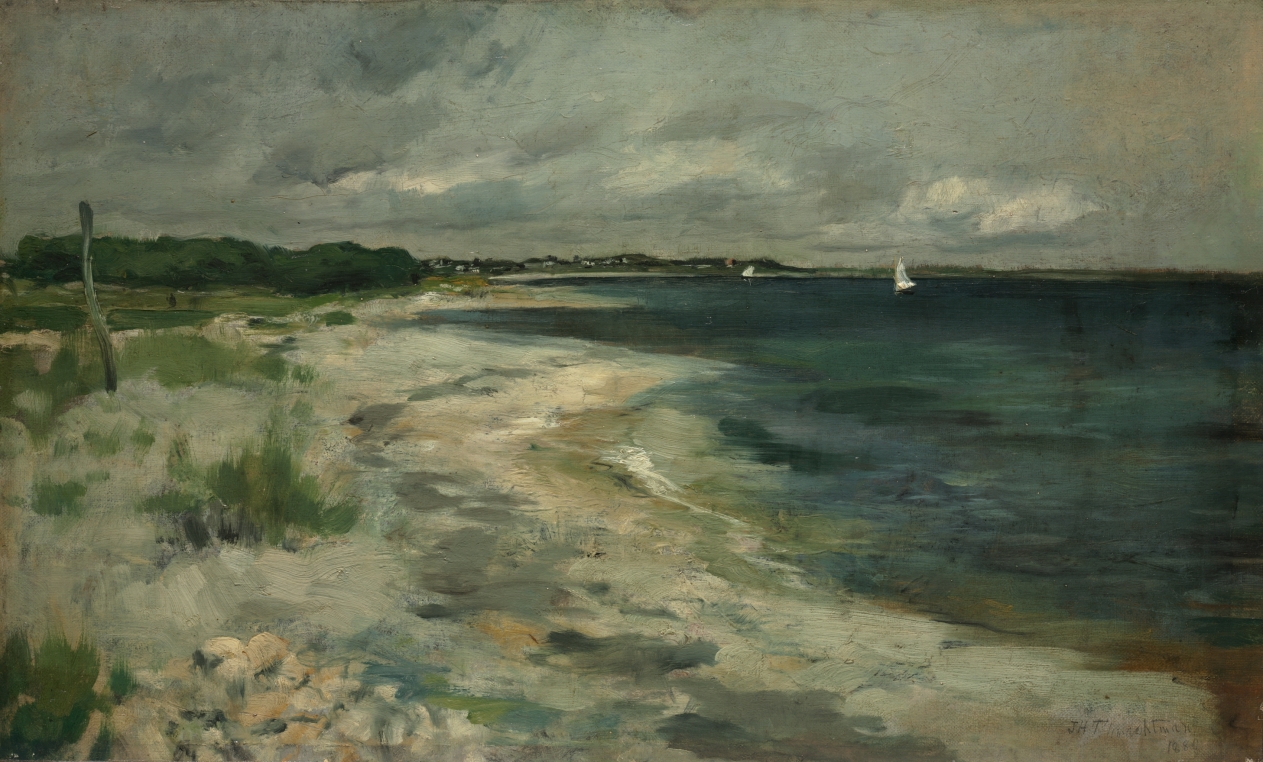
In 1892, John Twachtman, one of the most imaginative of the American Impressionists, established a summer colony at Cos Cob, Connecticut. This painting depicts the Holley Mill near Cos Cob. Unlike the French Impressionists, who tended to analyze the effects of light and color in a scene, Twachtman was interested in expressing the pure poetry of color and his emotional response to the changes he observed in nature.
Provenance
Estate of the artist (American Art Association, New York, Sale of the Work of the Late John. H. Twachtman, 24 March 1903, probably no. 93 as Deserted Wharf; possibly to E.A. Rorke, New York); Mr. and Mrs. William H. Marlatt, Cleveland; Bequest to The Cleveland Museum of Art, 1942.
Accession Number
1942.122
Medium
oil on canvas
Dimensions
Unframed: 61.5 x 51 cm (24 3/16 x 20 1/16 in.)
Classification
Painting
Credit Line
Bequest of Julia Morgan Marlatt
Tags
Painting Impressionist & Modern (1851–1900) Oil Painting Canvas American Color: Gray
Background & Context
Background Story
The Old Mill at Cos Cob depicts a subject from the area of Greenwich, Connecticut, where Twachtman lived and painted during the most productive period of his career. The wharf and mill at Cos Cob were familiar landmarks of the Connecticut coast, and Twachtman painted them repeatedly, finding in this modest working waterfront the same atmospheric subtleties that other artists sought in more dramatic scenery. The 'deserted' quality of the title suggests a wharf that has outlived its commercial purpose—a structure that is no longer functional but still structurally present, providing the kind of melancholy, time-worn subject that Twachtman preferred.
Cultural Impact
Cos Cob was the site of the art colony organized by Twachtman and his friend J. Alden Weir, and it became one of the centers of American Impressionism. The old mill and wharf were painted by several artists in the colony, but Twachtman's versions are the most radical, reducing the subject to its atmospheric essentials and eliminating the picturesque details that other artists would have emphasized.
Why It Matters
Deserted Wharf (The Old Mill at Cos Cob) is Twachtman's Connecticut at its most atmospheric: a working waterfront that has outlived its working life, reduced to the subtle tonal modulations of water, sky, and weathered wood. The 'deserted' quality is not emptiness but contemplative silence.