Description
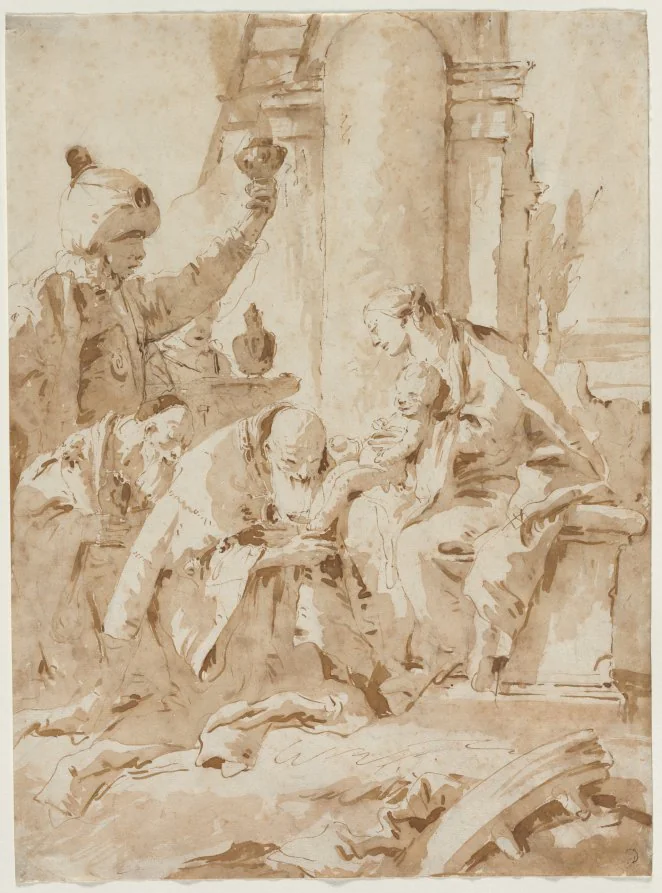
According to the Gospel of Matthew, three Magi, guided by a star, found the newborn Jesus and laid gifts of gold, frankincense, and myrrh before him. Giovanni Battista (Giambattista) Tiepolo’s drawing of the traditional subject places the Madonna on a platform as she holds the Christ child out toward three approaching magi. Two bearded white magi kneel in supplication as the turbaned black magi stands behind them. Tiepolo plays with the conventions of the Adoration subject by employing an asymmetrical composition. Working over his black chalk underdrawing, traces of which are visible in the figures’ robes, the artist delineated the scene with brown ink, quill pen, and brush before modeling with brown wash. Tiepolo’s mastery over value is evident in his contrasts of dark shadow with light midtones and the luminous white of his paper, producing his celebrated effects of glistening sunlight and clear atmosphere. The broken wheel in the foreground, an attribute of Saint Catherine, also appears in Tiepolo's etching of the same subject (1965.18) to which this drawing may be related.
Provenance
G. Déloye (Gustave Déloye) [1838-1899], Paris (inscribed with initials, lower right, in brown ink, similar to Lugt 756). (?-1898); Adoration of the Magi in Déloye collection sold (see H. Mireur, Dictionnaire des Ventes d'Art (Paris, 1911), 7:183). (1898); (Richard H. Zinser, New York, purchased by The Cleveland Museum of Art, Dec. 1944.) (?-1944); The Cleveland Museum of Art, Cleveland, OH. (1944-)
Accession Number
1944.474
Medium
pen and brown ink and brush and brown wash, over black chalk
Dimensions
Sheet: 38.7 x 28.5 cm (15 1/4 x 11 1/4 in.)
Classification
Drawing
Credit Line
Dudley P. Allen Fund
Tags
Drawing Baroque (1600–1750) Ink Italian Color: White
Background & Context
Background Story
Tiepolo's Adoration of the Magi (c. 1740) treats the Nativity story's most visually dramatic episode—the arrival of the three kings bearing gifts for the newborn Christ—with the splendor and theatricality that distinguish his religious painting from the quieter, more meditative traditions of earlier Venetian art. The three kings—traditionally representing the three known continents (Europe, Asia, Africa)—provided Tiepolo with an opportunity to depict exotic costumes, elaborate gifts, and the kind of processional composition he excelled at. Tiepolo's treatment emphasizes the scene's ceremonial aspect: the adoration becomes a courtly ritual, with the kings approaching the Madonna and Child as ambassadors approaching a throne. This interpretation reflects 18th-century Venice's courtly culture, where ceremony and display were essential to social and political life. The year 1740 places this during Tiepolo's most productive Venetian period, when he was painting altarpieces and decorative programs for churches and palaces across the Veneto. The painting's handling combines the narrative clarity of altarpiece tradition with the decorative brilliance of Tiepolo's secular ceilings: the same chromatic virtuosity and compositional assurance that served mythological subjects also serves devotional ones.
Cultural Impact
Tiepolo's Adoration paintings influenced how the Magi subject was represented in 18th-century European art, establishing a model of ceremonial splendor that contrasted with the humble, intimate treatments favored by Counter-Reformation devotion. The paintings influenced altarpiece design across Catholic Europe, introducing Rococo decorative elements into traditionally solemn formats. The subject also influenced how cultural diversity—the three kings' representation of different continents—was represented in religious art.
Why It Matters
This painting matters because it demonstrates Tiepolo's ability to serve both secular and devotional purposes with the same technical mastery and creative imagination. The Adoration of the Magi, while religious in subject, displays the same decorative genius that animated Tiepolo's mythological ceilings—suggesting that for an artist of Tiepolo's caliber, the distinction between sacred and secular subjects is less important than the quality of visual invention brought to either.