Description
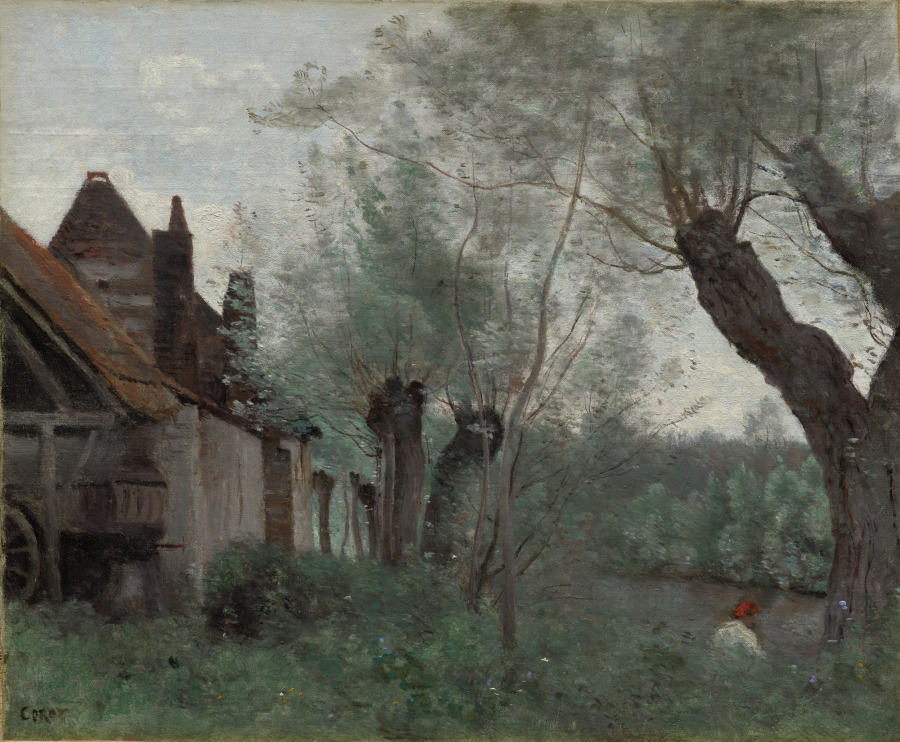
Corot painted this view of a pond near his home at Ville-d'Avray, just west of Paris, in his late style distinguished by soft, hazy forms and gentle, silvery light. Such paintings merge his lifelong study of nature with nostalgic memories and contrast sharply with the more formal compositions and precisely rendered shapes of his early landscapes. Corot's devotion to the direct study of nature was a major influence on the Impressionists.
Provenance
After 1919 Mrs. Francis F. Prentiss [1865-1944] Cleveland, OH, bequeathed to the Cleveland Museum of Art, 1944. (after 1919-1944); The Cleveland Museum of Art, Cleveland, OH (1944-); M. Goupil. J. Quincy Shaw, Boston, MA, by 1917.
Accession Number
1944.80
Medium
oil on fabric
Dimensions
Framed: 87 x 127 x 11 cm (34 1/4 x 50 x 4 5/16 in.); Unframed: 58.1 x 99.4 cm (22 7/8 x 39 1/8 in.)
Classification
Painting
Credit Line
Elisabeth Severance Prentiss Collection
Tags
Painting Impressionist & Modern (1851–1900) Oil Painting French Color: Gray Color: Black
Background & Context
Background Story
Jean-Baptiste-Camille Corot (1796-1875) was the bridge between the Neoclassical landscape tradition and the Impressionist revolution, and the pond at Ville-d'Avray—his family's country estate—was the subject he painted more than any other throughout his long career. This late 1860s version shows the pond with the silvery tonal unity and atmospheric subtlety that distinguish Corot's mature work: the trees, the water, and the sky are all rendered in shades of silver-gray that create a landscape of dreamlike tranquility. Ville-d'Avray was the site of Corot's most sustained landscape study, and the pond paintings from the estate represent the most complete record of his evolving approach to landscape.
Cultural Impact
Corot's pond at Ville-d'Avray is one of the most painted subjects in the history of French landscape, comparable to Monet's water lilies at Giverny. The series of paintings that Corot made of this pond over more than forty years constitute a visual diary of his artistic development—from the Neoclassical compositions of the 1820s to the silvery tonal paintings of the 1860s that influenced the Impressionists.
Why It Matters
Pond at Ville-d'Avray is Corot's most personal subject at its most distilled: the pond he had painted for forty years rendered in the silvery tonal unity of his late work. The trees, the water, and the sky dissolve into shades of silver-gray, creating a landscape that exists at the boundary between observation and memory.