Description
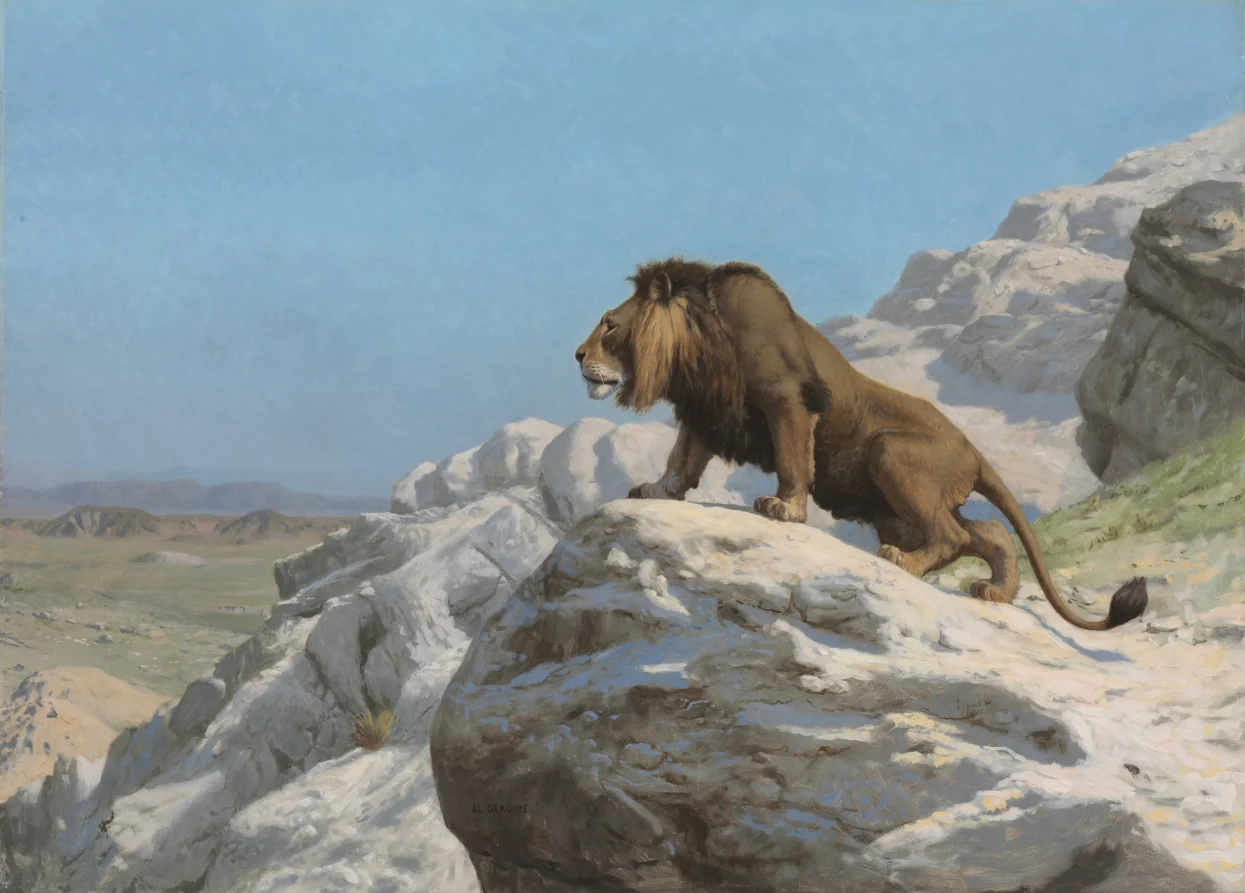
In addition to his fascination with the classical past, Gérôme was one of the leading painters of "orientalist" subjects-exotic and romantic themes inspired by Napoleonic adventures abroad, romantic literature, and European colonialism. From 1855, Gérôme travelled regularly in Turkey, Egypt, and Asia Minor. Long fascinated by African animals, he sketched lions in the Paris zoo as a student and later hunted them on safari in North Africa.
Provenance
Frederick Gehring, Cleveland. Given to the CMA in 1945.; (Knoedler & Co., New York, sold to Frederick Gehring in 1904)
Accession Number
1945.25
Medium
oil on wood panel
Dimensions
Framed: 105 x 133 x 13.5 cm (41 5/16 x 52 3/8 x 5 5/16 in.); Unframed: 72.3 x 100.5 cm (28 7/16 x 39 9/16 in.)
Classification
Painting
Credit Line
Gift of Mrs. F. W. Gehring in memory of her husband, F. W. Gehring
Tags
Painting Impressionist & Modern (1851–1900) Oil Painting Panel Painting French Color: Blue
Background & Context
Background Story
Lion on the Watch is one of Gérôme's most dramatic animal paintings, depicting a lion observing its prey from concealment in the North African landscape. Gérôme studied lions from life at the Paris zoo and in Egypt, and his understanding of feline anatomy and behavior gives the painting a conviction that more fanciful Orientalist animal paintings lack. The lion is rendered with the same archeological precision that Gérôme brought to his historical reconstructions: every muscle, every fold of skin, every whisker is observed and recorded with the accuracy of a naturalist rather than the imagination of a romantic painter.
Cultural Impact
Gérôme's animal paintings were among his most popular works, commissioned by collectors who prized their combination of exotic subject matter and scientific accuracy. The lion watching its prey was a subject that appealed to both Orientalist taste (the exotic animal in its native landscape) and academic taste (the precise rendering of anatomy and behavior). Gérôme's lions are never merely decorative—they are specific animals in specific landscapes, observed with the same precision that he brought to his human figures.
Why It Matters
Lion on the Watch is Gérôme the naturalist: a lion rendered with the same archeological precision that he brought to his Roman gladiators and Egyptian scenes. The animal is not a romantic fantasy but a specific observation—every muscle accurate, every whisker in place. Academic painting's claim to truth, applied to the king of beasts.