Provenance
Gifford Beal (the artist) [1879-1956] (1925); Ralph King [1855-1926] (1925-26); Fanny Tewksbury King [d. 1949], Cleveland, OH (1926-46); The Cleveland Museum of Art, Cleveland, OH (November 25, 1946)
Accession Number
1946.284
Medium
watercolor
Dimensions
N/A
Classification
Drawing
Credit Line
In memory of Ralph King, gift of Mrs. Ralph King; Ralph T. Woods, Charles G. King; and Frances King Schafer
Tags
Drawing Early Modern (1901–1950) Watercolor American Color: Teal Color: Blue
Background & Context
Background Story
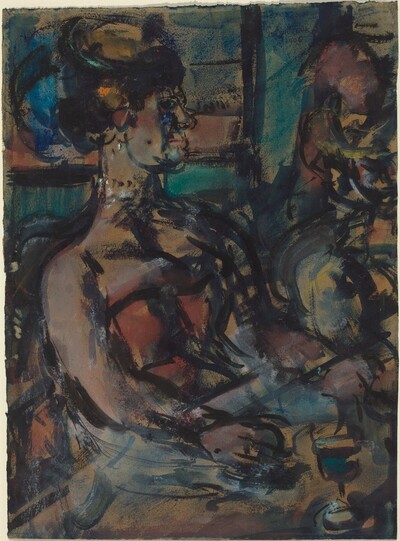
Twilight from 1925 is a watercolor that demonstrates Beal's ability to capture the transitional light of dusk with the subtlety and chromatic range that distinguish his best work on paper. Twilight—the brief period between daylight and darkness—is one of the most challenging subjects for watercolor because the colors are fugitive and the effects of light change rapidly. Beal's treatment captures the specific quality of twilight: the way colors deepen and merge as the light fades, the way forms lose their definition and become silhouettes, and the way the sky retains luminosity even as the landscape below falls into shadow.
Cultural Impact
Beal's twilight watercolors demonstrate his mastery of the most challenging aspect of the watercolor medium: the capture of fugitive natural effects that change rapidly and cannot be revisited. Twilight is particularly challenging because the colors and values shift continuously as the light fades, and Beal's ability to render these transitions in watercolor demonstrates the medium's capacity for subtlety as well as brilliance.
Why It Matters
Twilight is Beal's watercolor at its most subtle: the fugitive effects of dusk captured in a medium that rewards rapid execution and chromatic sensitivity. The transitional light of twilight—colors deepening, forms losing definition, the sky retaining luminosity as the landscape falls into shadow—is rendered with a subtlety that demonstrates watercolor's capacity for capturing the effects that oil painting cannot.