Description
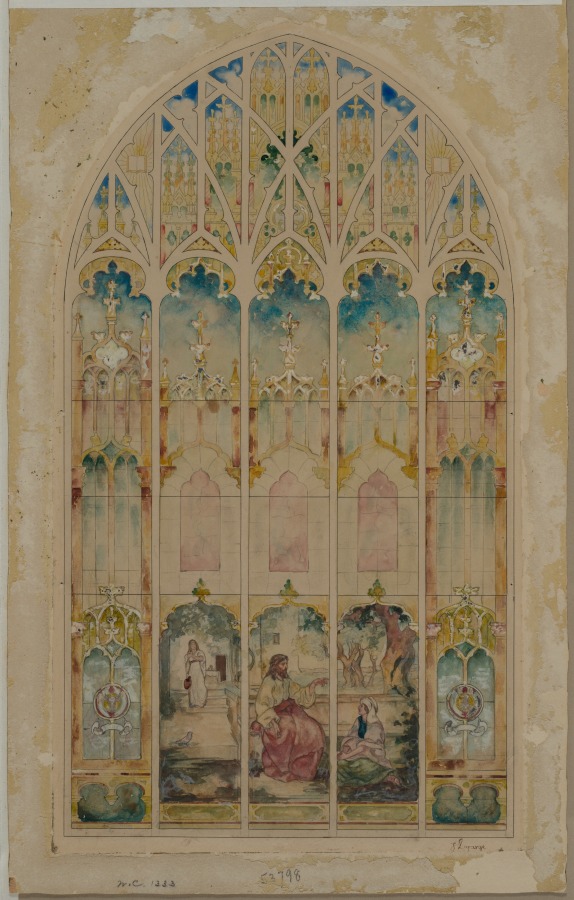
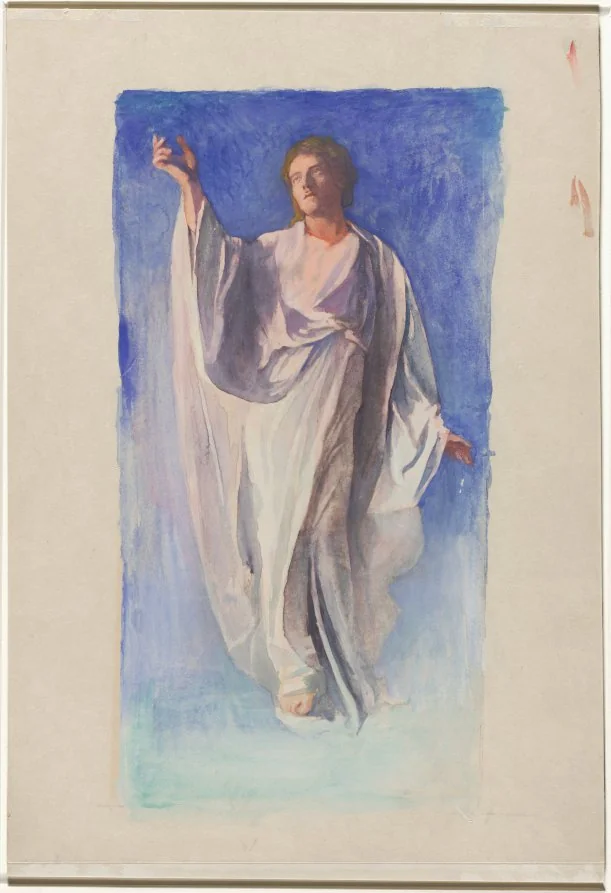
This watercolor is a study for the figure of Christ in a stained glass window La Farge designed for the west wall of the north transept of Trinity Church in Boston.
Provenance
Fanny Thrall Tewksbury King [1867-1949], Cleveland, OH (?-1946); The Cleveland Museum of Art, Cleveland, OH (November 25, 1946)
Accession Number
1946.288
Medium
watercolor and gouache; partial framing lines in graphite
Dimensions
Sheet: 44.9 x 31.4 cm (17 11/16 x 12 3/8 in.); Secondary Support: 45.6 x 31.4 cm (17 15/16 x 12 3/8 in.)
Classification
Drawing
Credit Line
In memory of Ralph King, gift of Mrs. Ralph King; Ralph T. Woods, Charles G. King; and Frances King Schafer
Tags
Drawing Impressionist & Modern (1851–1900) Watercolor Graphite & Pencil Gouache American Color: Blue Color: Gray
Background & Context
Background Story
This watercolor for The Resurrection of Christ is a late work by La Farge, made when he was in his late sixties and still working at full creative power. The Resurrection was a subject that La Farge had treated in stained glass throughout his career, and this watercolor design — with its partial framing lines in graphite suggesting the boundaries of a glass panel — shows his continued engagement with the most challenging subject in Christian iconography: the moment when divine power overcomes death. The combination of watercolor and gouache allows La Farge to study the effects of both transparent and opaque passages, the same contrast that distinguishes opalescent glass from cathedral glass.
Cultural Impact
La Farge's religious subjects are among his most personal works, reflecting his lifelong engagement with Catholic art and theology. The Resurrection was the ultimate test of his theory that color could carry spiritual meaning — that the experience of looking at transmitted light through colored glass could approximate the experience of spiritual transcendence. This watercolor design tests that theory at its most demanding subject.
Why It Matters
The Resurrection of Christ is La Farge's ultimate stained glass subject — the moment when light overcomes darkness — and this watercolor design is his attempt to solve the problem on paper before committing it to glass. The partial framing lines remind us that this is not a finished painting but a study for a more luminous medium.