Accession Number
1947.139
Medium
brush and gray wash and graphite, white gouache (upper left, medium unrelated to composition)
Dimensions
Sheet: 23.4 x 38.8 cm (9 3/16 x 15 1/4 in.); Secondary Support: 23.4 x 38.8 cm (9 3/16 x 15 1/4 in.)
Classification
Drawing
Credit Line
Gift of Mrs. Malcolm L. McBride
Tags
Drawing Baroque (1600–1750) Graphite & Pencil Gouache Dutch Color: White Color: Gray
Background & Context
Background Story
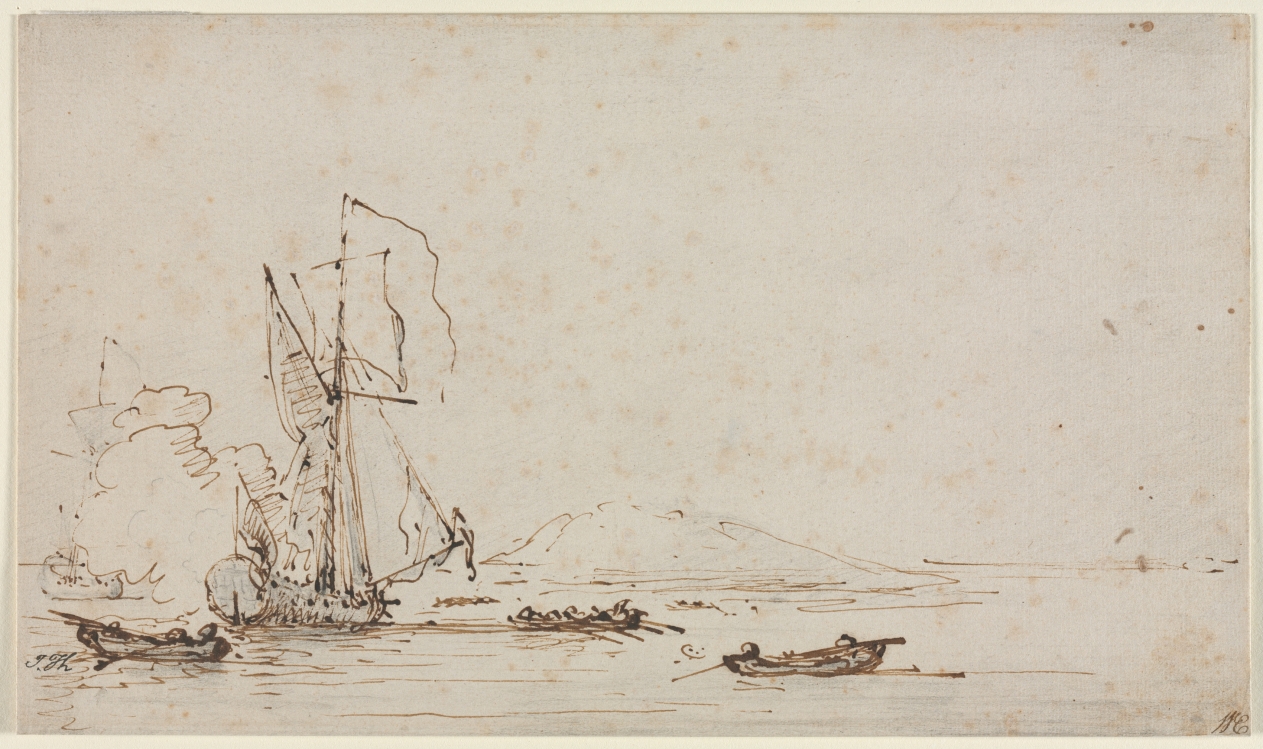
Willem van de Velde the Younger (1633-1707) was a Dutch painter known for the precisely observed marine paintings that make him the most accomplished marine painter of the Dutch Golden Age. Shipping on a Rough Sea from 1665 depicts ships on a rough sea in the precisely observed, atmospheric manner that distinguishes van de Velde's best marine paintings from the more generalized sea painting of his contemporaries. The 1665 date places this in van de Velde's most productive period, when he was producing the precisely observed marine paintings that are his most accomplished works.
Cultural Impact
Shipping on a Rough Sea is important in the history of marine painting because it demonstrates the precisely observed, atmospheric manner that makes van de Velde the most accomplished marine painter of the Dutch Golden Age. Van de Velde's precisely observed marine paintings—recording the exact appearance of ships, sea, and weather with the accuracy of a navigational document—represent the highest level of accomplishment in marine painting, and the 1665 painting shows this level at its most dramatic.
Why It Matters
Shipping on a Rough Sea is van de Velde's precisely observed marine painting: ships on a rough sea rendered with the atmospheric accuracy that makes him the most accomplished marine painter of the Dutch Golden Age. The 1665 painting shows marine painting as both navigational document and dramatic art.