
Description
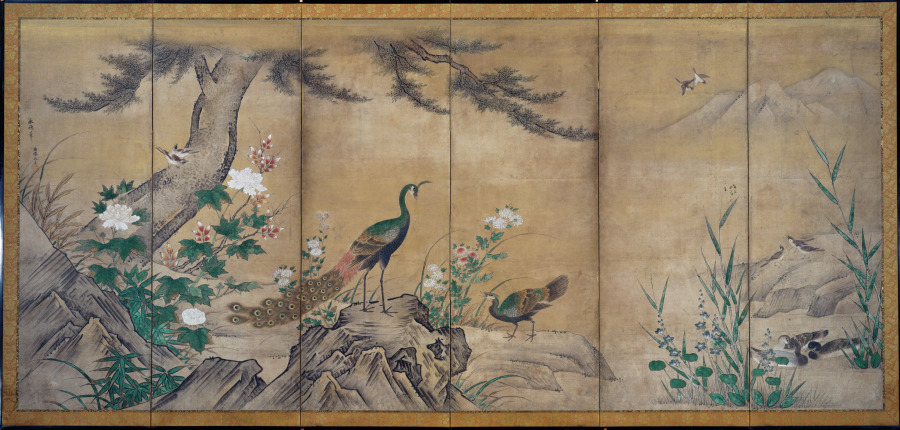
The landscape depicted in this pair of screens follows a seasonal progression from right to left, starting with the blossoming plum of early spring and ending with late autumn peonies. A variety of smaller birds are positioned throughout the scene, and a trio of swimming ducks is bracketed by early summer irises and early autumn bellflowers at the center. While some raptors (birds of prey) terrorize a pheasant and an egret (a waterfowl) to the right, a peacock and peahen converse to the left. Hawks are associated with military prowess, while the peafowl suggest cultural prestige.
Provenance
William G. Mather [1857–1951], Cleveland, OH, given to the Cleveland Museum of Art (?–1948); The Cleveland Museum of Art, Cleveland, OH (1948–)
Accession Number
1948.128
Medium
Pair of six-panel folding screens; ink, color, and gold on paper
Dimensions
Image: 155.5 x 340 cm (61 1/4 x 133 7/8 in.)
Classification
Painting
Credit Line
Gift of William G. Mather
Tags
Painting Renaissance (1400–1599) Ink Panel Painting Gold Leaf Paper Japanese Color: Brown Color: Gray
Background & Context
Background Story
Birds and Flowers from the late 1500s is a Japanese painting by Kano Mitsunobu and Kano Shoei, two members of the Kano school that was the most important painting school in Japan from the Muromachi period through the Edo period. The birds and flowers subject is one of the most important subjects in the Kano school tradition, combining Chinese painting traditions with Japanese artistic sensibilities. The late 1500s date places this in the Momoyama period, when the Kano school was producing its most accomplished work for the castles and temples of the new military rulers of Japan, and the collaboration between Mitsunobu and Shoei shows how the Kano school worked as a workshop producing paintings for elite patrons.
Cultural Impact
Birds and Flowers is important in the history of Japanese painting because it demonstrates the collaboration between two members of the Kano school, the most important painting school in Japan. The collaboration between Kano Mitsunobu and Kano Shoei shows how the Kano school worked as a workshop producing paintings for elite patrons in the Momoyama period, and the birds and flowers subject shows how the Kano school combined Chinese painting traditions with Japanese artistic sensibilities to create one of the most accomplished painting traditions in Japanese art.
Why It Matters
Birds and Flowers is a Kano school collaboration: the birds and flowers subject rendered by two members of the most important painting school in Japan. The late 1500s painting shows how the Kano school combined Chinese painting traditions with Japanese artistic sensibilities to produce work for the castles and temples of the Momoyama period.
![Saint Bernard and Saint Catherine of Alexandria with the Virgin of the Annunciation [right panel]](https://api.nga.gov/iiif/e6890364-4d99-4684-a62b-5060ee3c3446/full/400,/0/default.jpg)