Provenance
possibly Joshua Hutchinson Hutchinson [c. 1829-1891] (1880-1892); (possibly his sale, Sotheby's, London, March 3, 1892, no. 247, sold to Frederick Keppel) (1892); (possibly sale, Christie's, London, February 7, 1911, no. 174, sold to Parsons) (1911); (possibly sale, Sotheby's, London, November 3, 1919, no. 78A, sold to Max Williams) (1919); (Max Williams, New York, NY) (1919-1920); (sale, Associated American Artists, New York, NY, February 19, 1920, no. 153) (1920); possibly Mitchell Kennerly [1878-1950], New York, NY (1921); (possibly V.G. Fischer, Washington, DC) (1921-1925); Henry Sayles Francis [1902-1994], Cleveland, OH, given to the Cleveland Museum of Art (after 1925-1949); Cleveland Museum of Art, Cleveland, OH (1949-)
Accession Number
1949.519
Medium
charcoal
Dimensions
N/A
Classification
Drawing
Credit Line
Gift of Mr. and Mrs. Henry Sayles Francis
Tags
Color: Brown
Background & Context
Background Story
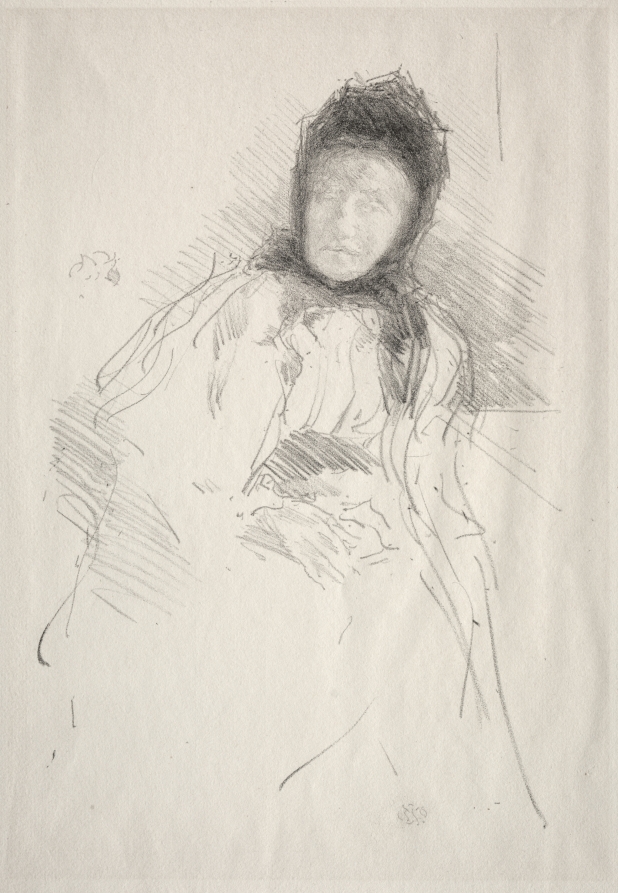
James McNeill Whistler, the American-born, European-trained artist who championed "art for art's sake," created this charcoal drawing of the Riva degli Schiavoni, Venice's iconic waterfront promenade, in 1879–80. Whistler had arrived in Venice in 1879 under dire circumstances: declared bankrupt after losing a highly publicized libel suit against John Ruskin (who had accused him of "flinging a pot of paint in the public's face"), Whistler was commissioned by the Fine Art Society to produce twelve etchings of Venice, giving him both income and a creative refuge.
Whistler worked obsessively in Venice, producing not only the commissioned etchings but also a remarkable series of pastels and charcoal drawings like this one. The Riva shows Whistler's commitment to what he called "arrangements" and "nocturnes"—compositions built from tonal harmonies rather than topographical accuracy. The charcoal is used almost musically: soft horizontal strokes suggest the lagoon's calm waters, while vertical accents define the architecture of the Doge's Palace and the columns of San Marco in the distance. Whistler's line is deliberately imprecise; he evokes atmosphere and mood rather than architectural detail.
Drawing on blue-gray paper, Whistler used the paper's own color as the mid-tone, adding black charcoal for shadows and—unusually—white chalk for highlights, visible in the reflections on the water and the sunlit facades. The effect is a study in tonal relationships: the dark mass of the foreground gondola, the lighter buildings, the luminous sky. This approach reflects Whistler's profound interest in Japanese aesthetics, particularly the emphasis on suggestion, asymmetry, and the beauty of empty space.
Venice transformed Whistler's career. The pastels and etchings he produced there were critically and commercially successful, rescuing him from bankruptcy and cementing his reputation as a leading figure in the Aesthetic Movement. The Riva captures Venice not as a tourist postcard but as a misty, poetic vision—a harmony in gray and silver.
Cultural Impact
Whistler's Venetian works, including this drawing, were pivotal in the Aesthetic Movement's campaign to separate art from narrative or moral purpose. His tonal approach influenced the development of American tonalism and, more broadly, the shift toward abstraction in early 20th-century painting. Whistler's emphasis on atmosphere over detail also prefigured Symbolism and, later, the lyrical abstraction of artists like Mark Rothko. The Venice sojourn itself is a legendary episode in art history—a phoenix rising from Ruskin's fire.
Why It Matters
A poetic, atmospheric vision of Venice that exemplifies Whistler's tonal philosophy, demonstrating how a single drawing can evoke an entire city's soul through mood and suggestion.