Description
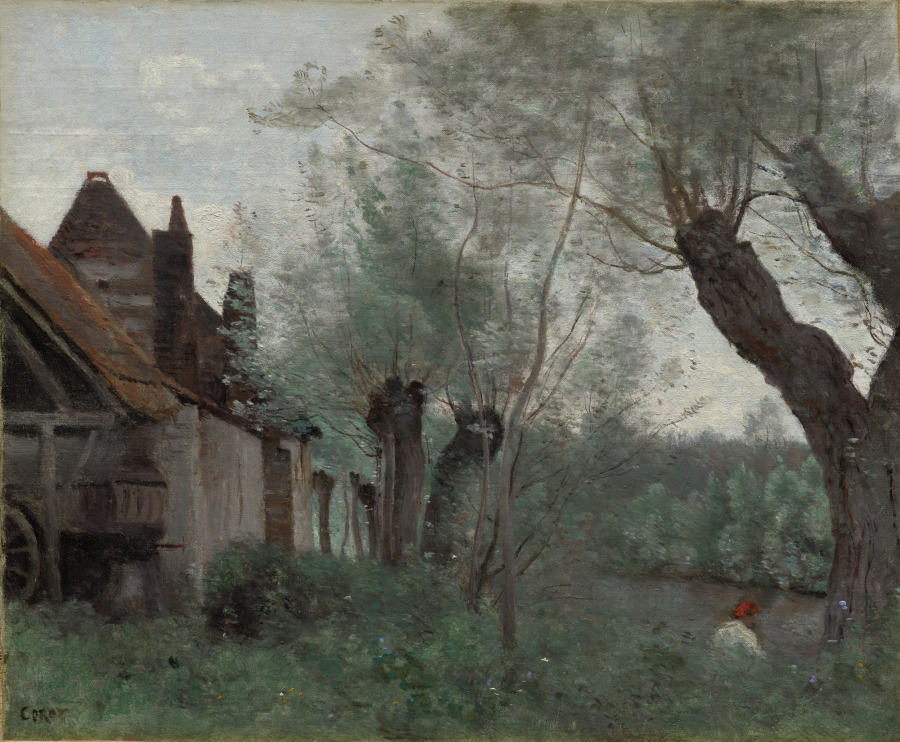
This scene of a pond bordered by large, leafy trees echoes Corot's well-known views of Ville-d'Avray, while the vaporous light and atmospheric effects within a restricted palette resemble those of the artist's late style of the 1860s and 1870s. The small forms of the peasant and white goat are also typical of Corot's late imagery. This is one of many views of a large pond at Ville-d'Avray, a small commune on the western suburbs of Paris, where Corot inherited a rural property from his parents.
Provenance
Dowager Duchess of Newcastle, widow of the sixth duke. Arnold & Tripp, Paris. Henry Reinhardt, dealer, Chicago. Purchased from him in December 1910 by William G. Mather, Cleveland. Bequeathed to the CMA in 1951.
Accession Number
1951.330
Medium
oil on fabric
Dimensions
Unframed: 46 x 61 cm (18 1/8 x 24 in.)
Classification
Painting
Credit Line
Bequest of William G. Mather
Tags
Painting Impressionist & Modern (1851–1900) Oil Painting French Color: Gold
Background & Context
Background Story
The Pond at the Entrance of the Woods combines two of Corot's most characteristic subjects: the pond (at Ville-d'Avray and elsewhere) and the woodland interior (at Fontainebleau and elsewhere). The pond provides the reflective surface that animates the composition, the trees provide the framing device and the atmospheric depth, and the combination produces one of Corot's most balanced compositions—a landscape where water and woodland, reflection and depth, exist in perfect equilibrium. The c. 1860-1875 date range suggests a work that Corot may have revisited over several years, adding to and refining a composition that he considered important.
Cultural Impact
Corot's woodland-and-pond compositions were among his most influential works, providing a model of landscape painting that balanced observation and memory, realism and poetry. The Pond at the Entrance of the Woods exemplifies this balance: the scene is observed from nature (the trees, the water, the light are all specific), but the mood is poetic and contemplative rather than descriptive.
Why It Matters
The Pond at the Entrance of the Woods is Corot's landscape philosophy in a single composition: water for reflection, woodland for depth, and a silvery tonal unity that makes observation and poetry feel like the same thing. The painting is both seen and remembered, both specific and universal.