Description
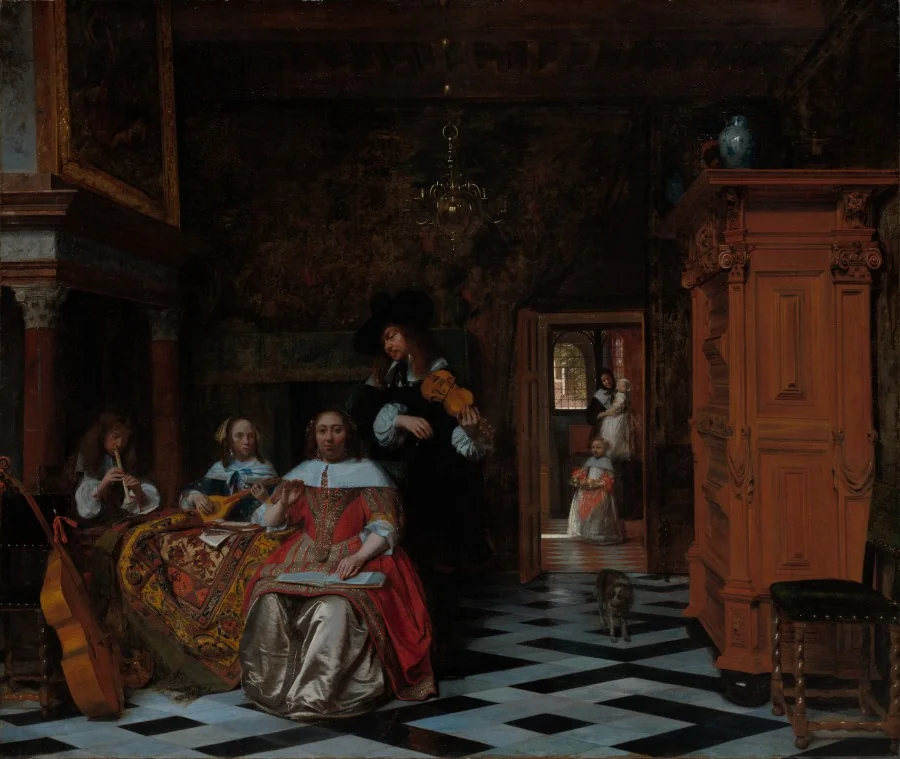
The identity of the sitters remains unknown, although the marble floor and mantelpiece, the Transylvanian prayer rug on the table, and the silk clothes all point to the family’s considerable wealth. Furthermore, the richly carved chest at the right supports Chinese vases and Japanese lacquered boxes, a reference to the flourishing Dutch trade with Asia. Music making often took place at home, and its appearance here also signifies the harmoniousness of the family.
Provenance
James A. Stuart-Wortley-Mackenzie, First Baron Wharncliffe (1776-1845), 1833;; John Smith, London;; William Theobald, London, 1842 (sale: Christies’s, London, May 10, 1851, no. 76);; private collection, Yorkshire;; E. E. Cook, Bath;; [Scott & Fowles, New York], sold to the Cleveland Museum of Art, 1951.
Accession Number
1951.355
Medium
oil on canvas
Dimensions
Framed: 124.5 x 142.5 x 7 cm (49 x 56 1/8 x 2 3/4 in.); Unframed: 98.7 x 116.7 cm (38 7/8 x 45 15/16 in.)
Classification
Painting
Credit Line
Gift of the Hanna Fund
Tags
Painting Baroque (1600–1750) Oil Painting Canvas Dutch Color: Orange
Background & Context
Background Story
Portrait of a Family Playing Music from 1663 shows de Hooch applying his characteristic spatial and perspectival skills to a group portrait—a genre that was more commonly practiced by artists like Frans Hals and Rembrandt. The family is arranged in a well-appointed interior, with musical instruments and a sense of domestic harmony that reflects the Dutch bourgeois ideal of cultured family life. The perspective construction—receding floor tiles, a window providing light, and a doorway opening to another room—creates the spatial complexity that distinguishes de Hooch's work from conventional portraiture.
Cultural Impact
The combination of portraiture and domestic interior in this painting reflects the 17th-century Dutch practice of commissioning family portraits that showed the subjects in their own homes, surrounded by the objects that defined their social status. De Hooch's contribution to this tradition is his handling of perspective and light: the family is not just depicted but situated in a constructed space that gives their domestic activity a sense of architectural order and social virtue.
Why It Matters
Portrait of a Family Playing Music is de Hooch's perspective applied to portraiture: a family making music in a constructed interior where every line and light source contributes to the sense of domestic order. The painting proves that de Hooch's spatial skills were not limited to genre scenes—they could transform a family portrait into an architectural meditation.