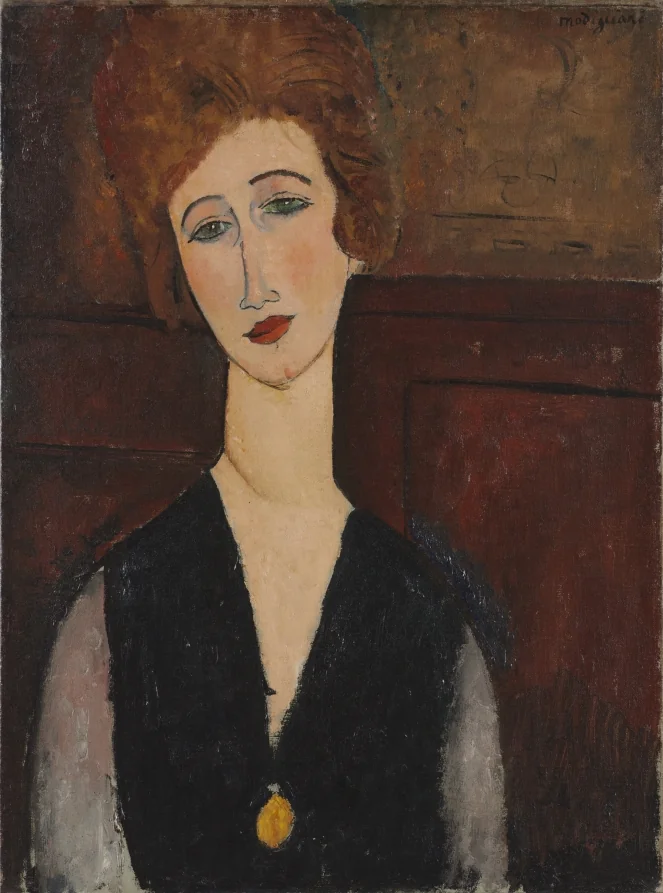
Description
Born to a Sephardic Jewish family in Livorno, Italy, Modigliani studied briefly in Florence and Venice before moving to Paris in 1906 where he became a key member of the avant-garde art world. His portraits, known for their subtle color and elegantly elongated forms, chronicle the lives of fellow artists and poets, although the woman in this painting remains unidentified. Influenced by African masks such as those made by the Baule people of the Ivory Coast and Cubism, a style of art that stresses abstract structure over realism, the artist rendered the sitter’s features as flat, geometric planes.
Provenance
Georges Bénard, Paris (Until 1933); (Bénard sale, Hôtel Drouot, June 9, 1933 (no. 67), sold to G. Bernheim) (1933); Probably Georges Bernheim, Paris, France (1933-); (Galerie Paul Guillaume, Paris, France) (?); (César de Hauke, Paris, sold to the Cleveland Museum of Art) (Until 1951); The Cleveland Museum of Art (1951-)
Accession Number
1951.358
Medium
oil on canvas
Dimensions
Framed: 94.6 x 77.5 x 6 cm (37 1/4 x 30 1/2 x 2 3/8 in.); Unframed: 65 x 48.3 cm (25 9/16 x 19 in.)
Classification
Painting
Credit Line
Gift of the Hanna Fund
Tags
Color: Red Color: Orange
Background & Context
Background Story
This Portrait of a Woman from c. 1917-18 is another version of Modigliani's most characteristic subject, depicting an unidentified woman with the elongated face, simplified features, and mask-like expression that define his portrait manner. The oil on canvas format distinguishes this from the cardboard portraits that Modigliani produced in the same period—the canvas support allowed a more finished surface than cardboard, and the painting's handling shows the care that Modigliani brought to his most important commissions. The c. 1917-18 date places this in the same period as the cardboard Portrait of a Woman, allowing a comparison between Modigliani's more informal and more finished approaches to the same subject.
Cultural Impact
The comparison between Modigliani's canvas and cardboard portraits from the same period reveals the range of his stylistic approach: the canvas portraits are more finished and more carefully structured, while the cardboard portraits are more rapid and spontaneous. This Portrait of a Woman on canvas shows Modigliani's more deliberate approach—the features are still elongated and mask-like, but the surface is more finished and the composition more carefully structured than the rapid cardboard portraits.
Why It Matters
Portrait of a Woman on canvas is Modigliani's more finished approach to his signature subject: the elongated face and mask-like features rendered with the care and compositional structure that distinguish his canvas portraits from the more rapid cardboard versions. The c. 1917-18 date allows comparison with his more informal cardboard portraits from the same period.


![Saint Bernard and Saint Catherine of Alexandria with the Virgin of the Annunciation [right panel]](https://api.nga.gov/iiif/e6890364-4d99-4684-a62b-5060ee3c3446/full/400,/0/default.jpg)