Description
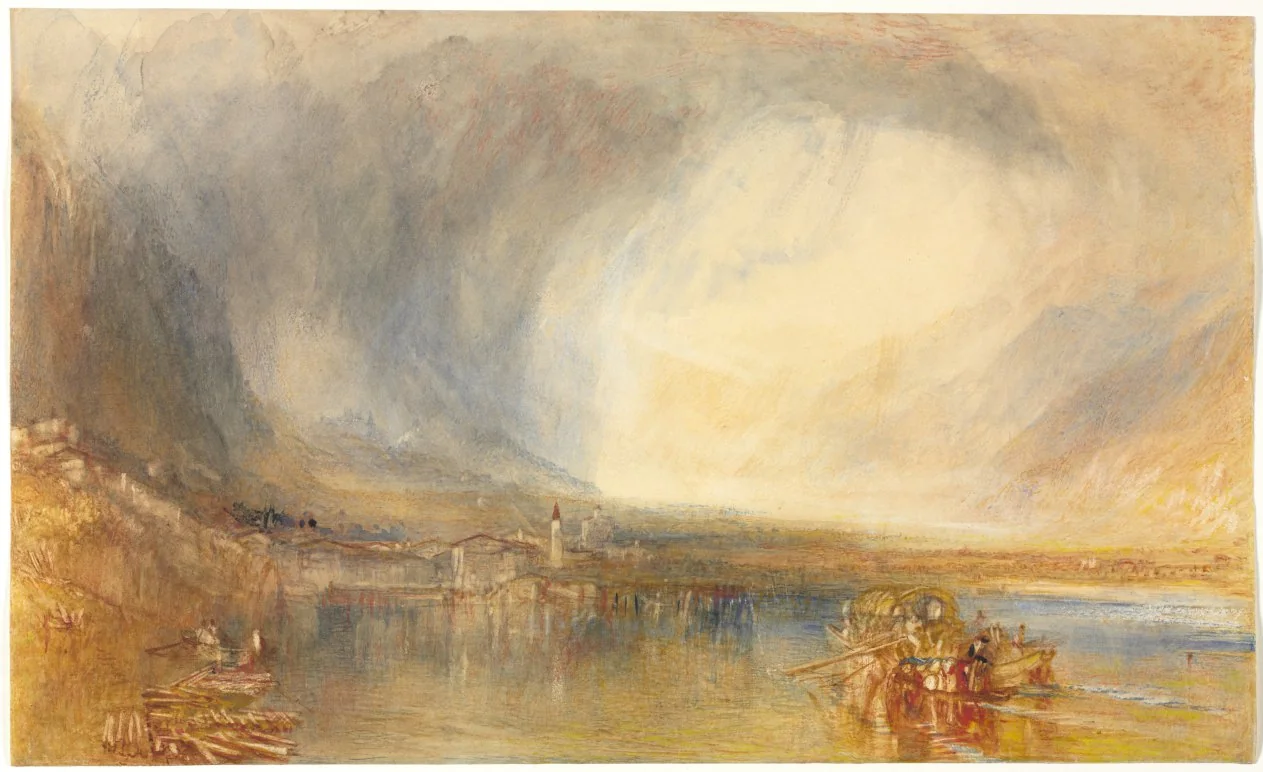
In this watercolor, created late in his life, J.M.W. Turner depicted the small Swiss town of Flüelen and its shimmering reflection out of violet-colored mist. The work belongs to a group of highly finished works that the artist created during several summer trips to Switzerland between 1841 and 1845. The swirling vortex of light underscores the grandeur of nature, while the inclusion of figures going about their daily lives within the vastness of the Alps is a reminder of the reality of the scene. At the time he painted this view, Turner was considered the great master of Romantic landscape painting in England.
Provenance
Hugh A. J. Munro of Novar? (?-before 1850); Rev. C. Upham Barry, Ryde, Isle of Wight, by descent to his daughter (by c. 1850-?); His daughter, wife of Colonel P. G. Hewitt, Ryde, Isle of Wight (?-1884); (her sale Christie's, London, March 25, 1884, no. 139) (1884); Ralph Brocklebank Sr., Haughton Hall, Tarporley (after 1884-?); Ralph Brocklebank Jr., Haughton Hall,. Tarporley (?-1922); (his sale, Christie's, London, July 7, 1922, no. 34) (1922); (Thomas Agnew and Sons, London) (after 1922-?); Grace Rainey Rogers [1867-1943], New York, NY (?-1943); (her sale, Parke-Bernet Galleries, New York, November 18, 1943, no. 41) (1943); Walter F. Wedgwood, New York, NY (after 1943-?); (Durlacher Brothers, New York, sold to the Cleveland Museum of Art, Cleveland, OH) (?-1954); Cleveland Museum of Art, Cleveland, OH (1954-)
Accession Number
1954.129
Medium
watercolor with gouache and scratch-away
Dimensions
Sheet: 29.2 x 47.9 cm (11 1/2 x 18 7/8 in.)
Classification
Drawing
Credit Line
Mr. and Mrs. William H. Marlatt Fund
Tags
Drawing Neoclassical & Romantic (1751–1850) Watercolor Gouache British Color: Orange Color: Yellow
Background & Context
Background Story
This late watercolor from Turner's final decade captures the Swiss lakeside town of Flüelen on Lake Lucerne with extraordinary freedom. The scratch-away technique — where the artist scrapes through the painted surface to reveal the white paper beneath — creates dazzling flashes of light on water and mountain snow. Turner's Swiss watercolors from the 1840s represent some of his most radical work in any medium, pushing watercolor toward pure abstraction while remaining anchored in observed reality.
Cultural Impact
Turner had been visiting Switzerland since 1802, but his late Swiss watercolors achieve something his earlier ones could not: the complete identification of medium and meaning. The transparency of watercolor becomes the transparency of Alpine air; the scratch-away becomes the play of sunlight on glaciers. These works were never exhibited in Turner's lifetime — they were too radical even for his supporters.
Why It Matters
These late Swiss watercolors are among Turner's greatest achievements in any medium. They anticipate the watercolor revolutions of Cézanne and the Abstract Expressionists while remaining rooted in the most careful observational tradition.