Accession Number
1954.689
Medium
pen and brown ink and brush and brown wash; framing lines in brown ink
Dimensions
Sheet: 13.7 x 20.2 cm (5 3/8 x 7 15/16 in.); Secondary Support: 13.7 x 20.2 cm (5 3/8 x 7 15/16 in.); Tertiary Support: 21.8 x 27.7 cm (8 9/16 x 10 7/8 in.)
Classification
Drawing
Credit Line
The Norweb Collection
Tags
Drawing Renaissance (1400–1599) Ink Italian Color: Orange
Background & Context
Background Story
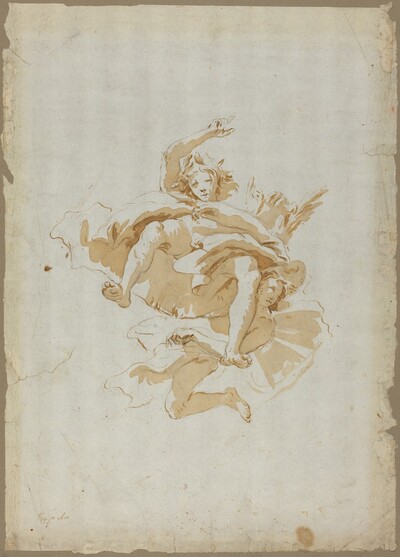
Victorious Soldiers with Trophy by Pellegrino Tibaldi, created in the 1550s, is a work from one of the most versatile and accomplished artists of the Italian Mannerist period. Tibaldi, born in Bologna in 1527, was a painter, sculptor, and architect whose work bridged the High Renaissance and Mannerist styles, eventually influencing the development of Baroque art. The subject—victorious soldiers displaying a trophy—draws from the ancient Roman tradition of the triumph, in which military victories were celebrated through public processions displaying captured arms, standards, and treasures. In the context of sixteenth-century Italian art, such subjects carried both classical and contemporary resonance: they recalled the military achievements of ancient Rome, which Renaissance artists and patrons admired and emulated, while also reflecting the ongoing military conflicts that shaped Italian politics during the period of the Italian Wars. Tibaldi's treatment likely combines the muscular, dynamic figures characteristic of Mannerist painting with the compositional complexity and spatial experimentation that defined the style. The trophy itself—a display of captured arms and armor—served as a powerful symbol of military prowess and divine favor, connecting Tibaldi's Renaissance patrons to the glory of ancient Rome. The 1550s were a moment of particular artistic ferment in Italy as the reforms of the Counter-Reformation began to reshape artistic patronage and subject matter.
Cultural Impact
Tibaldi's work exemplifies how Mannerist artists translated ancient Roman triumph imagery into the visual vocabulary of sixteenth-century Italian courts, creating a bridge between classical heritage and contemporary military-political culture.
Why It Matters
This painting demonstrates how Renaissance artists used classical military imagery to create works that simultaneously honored ancient tradition and served the political needs of sixteenth-century Italian patrons.