Provenance
Benjamin Barker, Bath (according to departmental card). Kate Field, Washington (according to departmental card).
Accession Number
1954.690
Medium
pen and brown ink (iron gall?) and brush and brown wash; framing lines in graphite
Dimensions
Sheet: 9.8 x 8 cm (3 7/8 x 3 1/8 in.)
Classification
Drawing
Credit Line
The Norweb Collection
Tags
Drawing Renaissance (1400–1599) Ink Graphite & Pencil Italian Color: Orange Color: White
Background & Context
Background Story
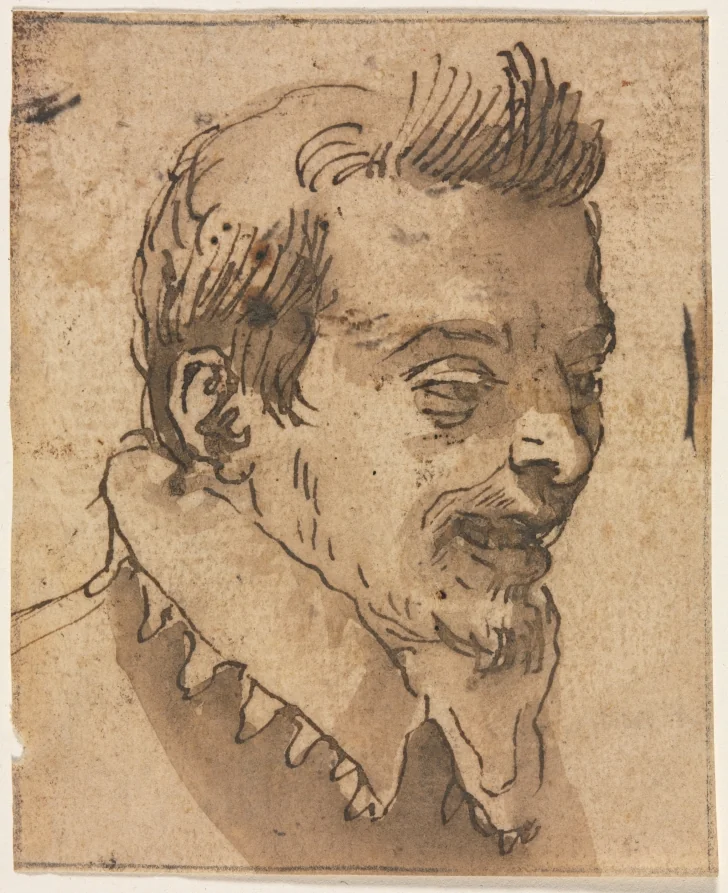
Head of a Man is a drawing by Annibale Carracci in pen and brown ink with brush and brown wash, demonstrating the draftsmanship that was central to the Carracci reform of Italian painting. The drawing combines the rapid pen work that captures the essential character of the sitter with the brown wash that provides tonal modeling and atmospheric depth. The medium (iron gall ink, which can corrode paper over time) and the framing lines in graphite suggest that this was a finished study rather than a casual sketch—intended for preservation and possibly for use as a model for a painting.
Cultural Impact
Annibale Carracci's drawings were central to his reform of Italian painting because they demonstrated the direct observation of nature that the Carracci academy advocated as an alternative to Mannerist artificiality. Head of a Man shows this direct observation at work: the features are recorded with the economy and accuracy that come from looking carefully at a real face rather than inventing one according to Mannerist conventions.
Why It Matters
Head of a Man is Annibale Carracci's reform of Italian drawing in action: direct observation of a real face, rapid pen work capturing essential character, and brown wash providing tonal depth. The drawing demonstrates the Carracci academy's principle that painting should be based on nature rather than on Mannerist convention.