Accession Number
1954.773
Medium
conté crayon and graphite
Dimensions
N/A
Classification
Drawing
Credit Line
John L. Severance Fund
Tags
Drawing Early Modern (1901–1950) Graphite & Pencil British Color: Brown
Background & Context
Background Story
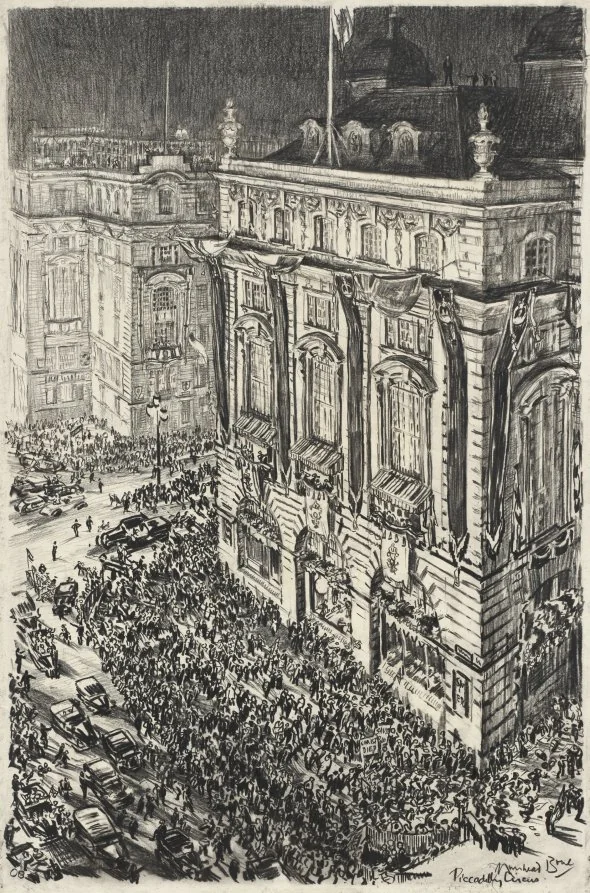
Piccadilly Circus on the eve of George VI's coronation in 1937 is Bone at his most spectacular as an urban documentarian. The crowded London intersection is alive with decorations, crowds, and the anticipation of the following day's ceremony. Bone's conté crayon and graphite technique allows him to capture both the architectural grandeur of the Piccadilly buildings and the human density of the crowd below, with the conté crayon providing dark accents and the graphite providing the mid-tones and highlights that give the drawing its atmospheric depth. The timing — the eve of a national celebration — adds a layer of social observation to Bone's usual architectural precision.
Cultural Impact
Bone's London drawings of the 1930s are among his most celebrated works, and this coronation scene demonstrates why. His ability to combine architectural documentation with social observation — to show both the permanent fabric of the city and the temporary spectacle of its celebrations — makes him the supreme visual chronicler of early 20th-century London. The conté crayon and graphite medium produces a tonal richness that approximates the effects of a mezzotint in a more portable format.
Why It Matters
Piccadilly Circus, Eve of the Coronation is Bone's London at its most public and most detailed. The drawing captures a specific historical moment — the eve of a coronation — with the same precision that he brought to construction sites and cathedrals, proving that celebration is as architecturally significant as construction.