Description
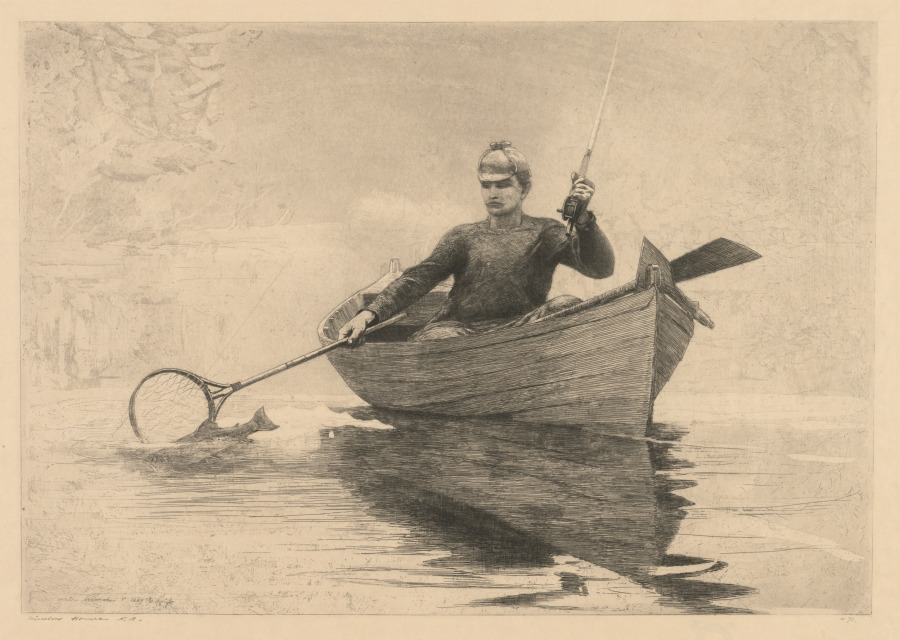
Mink Pond was Homer’s favorite haunt in the Adirondacks. With a subtle range of smoky blue washes, the artist conveyed the grandeur of the mountains and a stormy sky towering above a diminutive canoe with a casting fisherman. Small breaks of brightness provide moments of relief in the monochromatic tonality of the whole.
Provenance
[]
Accession Number
1954.833
Medium
watercolor
Dimensions
N/A
Classification
Drawing
Credit Line
Anonymous Gift
Tags
Drawing Impressionist & Modern (1851–1900) Watercolor American Color: White Color: Gray
Background & Context
Background Story
Mink Lake, Adirondacks (1892) represents Homer's engagement with the Adirondack lake country that he visited regularly throughout his career. The painting likely depicts a lake scene—the still water, the forested shore, and the particular light of the Adirondack wilderness that Homer knew deeply. The year 1892 places this during Homer's most productive Adirondack period, when he was painting sporting subjects and wilderness landscapes with the authority of long experience. Mink Lake, a specific body of water in the Adirondack highlands, provides a subject that combines topographical precision with the atmospheric sensitivity of Homer's mature style. The lake's still surface—common in the Adirondacks' sheltered valleys—served Homer's interest in reflective water effects and the dialogue between water and sky that characterizes lake painting. The painting's 1892 creation occurred during a period when the Adirondack Park, established in 1885, was being expanded and its conservation framework developed. Homer's painting of a pristine Adirondack lake implicitly supports the conservationist vision that was shaping the region's future, documenting the wilderness beauty that justified protection.
Cultural Impact
Homer's Adirondack lake paintings influenced how the Adirondack wilderness was represented in American art and culture, contributing to the visual identity of the Adirondack Park as a landscape of pristine beauty. The paintings influenced tourism for the Adirondack region and contributed to conservation arguments by documenting the wilderness's aesthetic value. The lake subjects influenced American watercolor practice and the broader tradition of lake painting in American art.
Why It Matters
This painting matters because it documents the Adirondack wilderness during the critical period when conservation was being established as public policy. Homer's Mink Lake captures the landscape that conservationists were arguing to protect, providing visual evidence of the wilderness's beauty and value that supported the policy arguments for preservation.