
Description
This drawing records a grand procession through Venice's Piazza San Marco on the penultimate day of the 1782 celebrations for the visit of the Russian Grand Duke Paul (Pavel) Petrovitch and his wife Maria Feodorovna. Francesco Guardi was likely commissioned by the Venetian state to document the ducal visit. Drawing from the vantage point of the Procuratie Nuove (a palace on one side of the piazza), Guardi sketched five carriages festooned with allegories, which were meant to celebrate the governments of Catherine the Great and Venice. In order to include as much of the procession as possible, he manipulated the perspective of the buildings on the right side of the square.The loose handling and lively immediacy of the pen work suggests he executed it on the spot. One drawing (Museen Preußischer Kulturbesitz, Berlin) and two oil paintings (private collections, Venice and Milan) of the same scene survive. Cleveland’s sheet likely preceded these more detailed and polished compositions.
Provenance
Henry Oppenheimer [1859-1932], London. (?-1936); (Sold at Henry Oppenheimer’s sale at Christie's, London, July 10, 1936, cat. no. 93.) (1936); Brinsley Ford [1908-1999], London. (?-1954); (Sold at Sotheby's, London, November 10, 1954, cat. no. 39.) (1954); (Richard H. Zinser, New York, NY, sold to The Cleveland Museum of Art, March 1955.) (probably 1954-1955); The Cleveland Museum of Art, Cleveland, OH. (1955-)
A Procession of Triumphal Cars in the Piazza San Marco, Venice, Celebrating the Visit of the Conti del Nord (recto)
1782
Accession Number
1955.164.a
Medium
pen and brown ink with brush and brown wash
Dimensions
Sheet: 25.9 x 36.8 cm (10 3/16 x 14 1/2 in.)
Classification
Drawing
Credit Line
John L. Severance Fund
Tags
Drawing Neoclassical & Romantic (1751–1850) Ink Italian Color: White Color: Gray
Background & Context
Background Story
This pen and brown ink drawing with brush and brown wash records the spectacular procession held in Venice's Piazza San Marco in 1782 to celebrate the visit of the Conti del Nord—the title given to the Russian Grand Duke Paul (later Tsar Paul II) and his wife Maria Feodorovna during their European tour under pseudonym. The drawing depicts triumphal cars (carri trionfali)—elaborate decorated floats drawn through the piazza as part of a lavish public spectacle. These processions were among the most expensive and elaborate events the Venetian Republic staged, designed to demonstrate Venice's continued magnificence to distinguished foreign visitors. Guardi's drawing captures the piazza's architecture as a theatrical backdrop for the procession, framing the triumphal cars against the Procuratie and the Basilica's domes. The wash technique allows Guardi to suggest the crowds, the decorations, and the effects of light across the vast space with economical means. This drawing served as a preparatory study for Guardi's painted versions of the same subject, now in various museums. The 1782 visit occurred during Venice's final decade of independence, making this drawing a record of the Republic's last great diplomatic spectacle.
Cultural Impact
This drawing influenced how Venetian public festivals were understood and recreated by historians and designers. Guardi's preparatory drawings for his ceremony paintings were widely collected and studied, providing insights into his working method. The Conti del Nord procession became a reference point for understanding Venetian festival culture, influencing 20th-century reconstructions of historical ceremonies and informing how Venice's political and social history was interpreted by scholars.
Why It Matters
This drawing matters because it reveals Guardi's working process—the bridge between observation and finished painting. It also documents a specific historical event that illuminates Venice's diplomatic strategies in its final years: the Republic invested heavily in spectacular entertainment for visiting dignitaries, using visual magnificence as a form of soft power. The drawing reminds us that even the most decorative art can encode political meaning.
Related Artworks
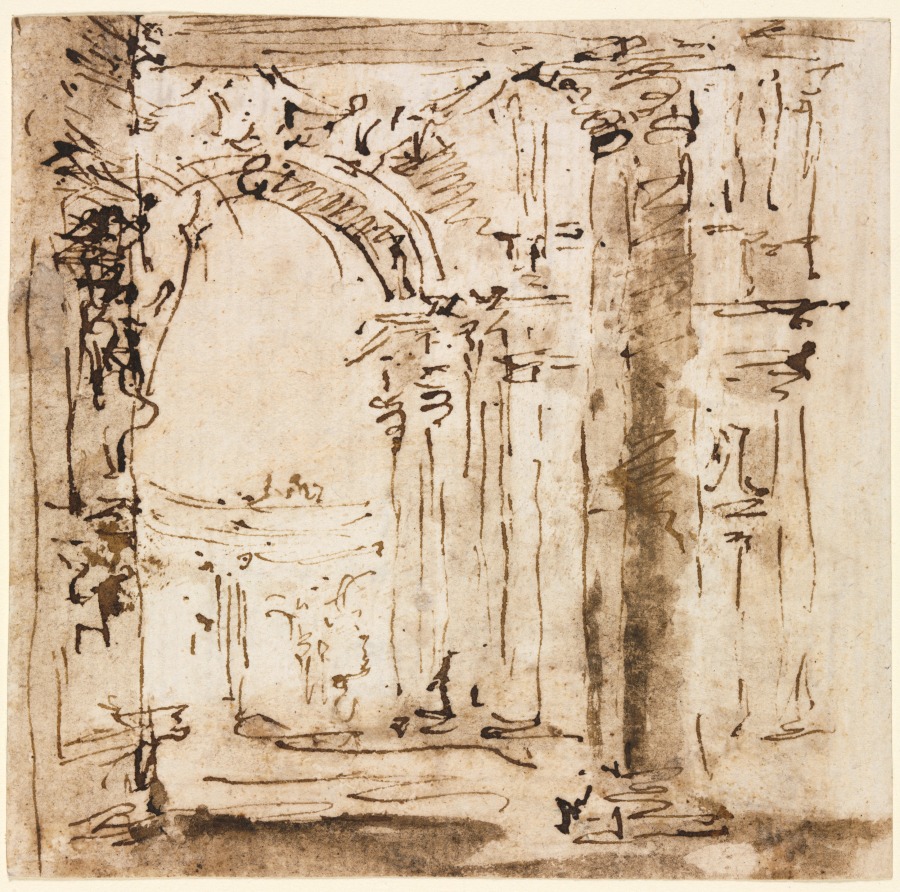
Pair of Drawings: Sketch of the Labyrinth of the Villa Pisani and Piazza San Marco with Doges' Palace
Francesco Guardi
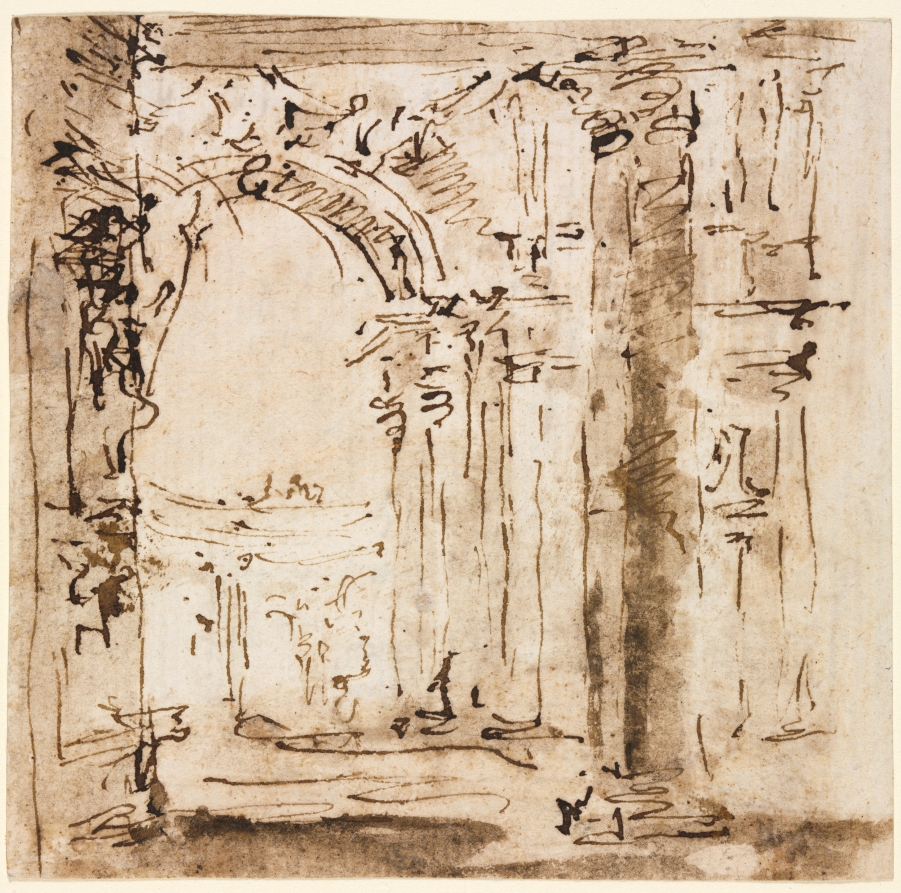
Sketch of the Labyrinth of the Villa Pisani
Francesco Guardi
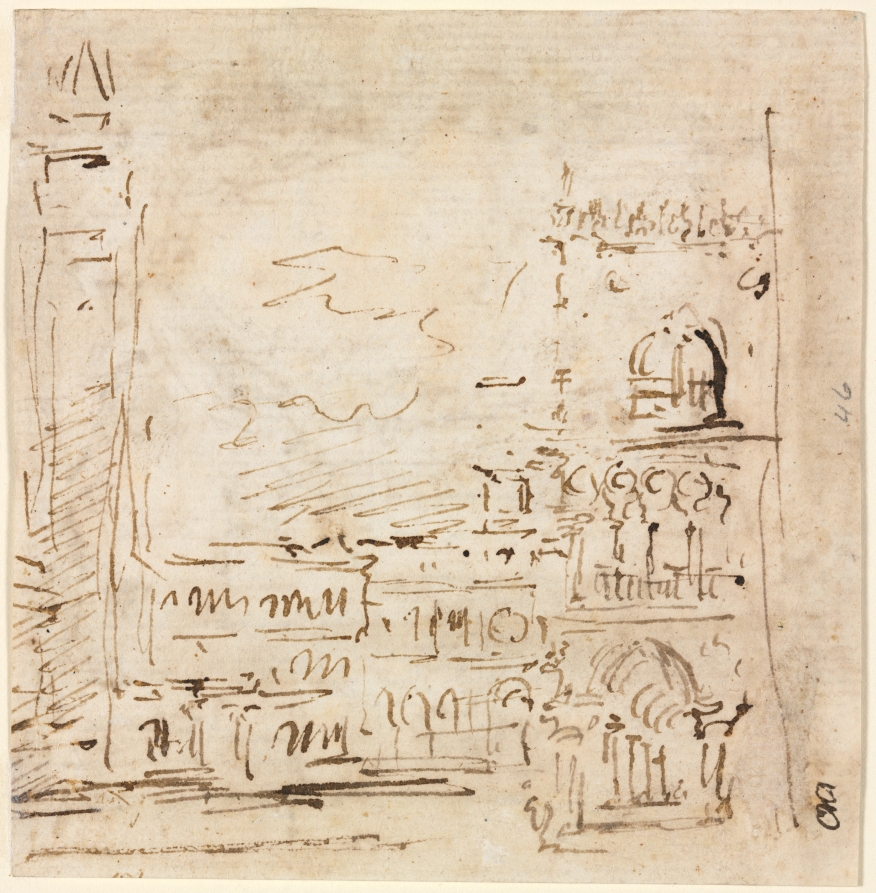
Piazza San Marco with Doges' Palace
Francesco Guardi
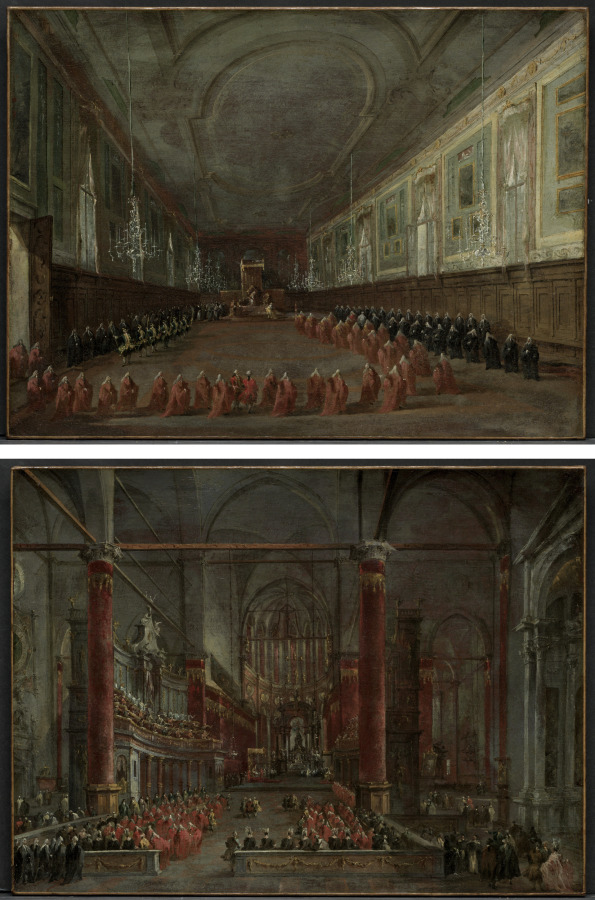
Pope Pius VI Descending the Throne to Take Leave of the Doge in the Hall of SS. Giovanni e Paolo, 1782 and Pontifical Ceremony in SS. Giovanni e Paolo, Venice, 1782 (pair)
Francesco Guardi