Description
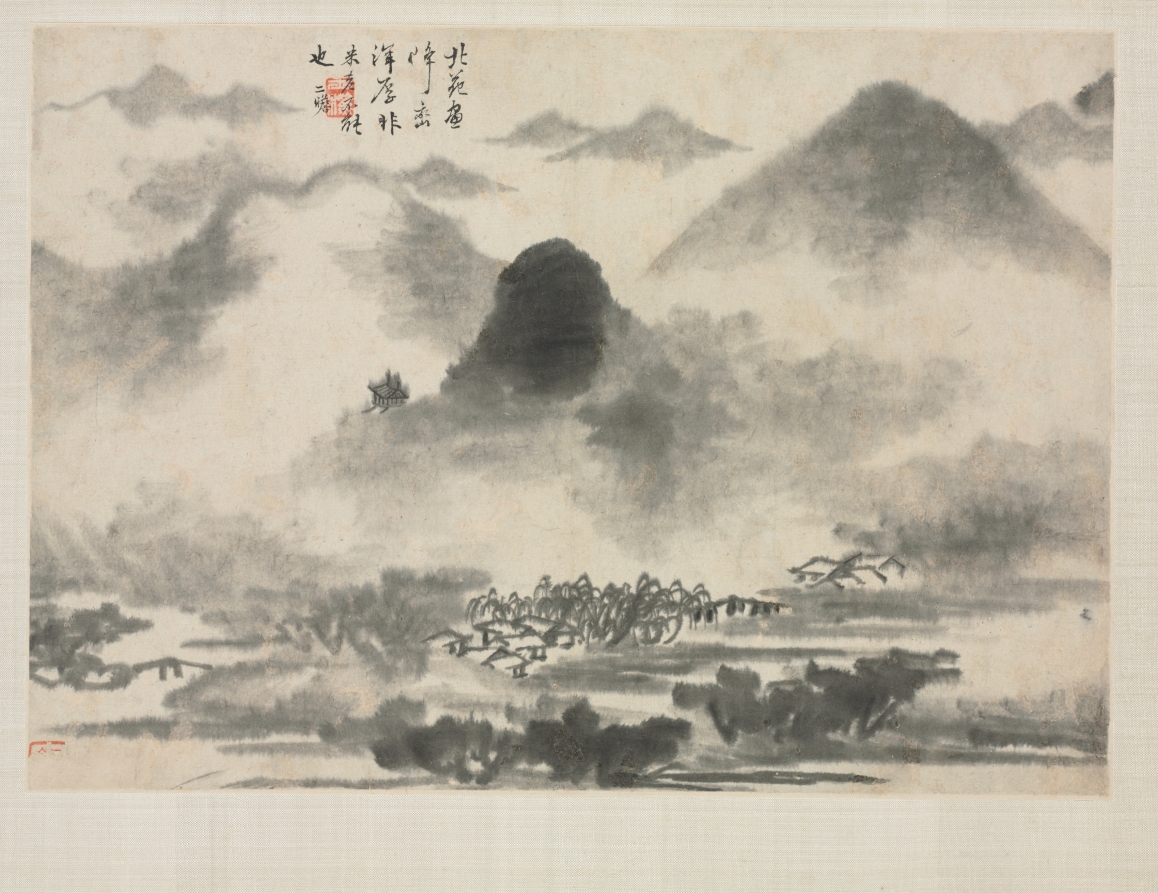
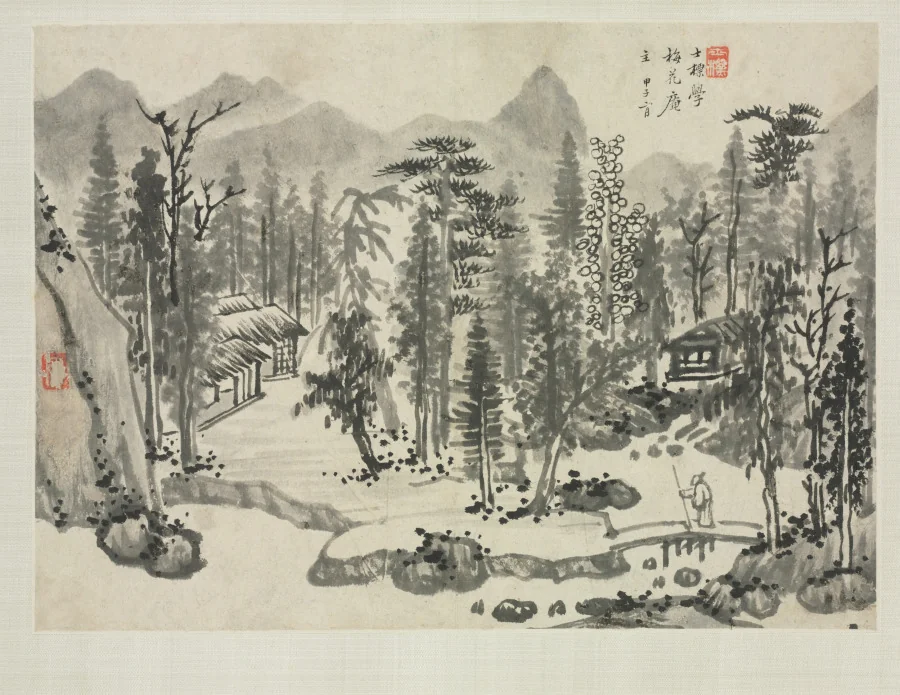
At age 68, Zha Shibiao painted this album with seasonal landscapes in various styles. Painted in fresh colors and wet strokes, all depict typical scenes of Jiangnan.
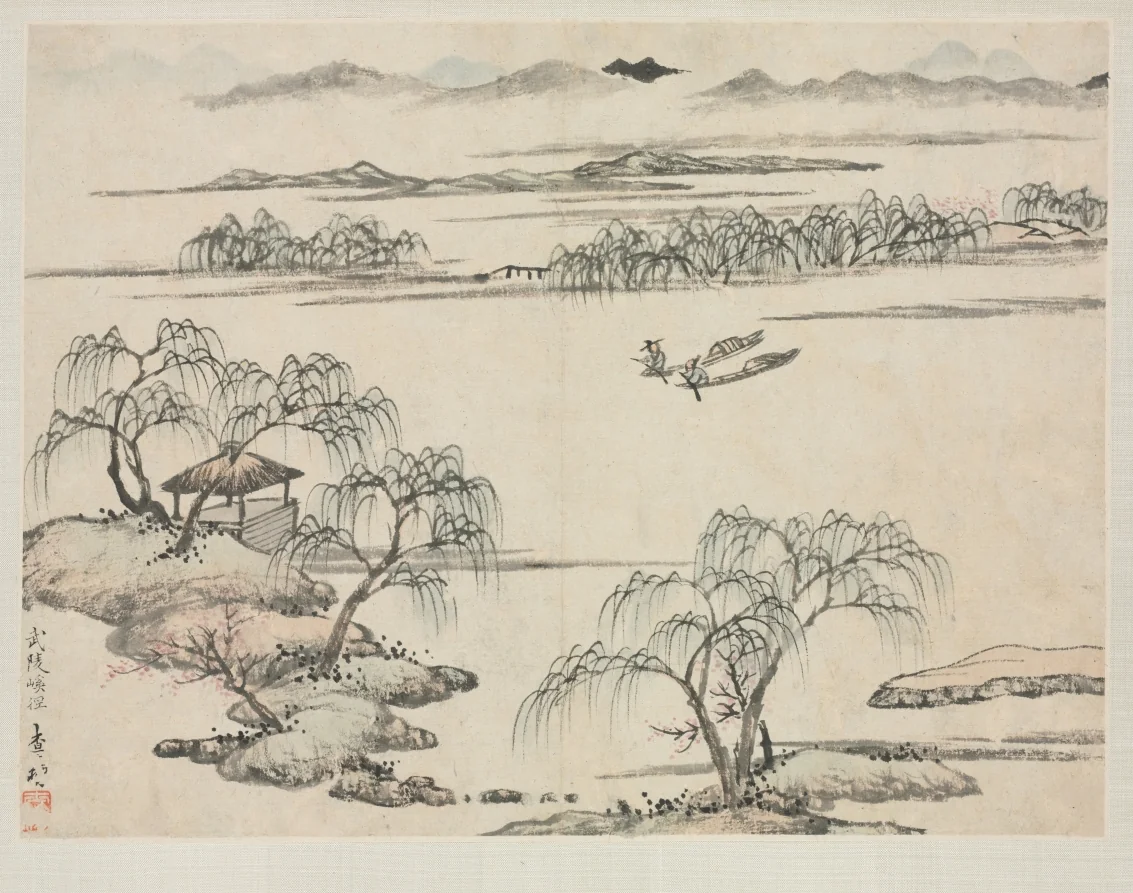
The mention of Wuling in the inscription signals the “Peach Blossom Spring,” but Zha Shibiao purposefully left out all the accepted iconography for that story: a lone fisherman, cave entrance, and village of hermits. Instead, two men in separate boats are engaged in conversation. Could they be talking about the way to the Peach Blossom Spring, or could one of them be that fisherman blessed by his unintended visit but no longer able to find his way back again? Around them unfolds a lyrical landscape, with willows along the shores, an empty pavilion, a wide-open lake surface, and endless distant hills.
The mention of Wuling in the inscription signals the “Peach Blossom Spring,” but Zha Shibiao purposefully left out all the accepted iconography for that story: a lone fisherman, cave entrance, and village of hermits. Instead, two men in separate boats are engaged in conversation. Could they be talking about the way to the Peach Blossom Spring, or could one of them be that fisherman blessed by his unintended visit but no longer able to find his way back again? Around them unfolds a lyrical landscape, with willows along the shores, an empty pavilion, a wide-open lake surface, and endless distant hills.
Provenance
Ma Yueguan 馬曰琯 [1688–1755]; Ding Huikang 丁惠康 [1868/1869–about 1918] and Gu Anmi 顧安宓; (C. T. Loo & Co., New York, NY, sold to the Cleveland Museum of Art) (?-1955); The Cleveland Museum of Art, Cleveland, OH (1955-)
Accession Number
1955.37.4
Medium
album leaf, ink and light color on paper
Dimensions
Overall: 29.9 x 39.4 cm (11 3/4 x 15 1/2 in.)
Classification
Painting
Credit Line
Gift of Mr. and Mrs. Severance A. Millikin
Tags
Painting Baroque (1600–1750) Ink Paper Chinese Color: Gray
Background & Context
Background Story
The Stream of Wuling refers to the famous story from Tao Yuanming's 'Peach Blossom Spring,' in which a fisherman discovers a hidden valley where people live in harmony, unaware of the outside world and its political upheavals. Zha Shibiao's depiction of this Daoist utopia takes on particular meaning in the context of 1684: the Stream of Wuling represents the hidden refuge that Ming loyalists longed for — a place beyond the reach of the Qing dynasty where Chinese culture could survive intact.
Cultural Impact
The Peach Blossom Spring was one of the most potent literary symbols for Ming loyalists, who saw in Tao Yuanming's hidden valley a model for their own situation: isolated communities of Han Chinese preserving their culture under foreign rule. Zha's Wuling Stream is not just a landscape painting but a coded communication with other loyalists, expressing a shared desire for a space outside the political order.
Why It Matters
The Stream of Wuling is Zha Shibiao's most explicitly political landscape. The hidden valley of the Peach Blossom Spring becomes a metaphor for the cultural refuge that Ming loyalists sought in the early Qing period — a place where Chinese civilization could survive until spring comes again.