Provenance
Ma Yueguan 馬曰琯 [1688–1755]; Ding Huikang 丁惠康 [1868/1869–about 1918] and Gu Anmi 顧安宓; (C. T. Loo & Co., New York, NY, sold to the Cleveland Museum of Art) (?-1955); The Cleveland Museum of Art, Cleveland, OH (1955-)
Accession Number
1955.37.5
Medium
album leaf, ink and light color on paper
Dimensions
Overall: 29.9 x 39.4 cm (11 3/4 x 15 1/2 in.)
Classification
Painting
Credit Line
Gift of Mr. and Mrs. Severance A. Millikin
Tags
Painting Baroque (1600–1750) Ink Paper Chinese Color: Gray
Background & Context
Background Story
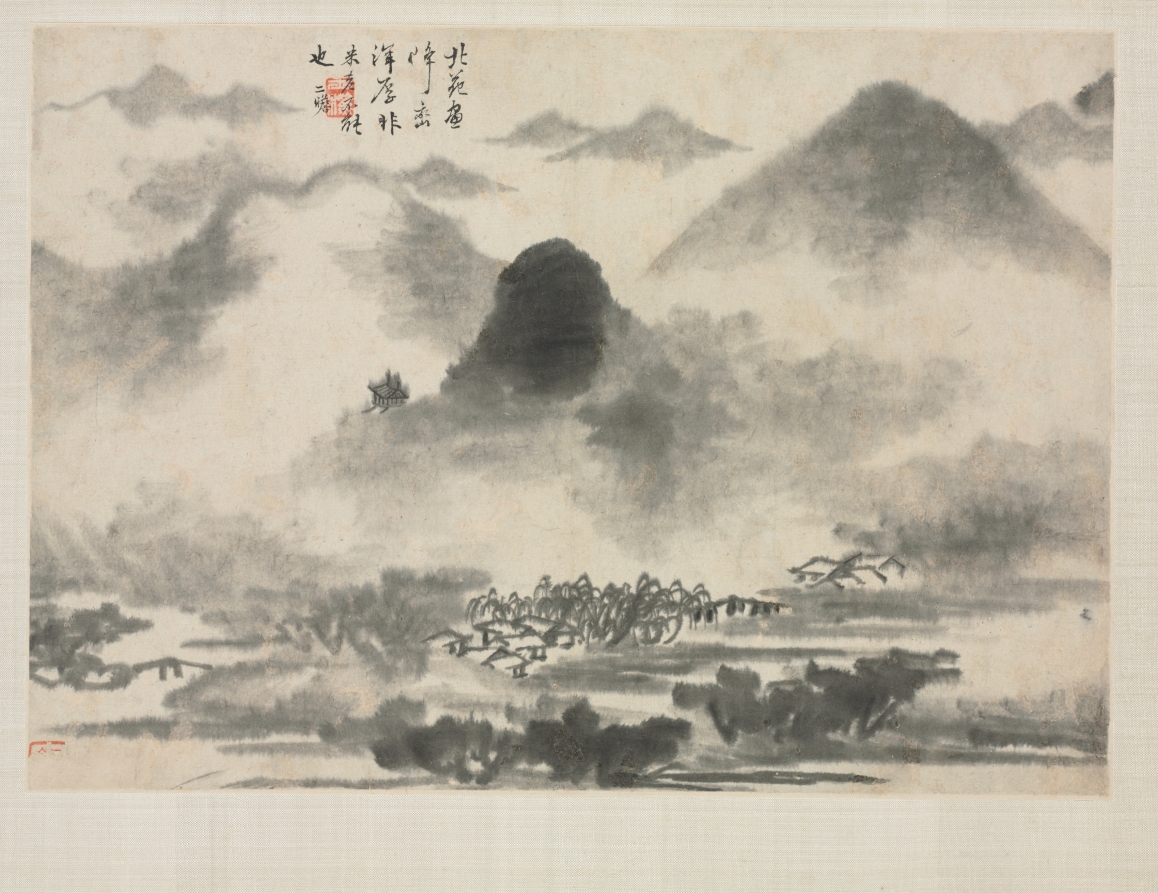
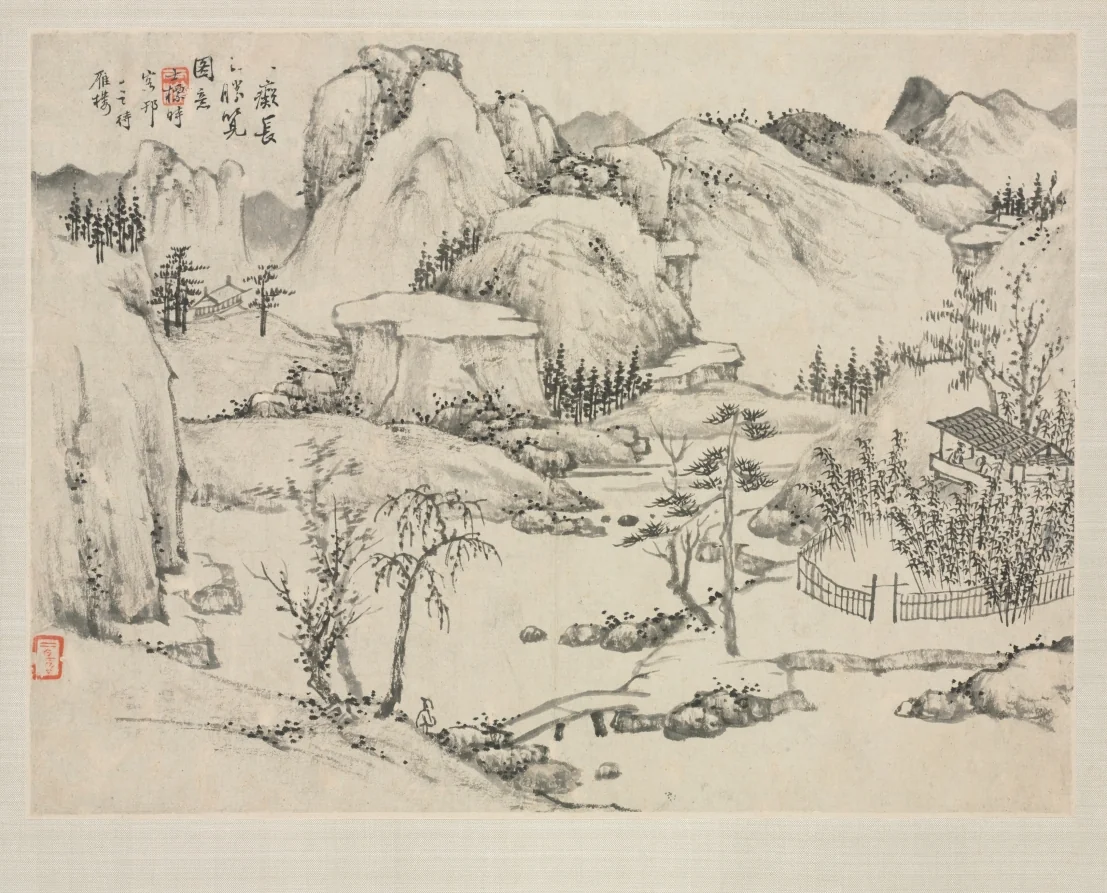
Working in the style of Huang Gongwang (1269-1354), the oldest of the Four Great Masters of the Yuan dynasty, Zha Shibiao adopts Huang's characteristic 'hemp-fiber' texture strokes and layered composition of mountains receding into distance. Huang Gongwang's masterpiece 'Dwelling in the Fuchun Mountains' was the most revered landscape painting in the Chinese tradition, and any artist working in his style was making a claim about the continuation of the orthodox lineage. Zha's choice to paint Mt. Changbai in Huang's style connects the landscape of his native Anhui to the grandest landscape tradition in Chinese painting.
Cultural Impact
The orthodox lineage of Chinese landscape painting — from Dong Yuan and Juran through the Yuan masters to the Ming and Qing painters who claimed descent from them — was more than an artistic tradition. It was a cultural inheritance that Ming loyalists were determined to preserve. By painting in Huang Gongwang's style, Zha Shibiao was asserting the continuity of that inheritance even under Qing rule.
Why It Matters
After Huang Gongwang is Zha's most explicit statement of lineage: Anhui's Mt. Changbai painted in the style of the Yuan dynasty's greatest landscapist. The message is clear: the mountains endure, and the tradition of painting them endures with them.