Provenance
Conte Lodovico Moscardo, Verona (according to departmental card); Marquis of Calceolari (according to letters from Fritz Lugt and F. Matthiesen in file). [Francis Matthiesen, London]
Accession Number
1956.39
Medium
pen and brown ink and blue gouache with brush and green wash and traces of orange gouache, heightened with white gouache
Dimensions
Sheet: 28.6 x 17.4 cm (11 1/4 x 6 7/8 in.); Secondary Support: 28.7 x 17.6 cm (11 5/16 x 6 15/16 in.)
Classification
Drawing
Credit Line
Dudley P. Allen Fund
Tags
Drawing Renaissance (1400–1599) Ink Gouache Italian Color: Orange Color: Gold
Background & Context
Background Story
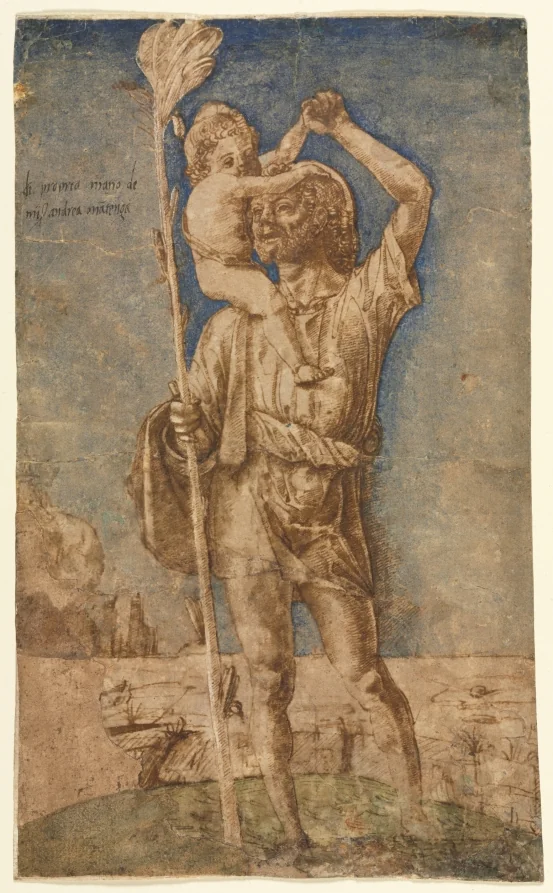
Andrea Mantegna's "Saint Christopher" (c. 1500) is a pen and ink drawing with gouache highlights depicting the legendary saint who, according to medieval tradition, carried the Christ Child across a river on his shoulders. The drawing showcases Mantegna's extraordinary draftsmanship — his ability to create monumental sculptural forms and dramatic spatial effects using nothing more than pen, ink, and wash on paper.
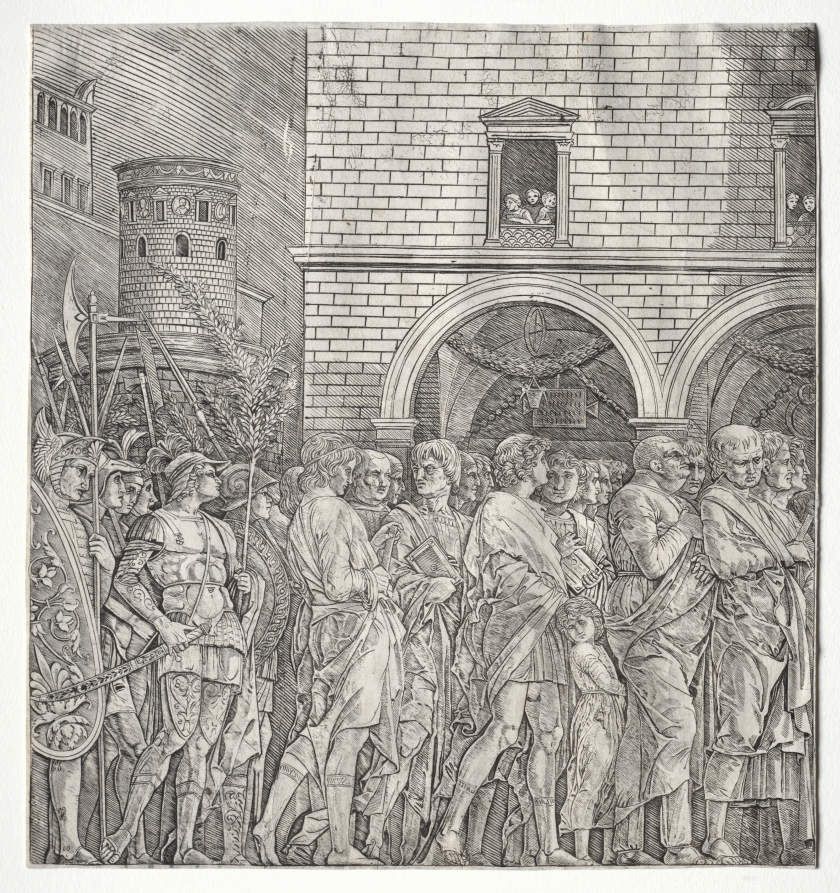
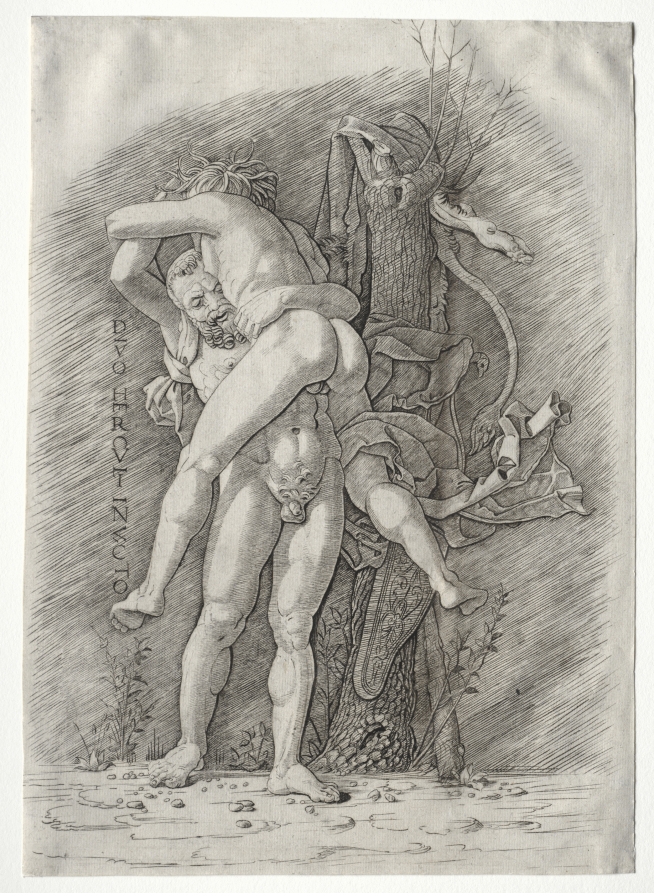
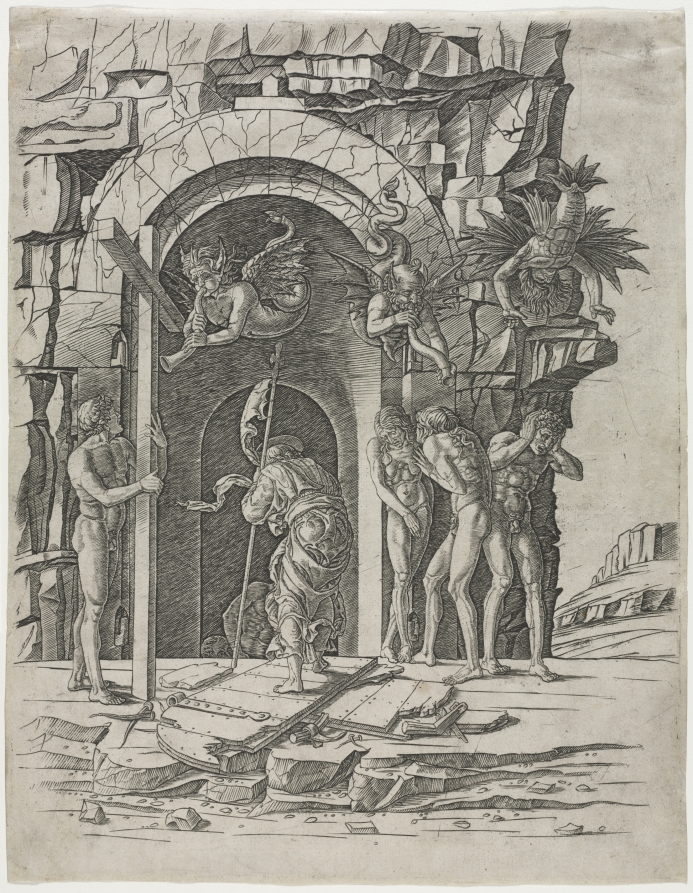
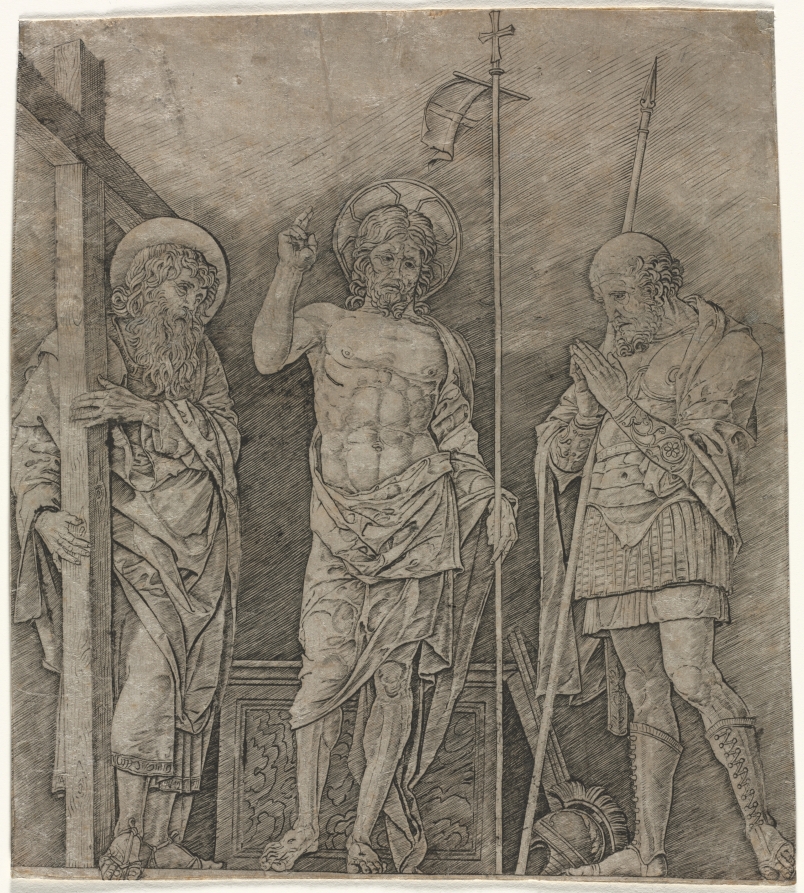
Mantegna (c. 1431–1506) was the leading painter of the Paduan School and one of the most innovative artists of the early Italian Renaissance. His paintings and drawings are characterized by their heroic, almost archaeological approach to classical antiquity — his figures have the mass and angularity of ancient Roman sculpture, and his landscapes are populated with the ruins and fragments of the classical world. Mantegna developed a highly personal style of drawing that combined the precision of a goldsmith with the monumentality of a sculptor, creating works on paper that rival his paintings in their visual power.
Saint Christopher — whose name means "Christ-bearer" — was one of the most popular saints in medieval and Renaissance devotion. According to legend, he was a giant who sought to serve the most powerful being in the world. After discovering that the devil feared Christ, Christopher determined to serve Christ by carrying travelers across a dangerous river. One night, a small child asked to be carried across, but as they crossed, the child grew impossibly heavy — revealing himself as Christ, who carried the weight of the world. Mantegna's drawing likely captures the moment when Christopher struggles under the weight of the child, his massive body straining against the divine burden.
This drawing dates from the last years of Mantegna's career — he died in 1506 — and it demonstrates that his powers of invention and observation remained undiminished. The saint's body is rendered with the same sculptural intensity that characterizes all of Mantegna's work: every muscle and sinew is articulated with the precision of an anatomist, and the foreshortening of the figures creates a dynamic sense of three-dimensional space. The use of blue gouache highlights and green wash adds an atmospheric dimension to the drawing, suggesting the landscape setting through which Christopher wades.
Mantegna's drawings were highly prized by collectors during his lifetime and for centuries afterward. His penwork — tight, precise, and almost metallic in its precision — created a new standard for drawing that influenced artists across Northern Italy, including the young Albrecht Dürer, who studied Mantegna's work during his Italian journey.
Cultural Impact
Mantegna's archaeological approach to classical antiquity and his innovation of dramatic perspective foreshortening made him one of the most influential artists of the Italian Renaissance, shaping the work of artists from Bellini to Dürer.
Why It Matters
This late drawing demonstrates Mantegna's sculptural draftsmanship at its most powerful — transforming the legend of Saint Christopher into a study of physical strain and divine weight, rendered with pen strokes that have the force of chisel marks.