Description
Is this painting by Titian?
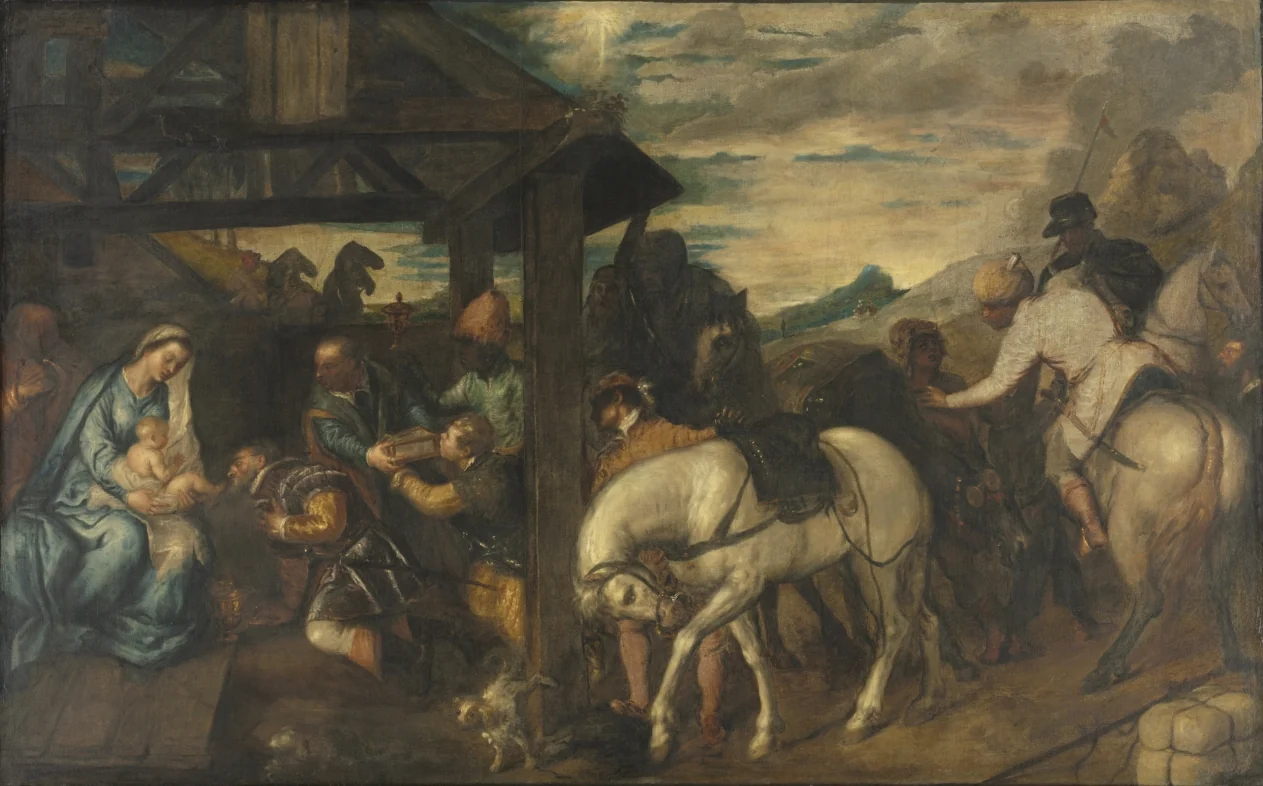
Titian, the celebrated and prolific 16th-century Venetian artist, and his large workshop painted several versions of this subject. Further research is needed to compare this painting with versions in Milan and Madrid to determine how much of each is by Titian himself, as opposed to being the work of his studio assistants. The Prado Museum in Madrid is often considered to have a copy made from Cleveland’s painting, which is superior in execution but not condition. Despite the damage caused by overcleaning, there are many fine passages, including the bowing white horse, his groom in shadow, and the cradled Christ child.
Titian, the celebrated and prolific 16th-century Venetian artist, and his large workshop painted several versions of this subject. Further research is needed to compare this painting with versions in Milan and Madrid to determine how much of each is by Titian himself, as opposed to being the work of his studio assistants. The Prado Museum in Madrid is often considered to have a copy made from Cleveland’s painting, which is superior in execution but not condition. Despite the damage caused by overcleaning, there are many fine passages, including the bowing white horse, his groom in shadow, and the cradled Christ child.
Provenance
Walsh Porter (died 1810), upon his death, held in trust by the estate; Estate of Walsh Porter (unsold, Christie's, London, April 14, 1810, no. 38; unsold, Christie's, London, June 21, 1811, no. 40; sold, Christie's, London, May 6, 1826, no. 7); Samuel Rogers (sold, Christie's, London, May 2, 1856, no. 700, to Mr. Ripp);; Hugh A. J. Munro of Novar (1797-1864), upon his death, held in trust by the estate; Estate of Hugh A. J. Munro of Novar, (unsold, Christie's, London, May 18, 1867, no. 183; sold, Christie's, London, June 1, 1878, no. 121, to C. Butler); Butler Johnstone, 1881; William Graham (1817-1885), upon his death, held in trust by the estate; Estate of William Graham (sold, Christie's, London, April 10, 1886, no. 472); J. Stewart Hodgson (sold, Christie's, London, June 3, 1893, no. 31); Ralph Brocklebank (sale: Christie's, London, July 7, 1922, no. 112); Julius Bohler, Munich; Durlacher Brothers, London and New York; Arthur Sachs [1880-1975] sold to the Cleveland Museum of Art (1928-1957); The Cleveland Museum of Art, Cleveland, OH (1957-)
Accession Number
1957.150
Medium
oil on canvas
Dimensions
Framed: 168 x 250 x 14 cm (66 1/8 x 98 7/16 x 5 1/2 in.); Unframed: 134.5 x 217 cm (52 15/16 x 85 7/16 in.)
Classification
Painting
Credit Line
Mr. and Mrs. William H. Marlatt Fund
Tags
Painting Renaissance (1400–1599) Oil Painting Canvas Italian Color: Brown
Background & Context
Background Story
Titian (c. 1488-1576) was a Venetian painter whose innovative use of color and atmospheric painting makes him one of the most important painters in the history of Western art. The Adoration of the Magi from the 1500s was produced with workshop assistance in the colorful, atmospheric manner that distinguishes Titian's best religious paintings from the more linear painting of his Florentine contemporaries. The Adoration—a biblical subject treated by many of the greatest painters—shows Titian and his workshop handling the subject in the colorful, atmospheric manner that defines the Venetian painting tradition.
Cultural Impact
The Adoration of the Magi is important in the context of Titian's workshop practice because it demonstrates how the master's religious compositions were produced with workshop assistance in 16th-century Venice. Titian's workshop was one of the most productive in Venice, and the collaborative manner in which his religious paintings were produced shows how Venetian painting was organized in the 16th century. The colorful, atmospheric manner of the painting shows the Venetian tradition at work in one of the most important biblical subjects.
Why It Matters
Adoration of the Magi is Titian's workshop handling the biblical subject in the colorful, atmospheric manner that defines the Venetian painting tradition. The 1500s painting shows how the master's religious compositions were produced with workshop assistance in 16th-century Venice—the Venetian tradition at its most colorful and atmospheric.