Description
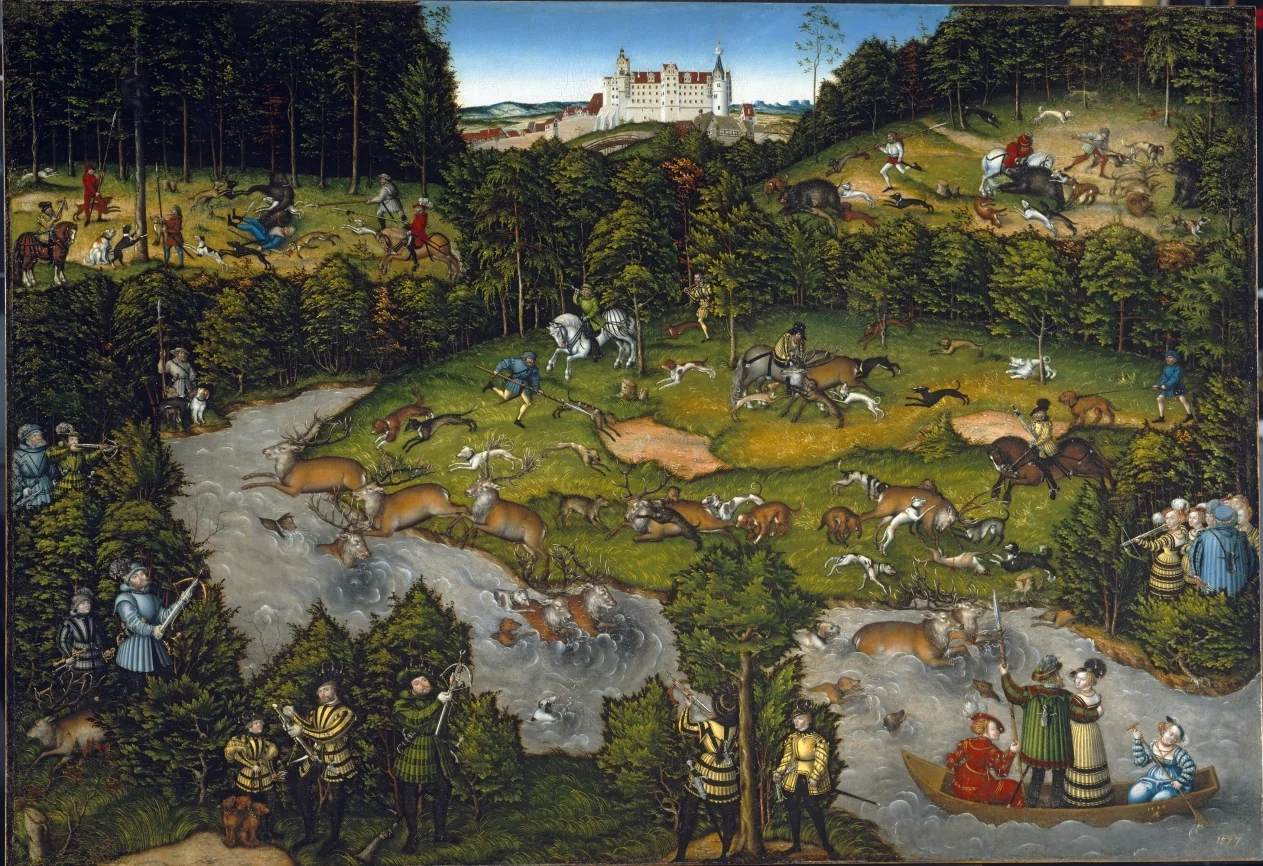
The Protestant rulers of Saxony commissioned this animated hunt scene, set near their residence seen in the background, Hartenfels Castle (in eastern Germany). John Frederick the Magnanimous, in the bottom left corner, wears dark green hunting attire; he spans his crossbow and waits for his courtiers and dogs to chase a stag across the river. His wife, the Electress Sibylle, stands at right, poised to take the first ceremonial shot. The prince electors of Saxony were passionate practitioners of hunting with dogs—elaborate, highly rehearsed occasions, coordinated by the use of signals from hunting horns. Cranach dated this work and his signature is the winged snake at lower right. 1577 in the right corner is an inventory number.
Provenance
Royal Collection of Saxony, Schloss Hartenfels and Schloss Moritzburg, consigned to M.H. Drey (1540-1950s); (M.H. Drey, London, sold to the Cleveland Museum of Art) (Until 1958); The Cleveland Museum of Art, Cleveland, Ohio (1958-)
Accession Number
1958.425
Medium
oil, originally on wood, transferred to masonite
Dimensions
Framed: 133 x 185.5 x 7.3 cm (52 3/8 x 73 1/16 x 2 7/8 in.); Unframed: 116.8 x 170.2 cm (46 x 67 in.)
Classification
Painting
Credit Line
John L. Severance Fund
Tags
Painting Renaissance (1400–1599) Oil Painting German Color: Gold
Background & Context
Background Story
Lucas Cranach the Elder (1472-1553) was a German painter known for his portraits of Martin Luther and the Protestant reformers, his mythological subjects, and his hunting scenes that document the court life of the Saxon electors. Hunting near Hartenfels Castle from 1540 depicts a hunting scene near the castle that was the seat of the Saxon electors in the detailed, narrative manner that distinguishes Cranach's best court subjects. The 1540 date places this in Cranach's mature period, when he was the court painter to the Saxon electors and producing the detailed, narrative subjects that document court life in Reformation Germany.
Cultural Impact
Hunting near Hartenfels Castle is important in the history of German painting because it demonstrates the detailed, narrative manner that Cranach brought to court subjects as the painter to the Saxon electors. The hunting scene documents the court life of the Protestant electors of Saxony in the detailed, narrative manner that makes Cranach one of the most important documentarians of court life in Reformation Germany, and the painting shows the intersection of art and politics in the Protestant Reformation.
Why It Matters
Hunting near Hartenfels Castle is Cranach documenting Reformation court life: a hunting scene near the Saxon electors' castle rendered in the detailed, narrative manner of the Protestant court painter. The 1540 painting shows the intersection of art and politics in Reformation Germany—the court painter documenting the life of the Protestant electors.