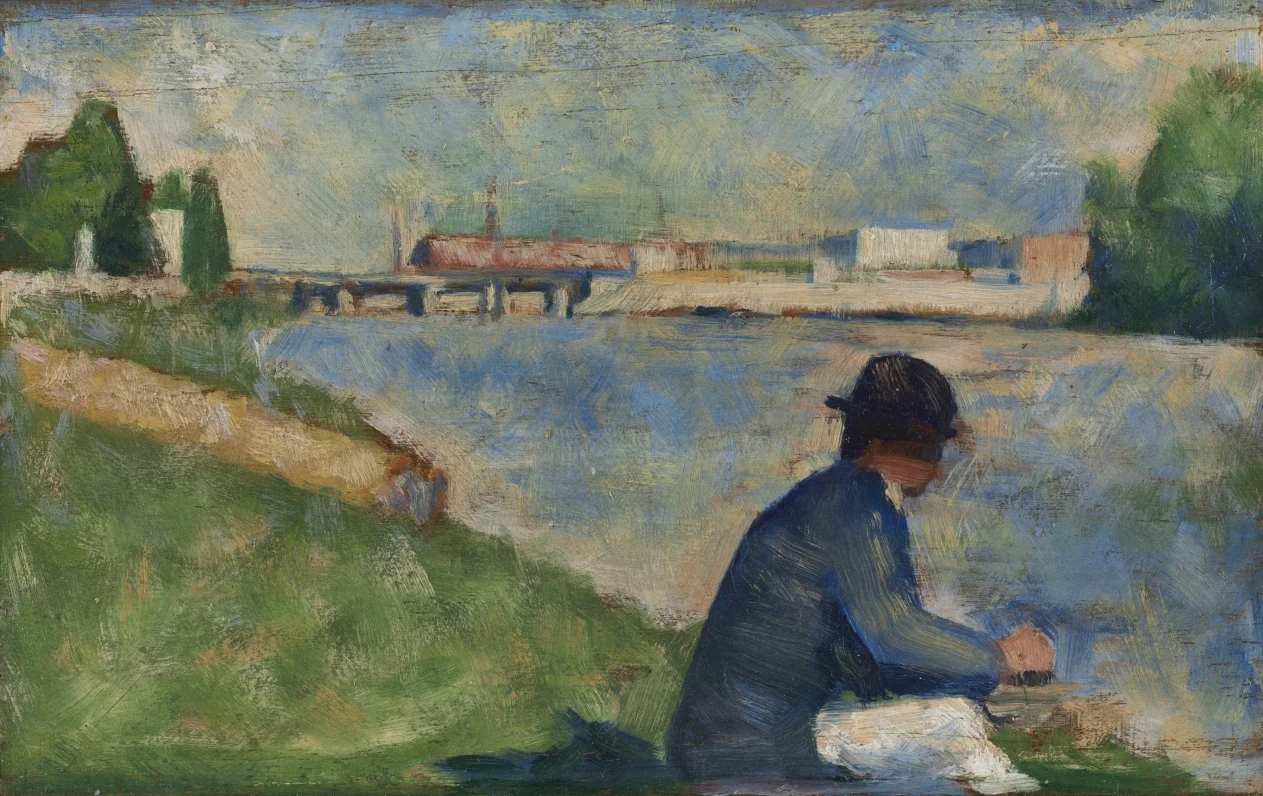
Description
This oil sketch is one of many preparatory studies Seurat made for his monumental painting Bathers at Asnières (1883-84), depicting men leisurely bathing in the Seine near an industrial suburb of Paris. Seurat borrowed the brilliant colors of Impressionism to suggest outdoor light, but added structure by emphasizing basic geometric shapes and firm outlines. As a leader of the movement to reform Impressionism, his style became known as Neo-Impressionism.
Provenance
Estate of the artist, distributed to Théo van Rysselberghe1 (c. 1883/1884-1891); Théo van Rysselberghe [1862-1926], Saint-Clair, Var, France (1891-?); Felix Fénéon [1861-1944], Paris, sold to Anson Conger Goodyear through de Hauke & Co (Until 1929); Anson Conger Goodyear [1877-1964], Old Westbury, NY (1929-); (Paul Rosenberg & Co., New York) (?); Walter Bareiss [1919-2007], Greenwich, CT (?); (Paul Rosenberg & Co., New York, sold to Leonard C. Hanna, Jr.); (Leonard C. Hanna, Jr. [1889-1957], Cleveland, OH, bequeathed to the Cleveland Museum of Art) (1952-1958); The Cleveland Museum of Art, Cleveland, OH (1958-)
Accession Number
1958.51
Medium
oil on wood panel
Dimensions
Framed: 32 x 41 x 5 cm (12 5/8 x 16 1/8 x 1 15/16 in.); Unframed: 15.7 x 24.9 cm (6 3/16 x 9 13/16 in.)
Classification
Painting
Credit Line
Bequest of Leonard C. Hanna Jr.
Tags
Painting Impressionist & Modern (1851–1900) Oil Painting Panel Painting French Color: Green Color: Gray
Background & Context
Background Story
This is one of several preparatory studies Seurat made for Bathers at Asnieres, each one refining the composition and color relationships that would make the final painting one of the landmarks of modern art. The small wood panel format allowed Seurat to work outdoors and capture the actual light of the Seine riverbank. Compared to the finished canvas, this study is freer and more spontaneous, but the underlying structure — the horizontal bands of water, bank, and sky, the carefully placed figures, the tonal contrast between sunlit foreground and hazy industrial background — is already fully developed.
Cultural Impact
Seurat's methodical approach to painting was revolutionary. Rather than relying on spontaneous inspiration, he made dozens of studies for each major canvas, testing every element before combining them in the final composition. This scientific approach to art-making anticipated Cubism's analytical method and would influence every subsequent movement that valued structure over spontaneity.
Why It Matters
Each study for Bathers at Asnieres is a small masterwork in its own right and a clue to Seurat's method. This panel shows that the painting's radical structure was not an afterthought but the starting point — the idea came first, in its essentials, before any brush touched the final canvas.
![Saint Bernard and Saint Catherine of Alexandria with the Virgin of the Annunciation [right panel]](https://api.nga.gov/iiif/e6890364-4d99-4684-a62b-5060ee3c3446/full/400,/0/default.jpg)