Description
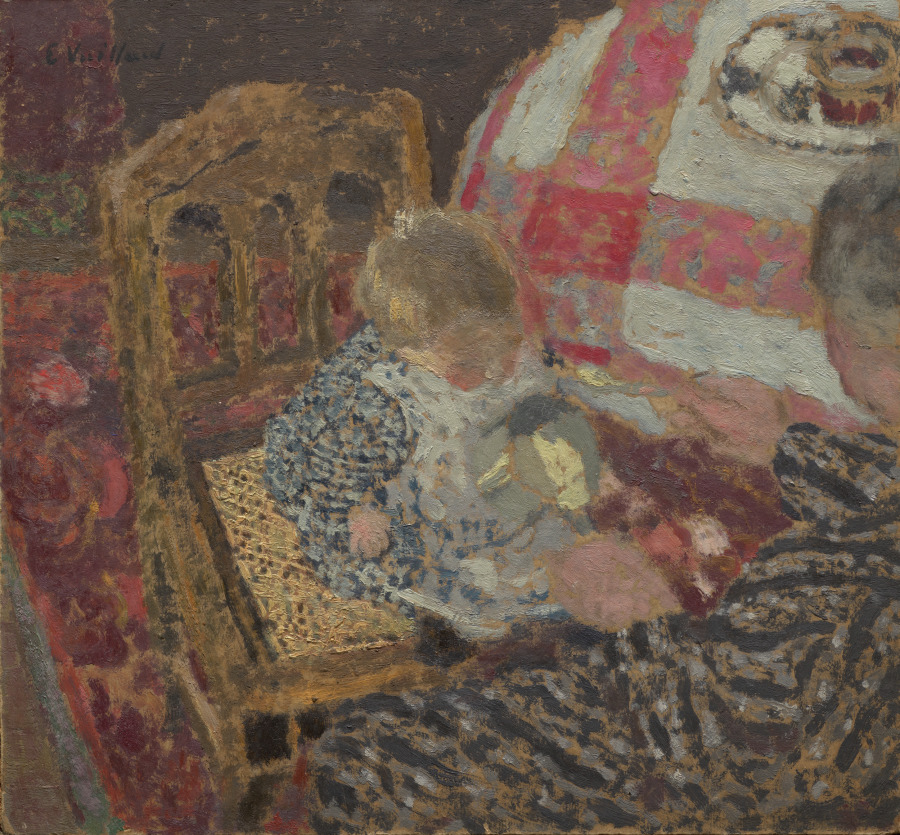
This scene of two women in a Parisian café has a hushed atmosphere that is heightened by the warm palette and glow of gaslight. Édouard Vuillard and Félix Vallotton were close friends and painted together in the 1890s, but Vuillard’s quiet café and Vallotton’s riotous Bistro (2020.114) could not be more different in mood.
Provenance
Ambroise Vollard, Paris. André Weil, Paris. Jacques Seligmann, New York. Theodore Schempp, Brodhead, Wisc. Purchased from him by Leonard C. Hanna together with a Gauguin painting, 7 June 1943. Bequeathed to the CMA in 1958.
Accession Number
1958.57
Medium
oil on board, laid on cradled panel
Dimensions
Unframed: 28.8 x 27.5 cm (11 5/16 x 10 13/16 in.)
Classification
Painting
Credit Line
Bequest of Leonard C. Hanna Jr.
Tags
Painting Impressionist & Modern (1851–1900) Oil Painting Panel Painting Board French Color: Orange
Background & Context
Background Story
Edouard Vuillard (1868-1940) was a French painter known as a member of the Nabis, whose intimate interior scenes in the patterned, decorative manner make him one of the most important painters of the French Intimist tradition. At the Cafe from c. 1897-99 depicts figures in a cafe in the patterned, decorative manner that distinguishes Vuillard's best Intimist paintings from the more straightforward Impressionist painting of his contemporaries. The c. 1897-99 date places this in Vuillard's most productive Nabis period, when he was producing the intimate, patterned paintings that are his most accomplished works.
Cultural Impact
At the Cafe is important in the history of French painting because it demonstrates the patterned, decorative Intimist manner that Vuillard developed as a member of the Nabis. Vuillard's Intimist manner—combining intimate observation with decorative patterning—represents an important alternative to the Impressionist tradition in French painting, and the cafe subject shows the Intimist tradition applied to the public space of the cafe rather than the private interior.
Why It Matters
At the Cafe is Vuillard's Intimist manner in public: figures in a cafe rendered in the patterned, decorative manner that he developed as a member of the Nabis. The c. 1897-99 painting shows the Intimist tradition—combining intimate observation with decorative patterning—applied to the public space rather than the private interior.