Provenance
Estate of Leonard C. Hanna, Jr., Cleveland, OH, given by bequest to The Cleveland Museum of Art, Cleveland, OH (?–1958); The Cleveland Museum of Art, Cleveland, OH (November 29, 1958–)
Accession Number
1958.7
Medium
pen and brown and gray ink and watercolor wash
Dimensions
Sheet: 21.9 x 26.5 cm (8 5/8 x 10 7/16 in.)
Classification
Drawing
Credit Line
Bequest of Leonard C. Hanna Jr.
Tags
Drawing Neoclassical & Romantic (1751–1850) Watercolor Ink British Color: White Color: Gray
Background & Context
Background Story
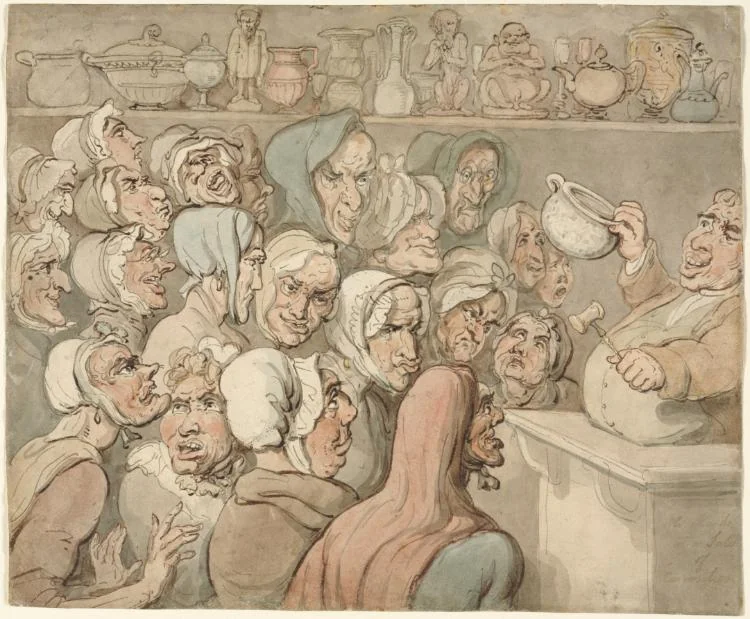
Old Maids at a Sale of Curiosities is one of Rowlandson's most characteristic social satires: a group of unmarried older women (the 'old maids' of the title) examining curiosities at an auction or sale. The subject allows Rowlandson to satirize multiple targets simultaneously — the greed and gullibility of collectors, the social pretensions of the middle class, and the particular vulnerability of unmarried women in Georgian society to ridicule. But Rowlandson's satire is never purely cruel; his old maids are drawn with a physical vitality and a relish for life that complicates the joke and makes the viewer complicit in their enjoyment.
Cultural Impact
The 'old maid' was one of the most enduring comic types in Georgian England, and Rowlandson's depictions of unmarried women are both satirical and surprisingly sympathetic. At a sale of curiosities, the old maids are both vulnerable (they may be cheated) and active (they are participating in the commercial and social life of their community). Rowlandson's drawing captures this duality — they are figures of fun, but they are also figures of independence.
Why It Matters
Old Maids at a Sale of Curiosities is Rowlandson's social satire at its most nuanced: the old maids are ridiculous, but they are also resourceful, independent women navigating a society that gives them few options. The curiosity sale is both the setting for the joke and a metaphor for the commercial culture that treats everything — including people — as merchandise.