Description
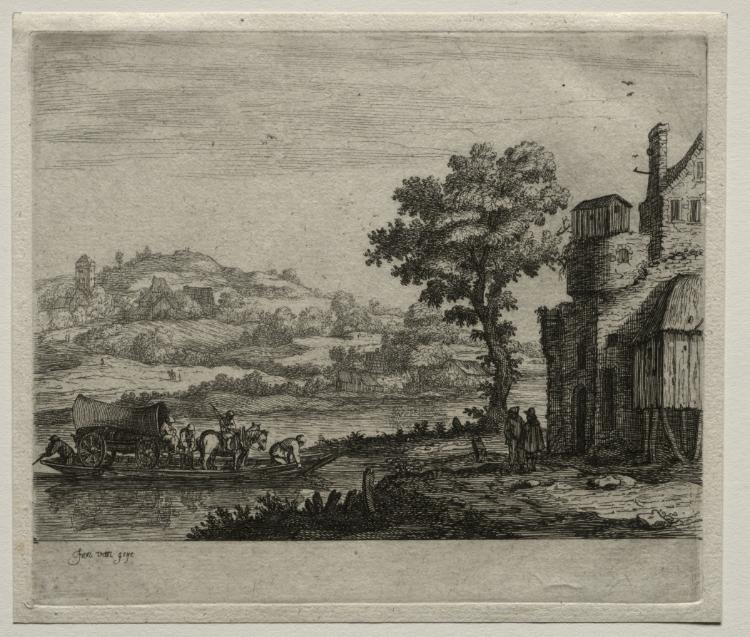
Jan van Goyen’s deceptively simple paintings record remarkably realistic impressions of weather, space, and the shifting interactions of land, water, light, and air. He worked with swift, intuitive brushstrokes and a limited range of colors: gray, brown, cool blues, and earthy greens. The artist often went on sketching trips along the Rhine River, visiting cities such as Arnhem, or the German city of Emmerich, depicted here. In the foreground, a shallow boat ferries passengers and horse-drawn wagons across the river.
Provenance
Robert, Earl Grosvenor (1820), later Marquess of Westminster, London;; Duke of Westminster, London; (sale: Sotheby's, London, June 14, 1959, no. 7);; [Leonard F. Koetser, London, 1959 Autumn Exhibition, no. 4), sold to the Cleveland Museum of Art, 1959.
Accession Number
1959.351
Medium
oil on wood
Dimensions
Framed: 105.5 x 136 x 9.5 cm (41 9/16 x 53 9/16 x 3 3/4 in.); Unframed: 65.4 x 96.7 cm (25 3/4 x 38 1/16 in.)
Classification
Painting
Credit Line
John L. Severance Fund
Tags
Painting Baroque (1600–1750) Oil Painting Dutch Color: White Color: Gray
Background & Context
Background Story
View of Emmerich depicts the German town of Emmerich on the Rhine, near the Dutch border, demonstrating van Goyen's interest in river towns beyond the borders of the Dutch Republic. The painting follows his characteristic compositional formula—low horizon, wide sky, panoramic view—but applies it to a German subject rather than a Dutch one, demonstrating the universality of van Goyen's approach to river landscape. The wood panel support gives the paint surface the smoothness and luminosity that distinguishes van Goyen's best works, and the 1645 date places this in his most productive period.
Cultural Impact
Van Goyen's View of Emmerich is one of several paintings he made of towns along the Rhine, documenting the river landscape from its source in Switzerland to its mouth at the North Sea. These river views were among the most popular subjects in 17th-century Dutch painting, combining topographic information with atmospheric beauty in a way that appealed to both local residents and travelers who wanted souvenirs of their journeys.
Why It Matters
View of Emmerich is van Goyen's tonal landscape applied to a German subject: the Rhine town rendered with the same atmospheric unity and limited palette that he brought to Dutch river views. The painting demonstrates that van Goyen's approach to landscape was not limited to Dutch scenery—it worked for any river town with a church spire and a wide sky.