Description
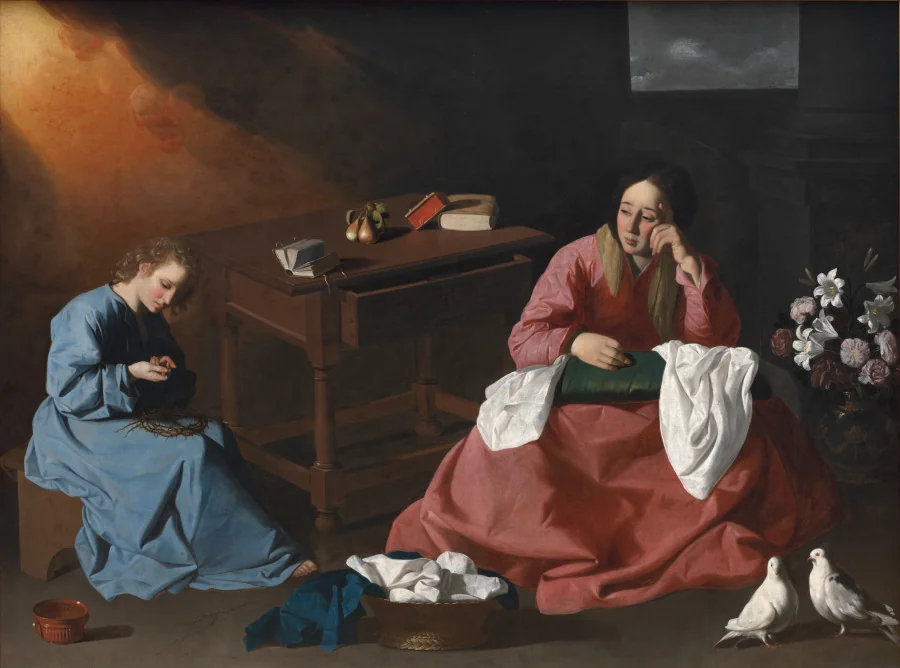
Stories of Christ’s childhood and adolescence became increasingly popular during the Counter-Reformation because they were easily understood by a broad public. Rather than taking a story from the Bible, Zurbarán appears to have invented this subject, in which Jesus pricks himself on a crown of thorns he is weaving, foretelling his later torment at the Crucifixion. Despite the grand scale and monumental figures, the work has remarkable intimacy and quietness, emphasizing such details as the Virgin’s tears.
Provenance
The Cleveland Museum of Art, Cleveland, Ohio (1960-); (François Heim, Paris, sold to the Cleveland Museum of Art) (1960); Various private collections in France (Ater 1821-1960); (Probably Walterstorff sale, Laneuville, Paris, March 26-27, 1821, no. 65, sold to Laneuville)1 (1821); Probably the Count of Walterstorff [1755-1820]1 (Until 1920)
Accession Number
1960.117
Medium
oil on canvas
Dimensions
Framed: 201 x 256 x 10 cm (79 1/8 x 100 13/16 x 3 15/16 in.); Unframed: 165 x 218.2 cm (64 15/16 x 85 7/8 in.)
Classification
Painting
Credit Line
Leonard C. Hanna Jr. Fund
Tags
Painting Baroque (1600–1750) Oil Painting Canvas Spanish Color: Orange
Background & Context
Background Story
Francisco de Zurbaran (1598-1664) was a Spanish painter known for the austere, mystical manner that makes him the most accomplished painter of the Spanish Baroque religious tradition. Christ and the Virgin in the House at Nazareth from c. 1640 depicts the Holy Family in the house at Nazareth in the austere, mystical manner that distinguishes Zurbaran's best religious paintings from the more dramatic work of his contemporaries. The c. 1640 date places this in Zurbaran's most productive period, when he was producing the austere, mystical religious paintings that are his most accomplished works.
Cultural Impact
Christ and the Virgin in the House at Nazareth is important in the history of Spanish painting because it demonstrates the austere, mystical manner that Zurbaran brought to religious subjects as the most important painter of the Spanish Baroque religious tradition. Zurbaran's mystical manner—combining austere composition with intense spiritual presence—represents the most accomplished tradition of Spanish religious painting, and the Holy Family subject shows this manner at its most intimate.
Why It Matters
Christ and the Virgin in the House at Nazareth is Zurbaran's mystical Spanish Baroque: the Holy Family rendered in the austere, spiritual manner that makes him the most important painter of the Spanish religious tradition. The c. 1640 painting shows Zurbaran's combination of austere composition with intense spiritual presence at its most intimate.
![Saint Bernard and Saint Catherine of Alexandria with the Virgin of the Annunciation [right panel]](https://api.nga.gov/iiif/e6890364-4d99-4684-a62b-5060ee3c3446/full/400,/0/default.jpg)