Accession Number
1960.72
Medium
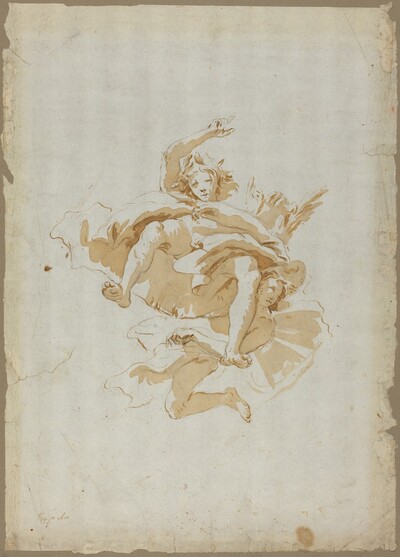
pen and brown ink and brush and gray wash, with traces of black chalk and brush and brown wash
Dimensions
Sheet: 29.2 x 39.3 cm (11 1/2 x 15 1/2 in.)
Classification
Drawing
Credit Line
James Parmelee Fund
Tags
Drawing Baroque (1600–1750) Ink Italian Color: Gray
Background & Context
Background Story
Giuseppe Bazzani (1690-1769) was an Italian painter known for the expressive, mannerist Baroque style that makes him one of the most distinctive painters of the 18th-century Mantuan school. Madonna and Child with Saints from the 1700s depicts the Virgin and Child with saints in the expressive, mannerist manner that distinguishes Bazzani's best religious paintings from the more classicizing work of his contemporaries. The 1700s date places this in Bazzani's mature period, when he was producing the expressive, mannerist religious paintings that are his most accomplished works in the late Baroque tradition of the Mantuan school.
Cultural Impact
Madonna and Child with Saints is important in the history of Italian 18th-century painting because it demonstrates the expressive, mannerist Baroque style that Bazzani developed as the most distinctive painter of the Mantuan school. Bazzani's expressive manner—combining the dramatic energy of the Baroque with the elongated forms and mannerist distortions of the late Renaissance—represents a distinctive type of 18th-century Italian painting that is neither fully Baroque nor fully Neoclassical, and the Madonna and Child shows this distinctive combination at its most characteristic.
Why It Matters
Madonna and Child with Saints is Bazzani's expressive Mantuan Baroque: the Virgin and Child with saints rendered in the dramatic, mannerist manner that makes him the most distinctive painter of the 18th-century Mantuan school. The 1700s painting shows the combination of Baroque energy with mannerist distortion that is neither fully Baroque nor Neoclassical.