Description
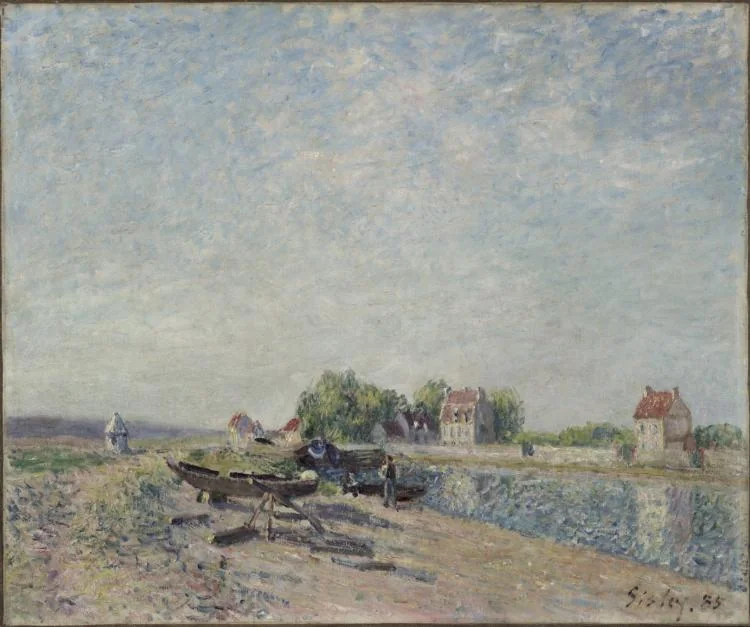
The small town of Saint-Mammès is located about forty miles south of Paris, where the Seine and Loing rivers are joined by a canal. Alfred Sisley was fond of the area and often painted there in the 1880s, undoubtedly attracted by the low rents, since his poverty had become chronic in the wake of the bankruptcy and death of his father. Sisley rendered this view of the Saint-Mammès-Loring canal with a classic Impressionist technique, using pure color and soft, flickering brushwork that dissolves forms into a haze of optical sensations approximating the effect of brilliant, outdoor light.
Provenance
Bought from the artist by Durand-Ruel, Paris (stock number 638) on 21 January 1885. Deposited with Joseph Durand-Ruel, 35 Rue de Rome, on 25 February 1885. Bought from Paul Durand-Ruel by Durand-Ruel, Paris (stock number 1442) on 25 August 1891. Sold to Durand-Ruel, New York (stock number 1888). Sold on 10 November 1926 to Lewis B. Williams, New York. Given to the CMA in 1961.
Accession Number
1961.262
Medium
oil on fabric
Dimensions
Unframed: 46.6 x 55.8 cm (18 3/8 x 21 15/16 in.)
Classification
Painting
Credit Line
Gift of Mr. and Mrs. Lewis B. Williams from The Blair Trust
Tags
Painting Impressionist & Modern (1851–1900) Oil Painting French Color: Brown Color: Gray
Background & Context
Background Story
Saint-Mammès, Loing Canal (1885) depicts the small town at the confluence of the Loing River and the Seine, where Sisley spent the last years of his life. The Loing Canal—a human-made waterway running parallel to the river—provided Sisley with subjects that combined natural and engineered water systems in a single composition. Canal locks, towpaths, bridges, and industrial buildings coexisted with natural riverbanks, trees, and sky, creating landscapes that documented both natural and human water management. By 1885, Sisley had been painting the Loing Valley for several years, developing an intimate knowledge of its every mood and aspect. This painting likely represents his mature ability to render the canal's specific atmosphere—the particular quality of light in a river valley, the way canal water differs visually from river water, the interaction between natural and artificial waterways. The year 1885 was also when the Impressionist group's final exhibition took place, effectively ending the movement as a collective. Sisley, who had remained the most loyal Impressionist—the one who never strayed from the group's core principles—found himself painting alone in Saint-Mammès while his former colleagues pursued individual paths. The painting's achievement—chromatic refinement, compositional balance, and atmospheric subtlety—demonstrates that independent work did not diminish Sisley's artistry but rather concentrated it.
Cultural Impact
Sisley's Saint-Mammès paintings influenced how canal landscapes were represented in art, establishing a visual vocabulary for the intersection of natural and engineered water systems. The paintings documented a specific phase of French canal infrastructure, making them valuable to historians of engineering and transportation. The Loing Canal subject also influenced how French waterways were perceived culturally, contributing to the recognition of canal landscapes as subjects worthy of artistic attention alongside more dramatic natural scenery.
Why It Matters
This painting matters because it represents Sisley's mature achievement: the ability to find infinite visual interest in a specific place through sustained, loving attention. Unlike artists who constantly sought new subjects, Sisley demonstrated that a single landscape—when truly known and deeply observed—yields inexhaustible artistic material. For contemporary artists working in place-based traditions, Sisley's devotion to the Loing Valley offers a model for how depth can compensate for breadth.