Description
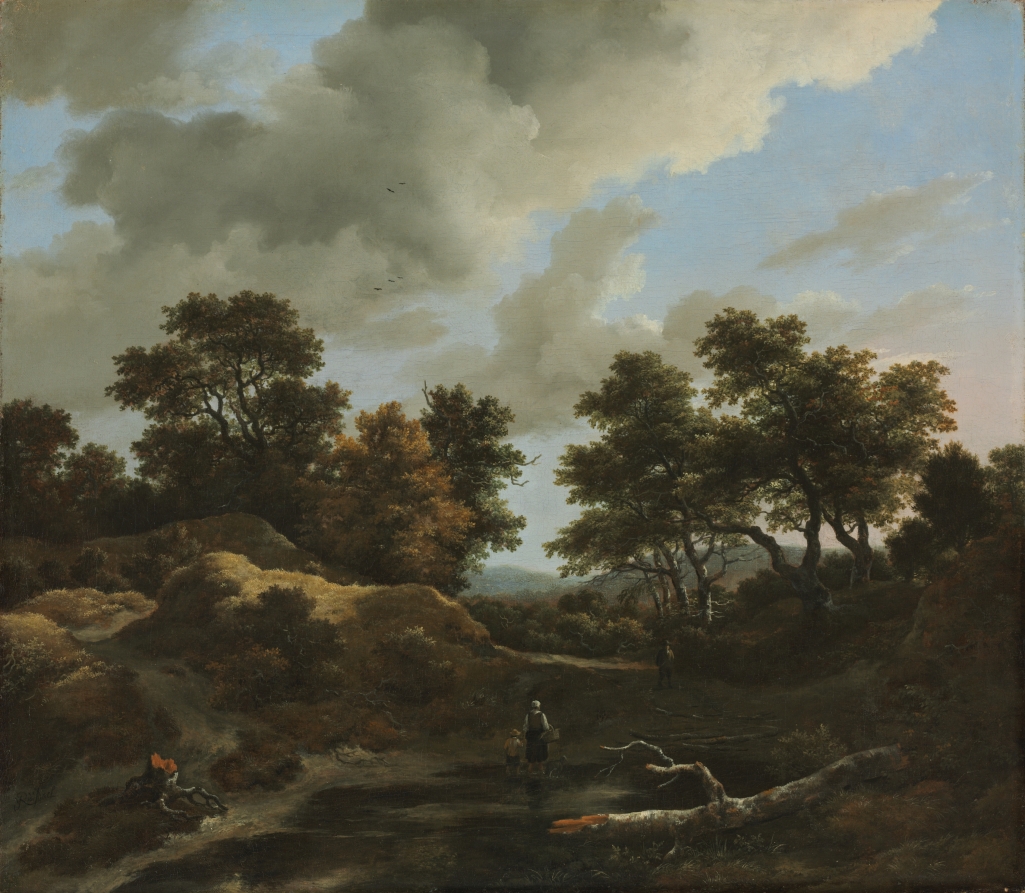
It is not known if Ruisdael considered his paintings to be social or moral commentary, for no documents from his lifetime indicate how the artist or his patrons interpreted the works. But in this painting dangerous rapids block access to the chapel, and severed logs litter the middleground, hinting at life’s transience and the challenge to reach salvation.
Provenance
The Cleveland Museum of Art, Cleveland, Ohio (1962-); Jane Taft Ingalls [1874-1962], Cleveland, OH, upon her death, held in trust by the estate Estate of Jane Taft Ingalls, by bequest to the Cleveland Museum of Art (1949-1962); (Rosenberg & Stiebel, New York, NY, sold to Jane Taft Ingalls) (1949); Baroness Clarice von Rothschild [1894-1967], widow of Baron Alphonse, New York, NY, sold to Rosenberg & Stiebel (1946-1949); In possession of the Allies, restituted to Clarice von Rothschild, widow of Alphonse1 (1945-1946); In possession of the Nazis; selected by Hitler for the Führermuseum, Linz1 (1938-1945); Baron Alphonse von Rothschild, Vienna [1878-1942], confiscated by the Nazis (Probably 1905-1938); Baron Nathaniel von Rothschild, Vienna [1836-1905], by descent to his nephew, Baron Alphonse von Rothschild (1874-1905); Baron Anselm von Rothschild [1803-1874], Vienna, by descent to his son, Baron Nathaniel von Rothschild (Probably 1873-1874); (Rochebousseau sale, Pillet, Paris, May 5-8, 1873, no. 198, sold to Guénot)1 (1873); Marquis de La Rochebousseau (Until 1873)
Accession Number
1962.256
Medium
oil on canvas
Dimensions
Framed: 100.3 x 83.8 x 10.8 cm (39 1/2 x 33 x 4 1/4 in.); Unframed: 71 x 55.2 cm (27 15/16 x 21 3/4 in.)
Classification
Painting
Credit Line
Bequest of Jane Taft Ingalls
Tags
Painting Baroque (1600–1750) Oil Painting Canvas Dutch Color: Orange Color: Gray
Background & Context
Background Story
Landscape with a Church by a Torrent (c. 1670) combines two of Ruisdael's most characteristic subjects—architectural elements within a dramatic landscape—to create a composition that was unprecedented in Dutch painting for its emotional power. The church, rendered with topographical precision, represents the human spiritual presence that Dutch landscape painting typically included as a reminder of divine order. The torrent, with its rushing water, broken rocks, and the dramatic landscape it has carved, represents the natural forces that exceed human control. The juxtaposition of church and torrent—the spiritual and the natural, the ordered and the chaotic—creates a visual argument about the relationship between human faith and natural power that was characteristic of Dutch Calvinist culture. The 1670 date places this during Ruisdael's most productive and most dramatic period, when his landscapes were reaching the emotional intensity that distinguished them from the more restrained treatments of his contemporaries. The church by the torrent also reflects the Dutch landscape's specific geography: churches were often built near water sources, and the combination of ecclesiastical architecture and natural watercourses was a feature of Dutch rural landscapes. Ruisdael's treatment gives this commonplace feature dramatic significance, transforming the ordinary into the sublime.
Cultural Impact
Ruisdael's church-and-torrent paintings influenced how the relationship between faith and nature was represented in Dutch art, creating visual arguments about divine order and natural chaos. The paintings influenced later Romantic painters who similarly found significance in the juxtaposition of human architecture and natural power. The torrent subject influenced how water's destructive force was represented in landscape painting, establishing the dramatic waterfall tradition that would influence European painting for centuries.
Why It Matters
This painting matters because it represents Ruisdael's most distinctive contribution to landscape painting—the combination of dramatic natural forces with human spiritual presence within compositions that argued for the coexistence of order and chaos, faith and power. The church by the torrent is one of European art's most powerful images of the relationship between human meaning and natural force.