Description
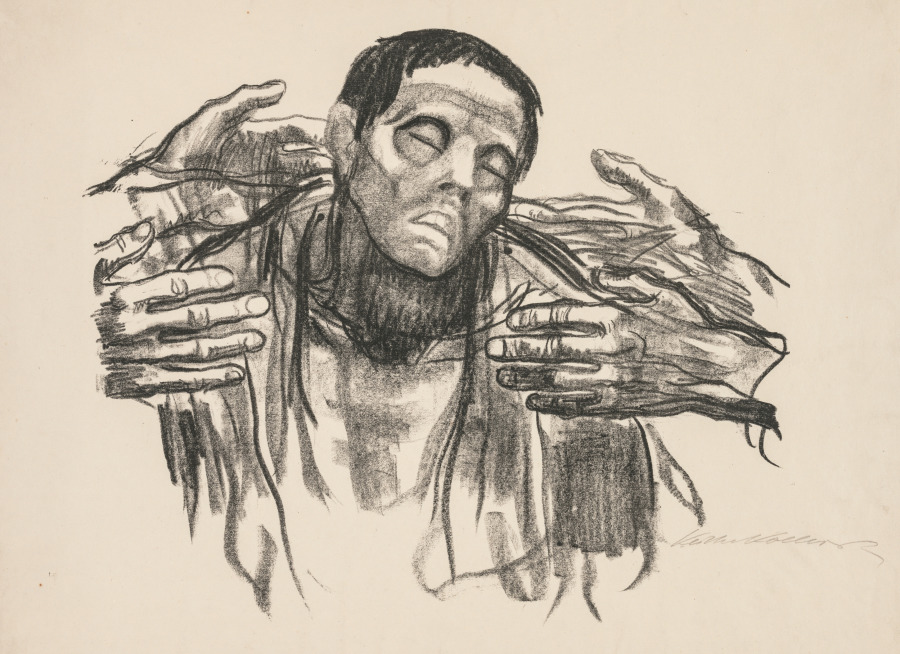
Working in a frank but emotional naturalistic style far different from that of her contemporaries, Käthe Kollwitz depicted a pregnant woman who stands as a universal symbol of human grief. Just a few bold strokes of crayon relay the woman’s despair. After World War I, Kollwitz’s work focused on the sorrows of those left behind: the children, widows, and mothers who underwent loss, physical neglect, and economic hardship. Her focus on grief and despair in this and other works emerged especially after her youngest son, Peter, was killed in the first months of the war.
Provenance
Private Collection, Boston; [Robert M. Light, Boston (departmental cataloguing sheet)]; Private Collection, Boston (according to departmental card)
Accession Number
1962.291.a
Medium
black chalk or charcoal? (rubbed in places)
Dimensions
Sheet: 64.3 x 49.7 cm (25 5/16 x 19 9/16 in.)
Classification
Drawing
Credit Line
Gift of The Print Club of Cleveland in honor of Leona E. Prasse
Tags
Color: White
Background & Context
Background Story
这是珂勒惠支《怀孕女子自尽之念》的正面版本。画面聚焦于一位怀孕女性的半身像,她低垂着头,右手托腮,双眼紧闭或望向虚空,嘴唇紧抿,每一寸线条都诉说着绝望。她的孕肚——按理应是生命的希望——在此刻却成为悲剧的根源:没有能力抚养另一个生命的绝望将她推向自尽的边缘。
珂勒惠支的创作生涯跨越了德意志帝国、魏玛共和国与纳粹时期。她长期与柏林的工人阶层同在,通过版画与素描为他们发声。1920年代,德国社会动荡、通货膨胀、贫困蔓延,女性尤其承受着生育与生存的双重压力。这幅画正是对这一社会现实的直接回应。
在技法上,珂勒惠支运用擦揉手法创造出柔和而忧郁的明暗层次,使画面带有一种朦胧的、近乎梦境的特质。她没有画出孕妇的完整身体,而是将焦点放在头部与手部——手部的姿态(托腮)传达了沉思与痛苦的重量。这种"以局部暗示整体"的手法是她素描艺术的标志性特征。
Cultural Impact
作为正面独立作品,这幅画强化了珂勒惠支艺术中"母性悲剧"的核心母题。她将怀孕——传统艺术中代表喜悦与希望的题材——翻转为一幕社会悲剧的载体。这种对传统母性叙事的解构在20世纪艺术中具有先锋意义。
Why It Matters
这幅正面版本独立地呈现了珂勒惠支最具冲击力的母题之一:怀孕与绝望的悖论结合。它以简洁而精准的素描语言,传递了超越时代的女性困境,是表现主义社会批判的典范。