Accession Number
1963.242.3
Medium
brush and gray ink and gray wash with black chalk
Dimensions
N/A
Classification
Drawing
Credit Line
John L. Severance Fund
Tags
Drawing Neoclassical & Romantic (1751–1850) Ink Austrian Color: Gray
Background & Context
Background Story
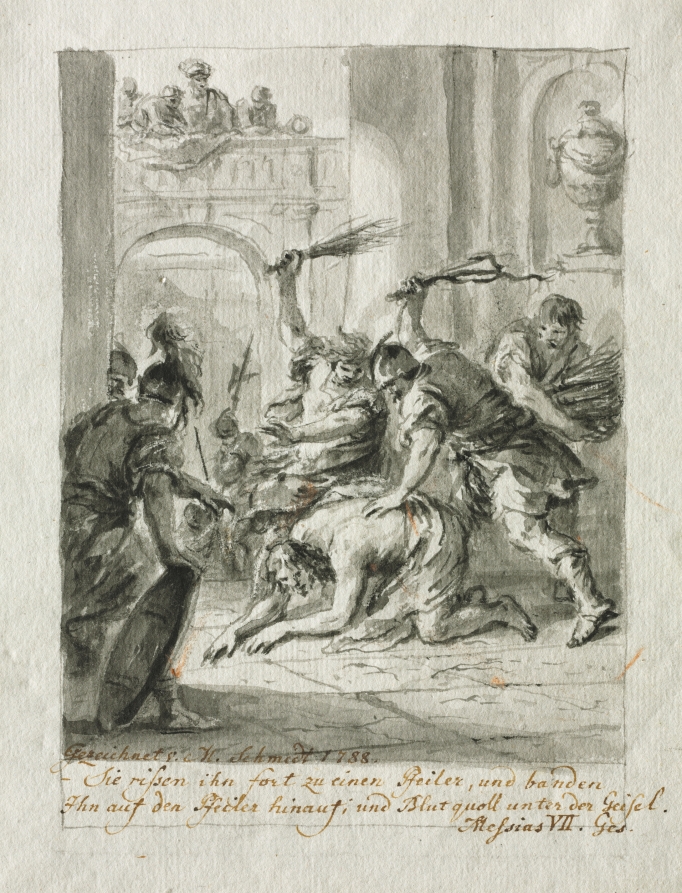
Martin Johann Schmidt (1718-1801), known as Kremser Schmidt, was an Austrian painter known for the dramatic, expressive manner that makes him the most important painter of the Austrian Baroque. Christ Crowned with Thorns from 1788 depicts the biblical episode in which Christ is crowned with thorns before his crucifixion in the dramatic, expressive manner that distinguishes Schmidt's best religious paintings. The 1788 date places this in Schmidt's late period, when he was still producing dramatic religious paintings in the Baroque manner at the age of 70, and the painting shows the Austrian Baroque tradition at its most expressive even in its final decades.
Cultural Impact
Christ Crowned with Thorns is important in the history of Austrian painting because it demonstrates the dramatic, expressive manner that Martin Johann Schmidt brought to religious subjects as the most important painter of the Austrian Baroque. Schmidt's dramatic manner—continuing the Baroque tradition into the late 18th century while Neoclassicism was becoming dominant elsewhere—shows the persistence of the Baroque in Austrian painting, and the 1788 painting represents the Austrian Baroque at its most expressive even in its final decades.
Why It Matters
Christ Crowned with Thorns is Kremser Schmidt's expressive Austrian Baroque: the biblical episode rendered in the dramatic manner that makes him the most important painter of the Austrian Baroque tradition. The 1788 painting shows the Baroque persisting in Austria even as Neoclassicism became dominant elsewhere—the Austrian Baroque at its most expressive even in its final decades.